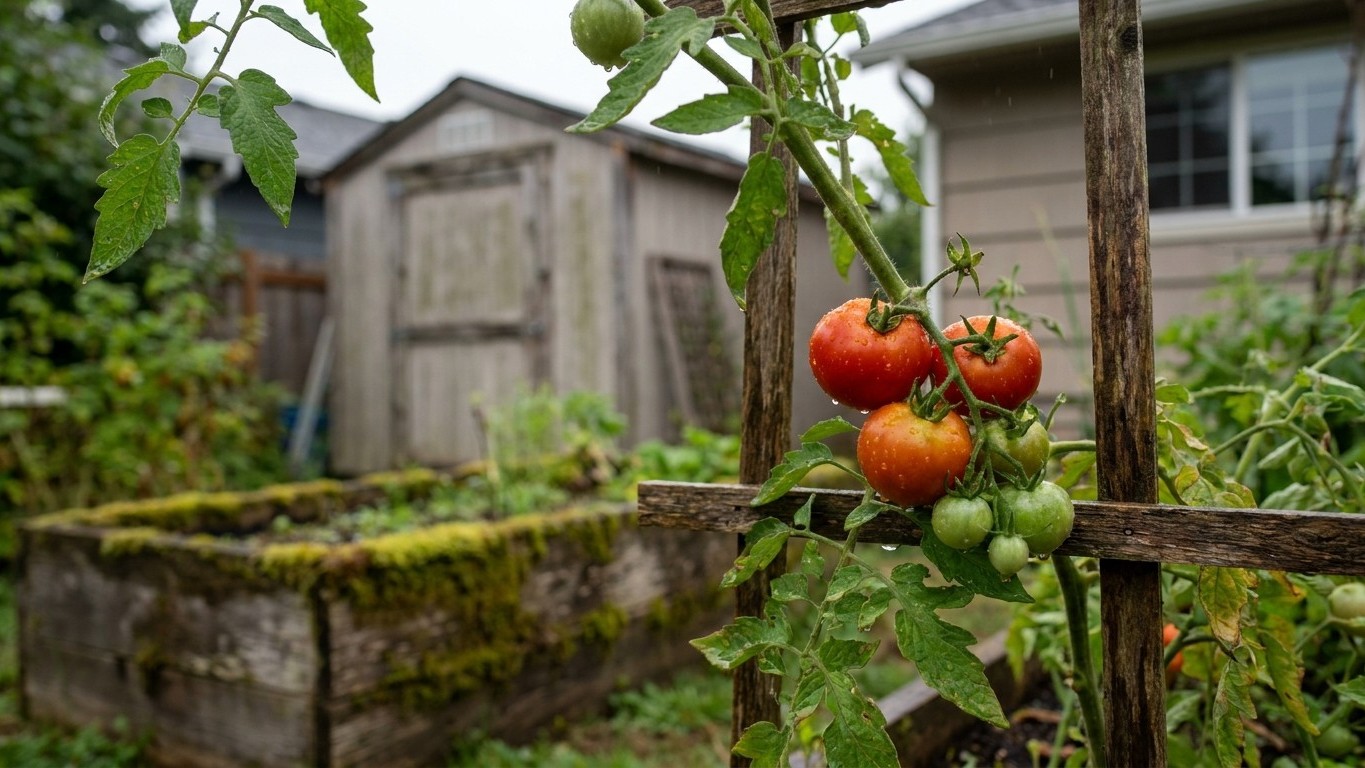

Tomatoes go into Oregon gardens once the danger of frost has passed and the soil has had time to warm, which for the Portland area runs from March 6 to March 21 according to NOAA’s NCEI 1991-2020 climate normals. Gardeners north of Portland, at higher elevations, or anywhere in the state’s central and eastern high desert are working with a shorter and later season and should not use this window as their own. This week, count backward six to eight weeks from your expected transplant date to fix your indoor seed-starting date, and hold off moving plants outside until the soil itself feels warm, not just the air.
When to plant Tomatoes in Oregon

The frost window and what it means
NOAA’s NCEI 1991-2020 climate normals put Portland’s last spring freeze between March 6 and March 21. That’s a range, not a single date, because it reflects thirty years of variation at one weather station. If you garden in the Willamette Valley near Portland, this window is a reasonable starting point. If you garden farther north toward the Columbia, at elevation in the foothills, or anywhere east of the Cascades, your last frost typically lands later and your growing season is shorter, sometimes drastically so in the high desert around Bend or Burns. Oregon’s geography splits the state into distinct climates within a few hours’ drive, so treat any single figure as a starting reference and confirm it against your own county before you commit seedlings to the ground. For a broader look at how these regional differences play out across the state, our Oregon guides cover more than just tomatoes.
Starting seeds indoors
Tomato seed packets, regardless of variety, are almost always written to be started indoors six to eight weeks before transplanting outside. Working from Portland’s frost window, and allowing that most gardeners wait a week or two past the last frost date itself so the soil has time to warm (tomatoes are far more sensitive to cold soil than to cold air), a reasonable transplant target for the Portland area falls in mid-March to early April. Counting back six to eight weeks from that range puts your indoor sowing date at roughly mid-January through late February. Sow into cell trays or small pots under grow lights or in your brightest window, keep the soil consistently moist, and expect germination within a week to ten days at room temperature.
Hardening off and transplanting
Seedlings raised indoors need seven to ten days outside in increasing doses of sun and wind before they go into open ground permanently. Start with an hour or two in dappled shade, and add time each day. Skipping this step is the single most common reason transplants stall or scorch in their first week outdoors. Once hardened off, plant into soil that has genuinely warmed rather than just frost-free air, since tomatoes set in cold, wet soil often sit and sulk for weeks rather than grow. Gardeners further along the coast or at elevation should expect to push all of these dates later, and should treat the Portland figures as a floor, not a target.
Soil and site preparation
Sun, drainage and bed prep
Tomatoes want a minimum of six to eight hours of direct sun and will reward you for more. Pick the sunniest, most open spot in the yard, away from the shade line cast by fences, sheds or mature trees as the season progresses. Soil texture matters more than most gardeners expect: tomatoes want a loose, well-drained loam and will struggle in heavy clay that stays soggy after rain, or in fast-draining sand that dries out between waterings. If your ground leans toward either extreme, work in several inches of finished compost the fall or early spring before planting, not the day you transplant, so it has time to integrate into the existing soil structure.
Spacing and timing
Give indeterminate varieties at least 24 to 36 inches between plants, and determinate bush types slightly less, around 18 to 24 inches. Crowded plants compete for light and airflow, and poor airflow is one of the biggest drivers of the fungal diseases that hit tomatoes late in the season. Raised beds and mounded rows help in areas with heavier soil, since they warm faster in spring and drain excess moisture away from the root zone. If you’re testing soil pH or nutrient levels for the first time, do it several weeks ahead of planting rather than the same week, so you have time to adjust lime or amendments and let them work into the root zone before transplants go in.
Varieties that suit Oregon
Matching days-to-maturity to your season
The trait that matters most for Oregon growers is days to maturity, because it determines whether a variety has time to ripen fruit before summer heat fades or fall rain sets in. Catalog figures are counted from the transplant date, not from seed, and they assume steady warmth through the growing season. Oregon’s cooler, cloudier summers, especially west of the Cascades and near the coast, often push actual ripening a week or two past the catalog number, so treat these figures as a floor rather than a guarantee. Disease resistance is the second trait worth weighing: cool, damp spring conditions common in western Oregon favor the fungal and viral pressures that resistant breeding targets, so a resistant hybrid is rarely wasted money even in a home garden.
Fast cherry and grape types for short seasons
For central and eastern Oregon’s high desert, where the growing season is meaningfully shorter than Portland’s, fast-maturing cherry and grape types are the safest bet. Sun Gold (57 days from transplant, indeterminate, resists Tobacco Mosaic Virus and Fusarium Wilt race 1) and Sakura (55 days, indeterminate, resists nematodes, Tomato Mosaic Virus, and Fusarium Wilt races 1 and 2) both have time to set and ripen fruit even in a compressed season. Working the arithmetic from Portland’s mid-March to early April transplant window, Sun Gold’s first ripe fruit lands around mid-May to early June, though gardeners farther east transplanting later should shift that estimate back accordingly. Growers in Montana face a similarly tight window, and our guide to growing tomatoes in Montana walks through the same fast-cherry logic for an even shorter season.
Slicers and paste types for longer seasons
West of the Cascades, where the season runs longer and milder, larger slicers and paste tomatoes have more room to work. Celebrity Plus (78 days, determinate, resists nematodes, gray leaf spot and Tomato Mosaic Virus) and Big Beef Plus (72 days, indeterminate, same three resistances) are dependable choices for a home slicer with real disease coverage built in. Heirlooms like Cherokee Purple and Brandywine (both 78 days from transplant) carry no listed disease resistance and are more of a gamble in a wet spring, but reward the wait with flavor most hybrids don’t match. For sauce and canning, San Marzano II (78 days) and Amish Paste (85 days) both need the full length of a Willamette Valley season to ripen a real crop, while Amalfi (68 days, determinate, resists nematodes, late blight and early blight at an intermediate level) finishes faster and carries more built-in disease protection for a damp spring.
| Variety | Days to maturity | Growth habit | Notable resistance |
|---|---|---|---|
| Sun Gold | 57 | Indeterminate | TMV (High), Fusarium race 1 (High) |
| Sakura | 55 | Indeterminate | Nematodes (Int.), ToMV (High), Fusarium races 1,2 (High) |
| Supersweet 100 | 60 | Indeterminate | Verticillium (High), Fusarium race 1 (High) |
| Juliet | 60 | Indeterminate | Late Blight (Int.), Early Blight (Int.) |
| Jasper | 60 | Indeterminate | Late Blight (High), Early Blight (Int.) |
| Amalfi | 68 | Determinate | Nematodes (Int.), Late Blight (Int.), Early Blight (Int.) |
| Big Beef Plus | 72 | Indeterminate | Nematodes (Int.), Gray Leaf Spot (High), ToMV (High) |
| Celebrity Plus | 78 | Determinate | Nematodes (Int.), Gray Leaf Spot (High), ToMV (High) |
| San Marzano II | 78 | Indeterminate | None listed |
| Brandywine | 78 | Indeterminate | None listed |
| Cherokee Purple | 72 | Indeterminate | None listed |
| Tiren | 75 | Indeterminate | Verticillium (High), ToMV (High), Fusarium race 1 (High) |
| Granadero | 75 | Indeterminate | Nematodes (Int.), Verticillium (High), ToMV (High) |
| Amish Paste | 85 | Indeterminate | None listed |
What to plant alongside
Neighbors that actually help
Basil is the classic tomato companion, and while there’s no solid evidence it changes flavor, it does draw in pollinators and its dense growth shades the soil around the tomato’s roots, cutting down on splash-borne fungal spores. Borage is worth the space for the bees and hoverflies it attracts, and marigolds, specifically French marigolds, have shown real suppression of root-knot nematodes in trials, which matters if nematodes have been a problem in that bed before. Nasturtiums work as a trap crop, drawing aphids away from the tomato foliage and onto themselves, where they’re easy to spot and remove.
- Basil: shades soil, draws pollinators, no proven flavor effect
- French marigolds: suppress root-knot nematodes in the surrounding soil
- Borage: draws pollinators and beneficial insects
- Nasturtiums: pull aphids away from tomato foliage
- Carrots and onions: shallow-rooted, share space without competing hard
What to keep away
Skip planting tomatoes near potatoes. Both are nightshades, both are susceptible to the same late blight pathogen, and planting them together gives that disease two hosts to spread between in a wet spring. Corn shares a pest with tomatoes too: the same moth that produces corn earworm produces tomato fruitworm, so growing them side by side can build up a bigger population of the same insect than either crop would face alone. Fennel is worth avoiding altogether near most vegetables, tomatoes included, since it releases compounds into the soil that can slow neighboring plants’ growth. Brassicas like broccoli and cabbage aren’t harmful, but they compete hard for the same nutrients and are better placed in a separate bed if you have the room.
Watering, feeding and support
Watering rhythm
Tomatoes want deep, infrequent watering rather than a light daily sprinkle. Aim to soak the root zone thoroughly, then let the top inch or two of soil dry before watering again. Shallow, frequent watering trains roots to stay near the surface, which makes plants far more vulnerable to heat stress and to blossom end rot later in the season. A soaker hose or drip line at the base of the plant keeps water off the foliage, which matters because wet leaves are what fungal spores need to germinate. A two-to-three inch layer of mulch, straw or shredded leaves both, holds soil moisture steady between waterings and keeps soil-borne fungal spores from splashing up onto the lower leaves during rain or overhead watering.
Feeding
Work compost or a balanced organic fertilizer into the bed before transplanting, then hold off on additional nitrogen for several weeks. Too much nitrogen too early produces a plant that’s all leaf and very little fruit, since nitrogen pushes vegetative growth at the expense of flowering. Once the first flower clusters appear, switch to a fertilizer higher in phosphorus and potassium to support fruit set and development, and repeat every few weeks through the height of harvest.
Staking, caging and pruning
Indeterminate varieties, which keep growing and setting fruit until frost, need a sturdy cage or a stake-and-tie system tall enough to support six feet or more of vine. Determinate types, which grow to a set size and ripen most of their fruit in a shorter window, need less support, usually just a basic cage. Removing suckers, the small shoots that emerge in the joint between the main stem and a leaf branch, on indeterminate varieties keeps the plant from turning into an unmanageable tangle and improves airflow through the foliage. Determinate types shouldn’t be pruned hard, since removing growth reduces the fruit they’d otherwise set.
Common problems

Blossom end rot
This shows up as a flat, sunken, leathery brown-to-black patch on the bottom of an otherwise healthy-looking fruit. It’s caused by uneven calcium delivery to the fruit, almost always driven by inconsistent watering rather than a true calcium shortage in the soil. The fix is watering on a steady schedule and mulching to keep soil moisture even, not adding calcium products, which rarely solve a watering problem.
Fruit cracking
Concentric rings or radial splits near the stem end happen when a dry spell is followed by a heavy watering or a sudden rain, and the fruit’s interior grows faster than its skin can stretch. Consistent watering and mulch reduce it, and some varieties, especially thin-skinned cherry types, crack more readily than thick-skinned slicers regardless of care.
Wilts and leaf curl
Yellowing that starts on the lower leaves and works upward, paired with wilting that doesn’t recover overnight, points to a soil-borne wilt disease like fusarium or verticillium. Slice the stem near the base: brown discoloration inside the stem confirms a vascular wilt, and there’s no cure once it’s in the plant, only removal. This is exactly why disease-resistant hybrids like Tiren and Granadero, both bred with resistance to verticillium wilt, are worth choosing if a bed has a history of the problem. Leaf curl on its own, without wilting, is more often a stress response to heat, wind or inconsistent watering than a disease, and usually resolves once conditions even out.
Pests
Aphids cluster on new growth and the undersides of leaves, and a strong blast of water or an insecticidal soap knocks back small infestations before they need anything stronger. Tomato hornworms are harder to spot despite their size, thanks to camouflage that matches the foliage almost exactly, and are usually found by the black droppings they leave on leaves below where they’re feeding. Hand-picking works fine for a small garden and doesn’t require any spray at all. Growers just across the Columbia River deal with the same pest pressure, and our guide to growing tomatoes in Washington covers the same wilts and pests from that side of the border.
Pests that actually show up in Oregon
Oregon’s extension service tracks a long list of vegetable garden pests, but most of them skip tomatoes entirely. Cucumber beetles, imported cabbageworm, cabbage maggot, carrot rust fly and symphylans are all real problems in Oregon gardens, just not on this crop. They target squash, brassicas, carrots and other root crops instead, so a gardener growing a mixed bed should watch for them there, not on the tomato vines.
What actually hits tomatoes in Oregon starts at ground level. Slugs, especially the gray field slug, chew ragged holes in lower leaves and can strip a seedling overnight, leaving a telltale slime trail across the soil and stems. Oregon State University Extension’s guide EM 9155, How to Control Slugs, ties their damage to two windows: they feed after dark once temperatures climb above 50°F in moist conditions, and they lay eggs heavily once fall rains begin in late September or early October. That makes early spring and the September-October stretch the two times bait or hand-picking actually pay off. Iron phosphate bait scattered around the base of young plants is the control that holds up over a season, since slugs stop feeding within days of ingesting it.
Brown garden snail causes the same ragged-hole damage and responds to the same iron phosphate bait, so treat the two as one problem when you’re patrolling the bed at dusk.
European earwig shows up as small, irregular holes in leaves and sometimes in ripening fruit itself, usually discovered when you find the insect curled inside a rolled leaf or under mulch during the day. Trapping with rolled damp newspaper or a shallow can of oil set at soil level, emptied each morning, knocks populations down without spraying anything on fruit close to harvest.
Brown marmorated stink bug leaves cloudy, sunken spots under the skin of the fruit rather than surface holes, and Oregon reports on this pest peak in fall. Hand-picking adults off the plant and clearing garden debris where they overwinter does more than any spray timed after the damage is already visible. Aphids also trouble tomatoes here, most often in July and August, but that’s covered under Common Problems above along with the fix.
Harvest and end of season
Picking at the right stage
Pick tomatoes once they’ve reached full color for their variety and give slightly under gentle pressure. Fruit picked at the first blush of color and ripened indoors on a windowsill will still develop decent flavor, which is useful protection against a late-season rain that threatens to split fruit left on the vine. Never refrigerate a fresh tomato you plan to eat: cold temperatures break down the compounds responsible for flavor and turn the texture mealy. Store ripe fruit at room temperature out of direct sun and use it within a few days.
As the season winds down
Watch your local forecast for the first fall frost warning rather than working from a fixed date, since fall timing varies by microclimate even within the Portland area. When a frost warning does arrive, harvest everything still on the vine, including green fruit. Green tomatoes at the mature, full-size stage will ripen slowly indoors over several weeks if kept at room temperature out of direct light, while smaller, still-growing fruit is better used green, in relishes or fried, since it won’t ripen well after picking. Pull spent plants at the end of the season rather than leaving them to rot in place, especially if any showed signs of wilt or blight, since leaving diseased material in the bed carries the problem into next year.
Local help
County-level frost dates, soil testing and variety trial results all vary within Oregon, and the fastest way to get numbers specific to your address is Oregon State University’s Extension Service. Its county offices run soil tests, answer variety questions by region, and track pest and disease pressure as it develops each season. Find your county office through the Oregon State Extension Service before you finalize a planting date this year.
Where to Go Next
Everything above comes down to timing, and timing starts with your frost window. If you haven’t nailed that down yet, walk through the tomato planting dates guide, which uses NOAA’s 1991-2020 climate normals to count backward from your local last frost instead of guessing at a generic date on a seed packet.
Once you know your window, the next question is whether your chosen varieties can actually finish inside it. That’s the whole point of the list of tomato varieties that ripen in time, which checks nine varieties against Oregon’s growing season length rather than trusting the packet’s days-to-maturity number blindly.
And once your plants are in the ground, the pest pressure is fairly predictable if you’re growing in Oregon. The rundown of tomato pests that actually show up here covers the short, repeatable cast of characters — cutworms, flea beetles, aphids, twospotted spider mites, tomato hornworms, and the brown marmorated stink bug now spreading through the Willamette Valley — so you know what to watch for before it becomes a problem.
Common questions
Can I just use the Portland frost date if I garden somewhere else in Oregon?
Only as a rough starting point. NOAA’s 1991-2020 normals for Portland reflect one weather station in the Willamette Valley, and anywhere north, higher in elevation, or east of the Cascades will run on a different, usually later, schedule with a shorter overall season.
Why are my tomato leaves curling but the plant still looks healthy otherwise?
Leaf curl without wilting or discoloration is usually a stress response to heat, wind or uneven watering rather than disease. Check your watering consistency first, since that’s the most common cause, and only worry about a pathogen if yellowing or wilting shows up alongside the curling.
Do I need to prune determinate tomato varieties like Celebrity Plus?

No, and pruning a determinate variety hard actually reduces your harvest, since it removes the growth that would otherwise set fruit. Save heavy pruning and sucker removal for indeterminate types like Big Beef Plus or Cherokee Purple, which keep growing all season.
My tomatoes aren’t ripening even though it’s past the days-to-maturity on the packet. What’s wrong?
Catalog days-to-maturity figures assume steady warm-season heat, and Oregon’s cooler, cloudier summers, particularly near the coast or in a shady yard, routinely push actual ripening a week or two past that number. Give it more time before assuming disease or a bad transplant date is to blame.
Is it worth buying disease-resistant hybrids for a small backyard garden?
Yes if your soil or a neighboring garden has a known history of wilt, nematodes or blight. Varieties like Tiren, Granadero or Jasper carry specific resistance codes for exactly those problems, and the seed costs the same either way, so there’s little downside to choosing a resistant variety over an heirloom with none.