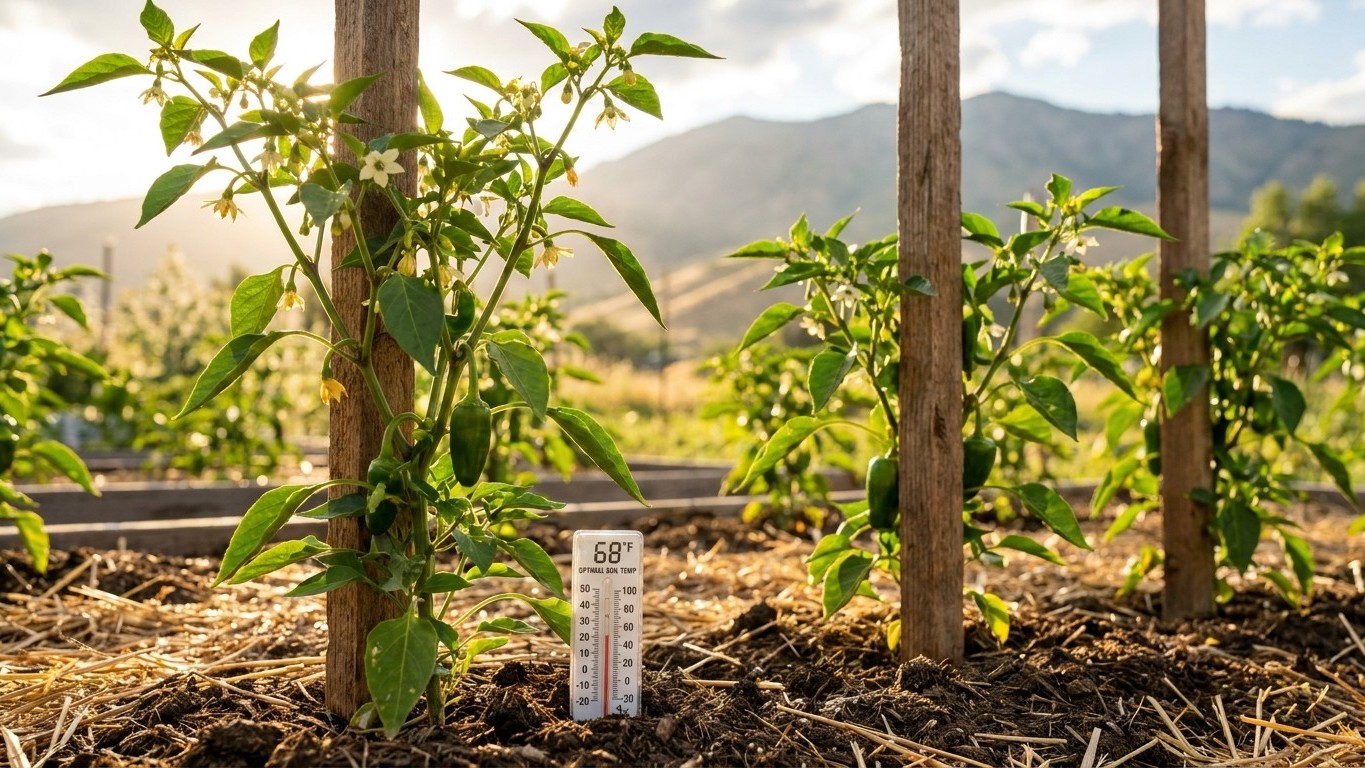

Prince Edward Island almost never delivers pepper-killing heat. The reference station at Charlottetown logs an average of 0.0 days a year at or above 90 F, which means the hot end of the fruit-set window is barely a factor here. The bigger risk sits on the cool side of the equation, and that’s the one growers on the Island need to track themselves, night by night, because it isn’t something a regional average can tell you.
The short answer

Start with the number that matters most for peppers on Prince Edward Island: 0.0 days a year at or above 90 F, measured at the Charlottetown reference station over the 1981-2010 normals period. That’s not a rounded-down “rare event” figure. It’s a flat zero. Pepper fruit set fails when daytime highs climb past 90 F, because the flowers abort or drop before they ever become fruit. On the Island, that failure mode essentially doesn’t happen in an average year. If you’ve gardened in a hot inland state and moved to PEI, you can mostly stop worrying about heat-stress blossom drop the way you used to.
That’s the easy half of the story. Fruit set fails at the other end too, when nights drop below 55 F. Cool nights slow pollen viability and can stall a plant in place for weeks even while the days look perfectly pleasant. This is where the picture gets harder to pin down for the Island, because this site tracks days-above-90 by territory but does not carry summer night minima. There’s no published figure here for how often a July or August night on PEI dips under 55 F, and it would be irresponsible to guess one from the province’s latitude or from how cold its winters run. Those two things don’t translate into a summer overnight-low forecast.
What that means in practice: you need to watch your own thermometer through the growing season, not rely on a regional average to tell you whether tonight is pepper-friendly. Coastal spots on the Island often run a few degrees milder overnight than inland fields because of the moderating effect of the water, and low-lying areas collect cold air that hillside or elevated plots don’t. A backyard in Charlottetown and a field twenty minutes inland can have genuinely different overnight patterns on the same date. If you’re seeing peppers flower and then drop those flowers without setting fruit during a stretch of cool, clear nights in midsummer, that’s very likely the 55 F threshold working against you, not a disease or a nutrient problem.
So the short answer splits in two. Heat almost never shuts down pepper fruit set on Prince Edward Island. Cool nights might, and only your own observation of nighttime lows through July and August will tell you how often that happens on your particular piece of ground.
When to start seed here
Getting the timing right for pepper transplants on PEI means working backward from two conditions that both have to be true before you put a plant in the ground: the frost risk has passed, and the soil itself has warmed to 60 F. Neither of those happens on a fixed calendar date, so the arithmetic below is meant to be redone with your own local numbers rather than followed blindly.
- Start with the average last spring frost. At the Charlottetown A climate station, the average date of the last spring frost is May 16, based on Environment and Climate Change Canada’s 1981-2010 climate normals. That’s a mean, not a guarantee. In roughly half of all years, frost arrives after May 16, sometimes well after. Treat it as the midpoint of a risk window, not a green light to transplant.
- Check soil temperature, not just the calendar. Utah State University Extension advises transplanting peppers only once the soil has reached 60 F, in addition to being past frost. Air temperature can feel warm well before soil temperature catches up, especially on the Island’s heavier clay soils, which warm more slowly than sandy ground. A soil thermometer pushed a few inches down is the only reliable way to know where you stand.
- Add a buffer past the average frost date. Because May 16 is a mean and not a safe cutoff, many Island gardeners hold off another one to two weeks past it before trusting the ground, especially in low-lying or inland spots that tend to run cooler than the Charlottetown reference station.
- Count backward 8 to 10 weeks for indoor sowing. Utah State University Extension puts the indoor head-start for pepper seedlings at 8 to 10 weeks before they go into the garden. If your realistic transplant date lands in early June once you’ve accounted for both frost risk and soil warmth, that puts your seed-starting date somewhere in the last week of March to the first half of April.
- Recheck before the transplant date arrives. Because frost dates are averages and soil warms unevenly across a property, confirm both conditions again in the days just before you planned to move seedlings outside, rather than trusting the calculation you made back in March.
None of this is a fixed date you can circle once and forget. It’s a moving target that depends on your specific soil, your specific site, and how that particular spring is behaving.
What goes wrong here
Even with PEI’s mild summer heat working in a pepper grower’s favor, plenty can still derail a crop between transplant and harvest. The failures below are the ones this climate is most likely to hand you, along with what actually addresses each one.
- Blossom drop from a cool night. Since fruit set fails when nights fall below 55 F, a run of clear, cool nights in early or midsummer can cause flowers to open and then fall without ever setting fruit. Because this site doesn’t track summer night minima for the Island, you have to catch this yourself by watching your own overnight lows and noting when blossom drop lines up with a cold snap. Row cover pulled over plants in the evening during a predicted cool stretch can hold a few extra degrees of warmth around the foliage.
- Blossom drop from a hot spell. The flip side is fruit set failing above 90 F, which is rare enough on PEI (an average of 0.0 such days a year at the Charlottetown reference station) that it’s not a routine concern here. It can still happen during an unusual heat spike, though, so if you do get a run of unseasonably hot days, expect the same blossom-drop symptom and don’t assume it must be a cool-night problem just because that’s the more common Island pattern.
- Sunscald on exposed fruit. Pepper fruit that develops without enough leaf cover can get a pale, blistered patch on the side facing direct sun, especially after a plant loses foliage to wind, hail, or aggressive pruning. Leaving the plant’s natural leaf canopy intact rather than stripping it back is the simplest prevention, since the leaves are what shade the fruit in the first place.
- Blossom-end rot on developing peppers. This shows up as a sunken, leathery patch on the blossom end of the fruit and usually traces back to inconsistent watering rather than a soil deficiency on its own; calcium can’t move into the fruit properly when the plant is cycling between drought stress and a sudden soak. Keeping soil moisture steady with regular watering and a layer of mulch does more to prevent it than any fertilizer application.
Common questions
Do peppers need full sun on Prince Edward Island?
Yes. Peppers are a warm-season crop that need direct sun for most of the day to flower and fruit well. Given how rarely PEI reaches damaging heat (an average of 0.0 days a year at or above 90 F at the Charlottetown reference station), a full-sun spot carries little risk of the plants overheating.
Is May 16 a safe date to transplant peppers outdoors on the Island?
No, and it isn’t meant to be treated that way. May 16 is the average last spring frost date at the Charlottetown A station, drawn from Environment and Climate Change Canada’s 1981-2010 climate normals. Because it’s a mean, frost falls after that date in roughly half of all years. Confirm soil temperature has reached 60 F as well before transplanting, and expect to wait longer in inland or low-lying spots than at the coastal reference station itself.
Why are my peppers flowering but not setting fruit?
The most likely explanation on PEI is a run of cool nights below 55 F, since that’s one of the two thresholds where pepper fruit set fails according to Utah State University Extension. Because this site doesn’t publish summer night minima for the Island, the only way to confirm it is to track your own overnight temperatures during the stretch when blossom drop shows up.
How early can I start pepper seeds indoors for a PEI garden?
Count backward 8 to 10 weeks from your realistic transplant date, which itself depends on both frost passing and soil reaching 60 F. Given the May 16 average last frost and typical soil warm-up on the Island, that generally points to a seed-starting window somewhere in late March through mid-April, adjusted for your own site conditions.