
Arkansas gardeners can get a full pepper crop, but the calendar only tells half the story. Between the frost date and the first hard freeze, plants face a stretch of extreme heat that stalls flowering just as often as a late cold snap does. The varieties that actually ripen here are the ones planted early enough to flower before the worst heat hits, and picked with both temperature limits in mind, not just the frost-free window on a seed packet.
The short answer

Little Rock averages 69.2 days a year at or above 90 F, according to NOAA NCEI Climate Normals for 1991-2020. That’s not a heat wave. That’s close to ten weeks scattered across the growing season, mostly stacked into July and August, when Arkansas peppers are supposed to be setting their heaviest flush of fruit. Utah State University Extension is direct about what that heat does to a pepper plant: fruit set fails once daytime temperatures climb above 90 F, because the flowers abort or drop before pollination can finish. A plant can look healthy, keep blooming, and still hand you an empty stem for weeks at a time simply because the thermometer is against it.
The same USU guidance names the other failure point too, and it matters just as much: nights below 55 F stop fruit set cold, no matter how warm the days are. Pepper pollen doesn’t function well in cool overnight air, so a string of chilly nights in late spring or early fall can shut down a plant just as effectively as a July heat spike.
Here’s where Arkansas gardeners need to do their own homework. This resource tracks days above 90 F by location because that figure is measured and published for the state’s reference stations. Summer night minimums are not part of that dataset, and they shift meaningfully depending on elevation, tree cover, and whether a garden sits in a low spot that collects cold air. A garden in the Ozark highlands can run several degrees cooler overnight than one in the Delta lowlands, even at the same latitude, and latitude alone tells you nothing reliable about what a given yard actually experiences after dark. Track your own nighttime lows with a min-max thermometer through late spring and again in early fall, since those are the windows where a run of sub-55 F nights is most likely to sneak in and quietly cancel a flush of blossoms.
Put together, the short answer is this: Arkansas’s frost-free season is long enough for a full pepper crop, but the practical ripening window is bookended by cold nights on one side and roughly ten weeks of 90-plus-degree days on the other. Varieties that set fruit fastest, and that you get transplanted early enough to flower before peak heat, are the ones that reliably fill a basket here.
When to start seed here
The math behind a pepper start date is simple once you have two anchor points: the last frost and the point where soil, not just air, is warm enough. Here’s how to work it backward for your own county.
- Start with the frost date that matters for a tender plant. NOAA NCEI’s 1991-2020 Climate Normals put the 32 F freeze probability window for this region between March 12 and March 28 (data from station USW00013963). But peppers are damaged well before an actual freeze, so the more useful number is the 36 F light-frost threshold. For Little Rock, that date is April 3 in spring and October 31 in fall, giving the real transplant target and the point at which fall harvest should wrap up.
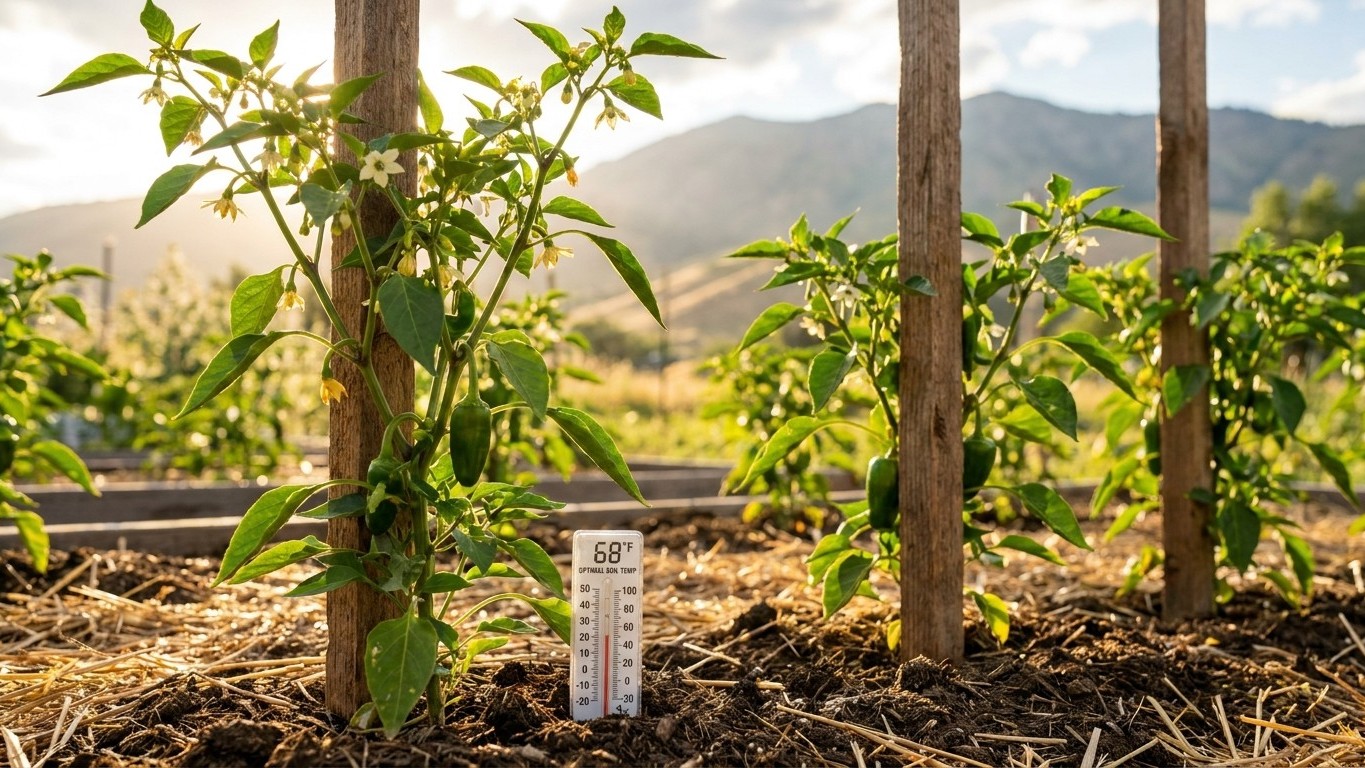
- Confirm soil temperature before moving transplants outdoors. USU Extension recommends waiting until the soil itself reaches 60 F, since cold soil stunts pepper roots even when the air feels mild. Push a soil thermometer 4 inches deep in the morning for a few days running; if the number is still in the 50s, hold transplants a little longer even if the calendar says it’s past frost.
- Count backward 8 to 10 weeks from your transplant date to find your seed-starting window. Working from an April 3 target, 10 weeks back lands on roughly January 23, and 8 weeks back lands on roughly February 6. That gives a starting window of late January through the first week of February for most of the state.
- Adjust for your own microclimate. Gardeners in cooler pockets, low valleys, or higher elevations should watch local soil temperature rather than relying on the state-level frost dates, and should lean toward the later end of that seed-starting window if spring tends to arrive slowly on their property.
- Hold transplants indoors if a cold snap is forecast near your planting date. A week of protection under grow lights costs nothing compared to replacing frost-killed seedlings and losing that early jump on the season.
None of this requires guessing. It’s two dates and one measurement, run backward through simple subtraction, and it’s the same arithmetic a gardener in any other Arkansas county can redo with their own local frost data.
What goes wrong here
- Blossom drop during a heat spell. Once daytime highs push past 90 F, a plant can keep flowering while producing nothing, because the blooms abort before pollination completes. There’s no fix for the heat itself, but shade cloth over the hottest afternoon hours during Arkansas’s peak summer stretch can knock a few degrees off leaf and flower temperature, and it often keeps enough blossoms viable to carry the plant through until cooler weather returns.
- Blossom drop from a cool night. The same failure shows up at the other end, when nighttime temperatures fall below 55 F, usually in early spring or early fall. Since this isn’t tracked by regional averages, the fix is personal: log your own overnight lows with a simple thermometer during those transition weeks, and if a cold stretch is coming, consider row cover in the evening to hold in a few extra degrees around the plant.
- Sunscald on exposed fruit. Arkansas summers deliver strong, direct sun, and peppers that lose leaf cover to disease, pruning, or wind damage end up with fruit exposed on the south and west sides of the plant. The skin develops a pale, blistered patch that turns papery and often rots. Keep foliage full through summer and avoid heavy pruning once fruit starts sizing, since the leaves are doing real work shading the pods underneath them.
- Blossom-end rot on the first fruit of the season. This shows up as a sunken, leathery brown-black spot on the bottom of the pepper, and it’s driven by uneven water delivery rather than a soil deficiency in most home gardens. A dry stretch followed by a heavy watering interrupts calcium uptake at exactly the wrong moment for a developing fruit. Consistent, even soil moisture with mulch to buffer against Arkansas’s swings between dry spells and downpours solves most cases within a couple of weeks.
Common questions
Can peppers still ripen if a heat wave hits in July?
Existing fruit already set will keep maturing through a heat spell, since it’s new flower pollination that shuts down above 90 F, not fruit already developing on the vine. The plant simply pauses new fruit set until temperatures ease.
Is it worth starting seed earlier than the 8 to 10 week window?
Starting much earlier usually backfires, since plants held too long indoors become root-bound and stressed before they ever reach the garden. The 8 to 10 week window from USU Extension is calibrated to hand off a healthy, compact transplant right around the outdoor planting date, not weeks ahead of it.
Do all pepper types respond to heat the same way?
Fruit-set failure above 90 F and below 55 F is a general pepper response documented by USU Extension, not something limited to one type. Specific heat tolerance or days-to-maturity figures for particular varieties aren’t published in the source data used here, so treat any variety-specific claim you see elsewhere with some caution unless it cites its own testing.
How many frost-free days does Arkansas actually offer for peppers?
Using the 36 F light-frost dates for Little Rock, spring transplant-safe conditions begin around April 3 and the season effectively closes around October 31. That’s a long window on paper, but the roughly 69 days above 90 F that fall inside it are what actually limit how much of that time produces new fruit.