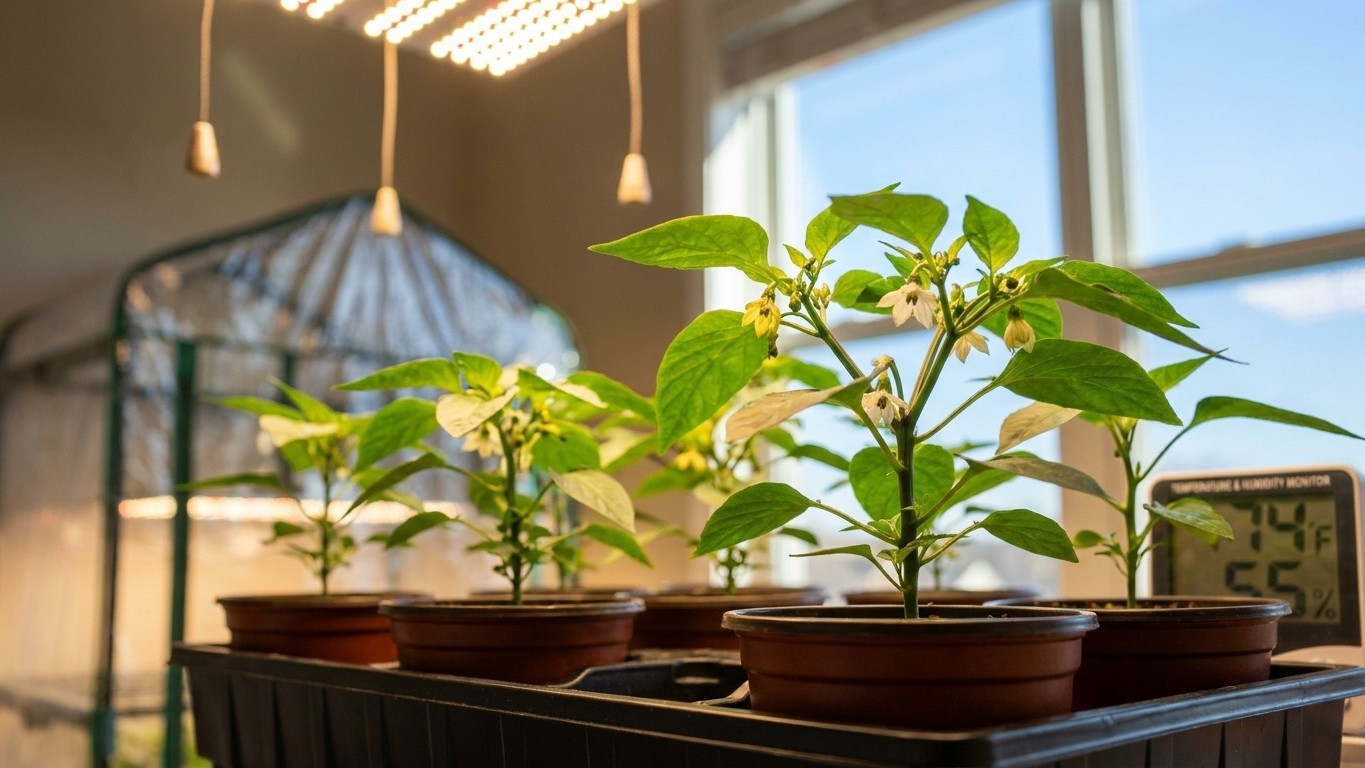

Peppers set fruit in the Northwest Territories more easily than the calendar suggests, at least on the hot side. The failure here comes from the other direction: a short season, a late average frost, and nights that can slip below the range peppers need to hold their blossoms. Start transplants early indoors and track your own nighttime lows closely, because the heat problem that plagues southern gardens almost never shows up this far north.
The short answer

The reference station at Yellowknife recorded an average of 0.0 days a year at or above 90°F, based on the Environment and Climate Change Canada Climate Normals for 1981-2010. That number is not a rounding error. It means a Yellowknife-area garden essentially never sees the kind of extreme daytime heat that causes pepper flowers to abort in warmer parts of the continent. Pepper plants growing in Texas or Arizona lose blossoms when afternoon highs climb past 90°F for days in a row. In the Northwest Territories, that particular failure mode is close to nonexistent.
That does not mean pepper fruit set is guaranteed. Fruit set fails at both ends of the temperature scale, and the cool end is the one that actually threatens a crop here. Utah State University Extension puts the lower threshold at nighttime lows below 55°F, a range where pollen becomes less viable and flowers drop before they ever become fruit. This site tracks days at or above 90°F for each territory, but it does not carry summer night minimum temperatures. For a fuller picture of Why Peppers Fail to Set Fruit in Northwest Territories, that figure, the one that matters most for a Northwest Territories pepper patch, is not published here.
Do not try to fill that gap by guessing from latitude or from how cold the coldest month runs. A location’s overall winter severity tells you almost nothing about how its July and August nights behave, and two gardens a short drive apart can differ by several degrees depending on elevation, water exposure, and how open the site is to clear-sky radiational cooling. The only reliable fix is to put a min-max thermometer in the garden itself and read it through the growing season. If nights are regularly dipping under 55°F, that is the constraint to manage, not summer daytime heat. Choosing among the Pepper Varieties That Ripen in a Northwest Territories Season can also help offset the risk that cool nights pose to fruit set.
When to start seed here
When to Start Pepper Seed in Northwest Territories is an exercise in counting backward from a transplant date that depends on two separate conditions being met, not one. Here is how the arithmetic runs, step by step, using the published normals for this territory as the starting point.
- Start with the average last spring frost. Environment and Climate Change Canada’s Climate Normals for 1981-2010, read from the YELLOWKNIFE A station (climate ID 2204100), put the mean last spring frost at May 25. That is a mean, not a guarantee: in roughly half the years on record, frost arrived later than that date. Treat May 25 as the midpoint of a window, never as a safe planting day.
- Check soil temperature separately from air temperature. Peppers need soil at 60°F before transplanting, and soil warms more slowly than air, especially in northern ground that may still be releasing winter cold well into late spring. Air can feel warm on a sunny afternoon while the soil a few inches down is still cold to the touch. A simple soil thermometer pushed a few inches into the bed removes the guesswork.
- Transplant only once both conditions are satisfied. That means waiting until the frost date has safely passed and the soil has independently reached 60°F, whichever of the two comes later in a given year. In a cool, late spring, soil temperature is usually the limiting factor even after the frost risk has passed.
- Count back 8 to 10 weeks from that realistic transplant date. Utah State University Extension recommends starting pepper seed indoors 8 to 10 weeks before transplanting outside. If your working transplant target lands in early June, that puts indoor seed-starting somewhere in the first half of April, adjusted for how far into June the soil actually warms in your own yard.
- Re-check the math every year rather than reusing last year’s dates. Because May 25 is an average and soil warming varies with snowpack, spring rainfall, and how exposed a particular bed is to sun, the real transplant window shifts from one year to the next. Recalculating from current conditions each spring is more reliable than working off a fixed date on the wall calendar.
What goes wrong here
Three failure patterns show up repeatedly in short-season, high-latitude pepper beds. Each has a specific cause and a specific fix.
- Blossom drop. Flowers form, then fall off before setting fruit. In the Northwest Territories this is almost always driven by the cool end of the scale rather than the hot end, since days above 90°F are effectively absent here. A run of nights below 55°F, or a sudden warm spell followed by a sharp cool snap, can both trigger it. Watch your own garden thermometer through the season and use row cover on nights that threaten to drop into that range, since buffering the plant even a few degrees can be enough to protect open flowers.
- Sunscald. Exposed fruit develops pale, papery patches where direct sun hits it for extended periods, particularly after heavy pruning removes too much of the canopy. Long summer daylight hours at high latitude mean fruit can be exposed to strong light for more hours per day than gardeners further south expect. Leave enough foliage in place to shade developing peppers, and avoid stripping leaves for the sake of tidiness.
- Blossom-end rot. A dark, sunken patch forms on the bottom of the fruit, usually tied to inconsistent watering that disrupts calcium uptake rather than a true calcium shortage in the soil. Raised beds and containers, common in northern gardens working with thin or rocky native soil, dry out faster and swing more sharply between wet and dry. Even, regular watering and a layer of mulch to buffer moisture swings address most cases without any soil amendment at all.
Checking this against your own county
Every number in this article comes from a single reference station, and a territory this size is not one uniform climate. Yellowknife’s frost date and heat totals describe conditions at that station, not necessarily conditions in a garden further north, further south, or at a different elevation. Local microclimates, exposure to open water, and soil type all shift the real dates a grower should plan around.
For a check against conditions specific to your own community, the Northwest Territories Department of Industry, Tourism and Investment maintains an agriculture services page covering growing conditions and support across the territory. That is the right first stop before finalizing a planting date based on normals from a single weather station.
Common questions
Can peppers even mature outdoors in the Northwest Territories?
Yes, but the short frost-free window is the limiting factor rather than summer heat. With zero average days at or above 90°F, heat-driven blossom drop is rarely the problem; getting enough warm days after the average May 25 last frost to finish fruit is the real challenge, which is why starting transplants 8 to 10 weeks early matters so much here.
What soil temperature should I check before transplanting?
Utah State University Extension recommends waiting until soil reaches 60°F, checked independently of air temperature since the two warm at different rates. A basic soil thermometer pushed a few inches into the bed gives a direct reading rather than relying on how warm the air feels.
Should I start seeds earlier than 8 weeks if the season is short?
The 8 to 10 week window from Utah State University Extension is the published range, and starting well outside it risks leggy, stressed transplants that do not necessarily perform better once moved outside. If your realistic transplant date runs later into June because of slow soil warming, that shifts the seed-starting date later too, rather than calling for starting seed earlier than 10 weeks out.
Does the May 25 frost date apply everywhere in the territory?
No. That date comes specifically from the YELLOWKNIFE A station in the Environment and Climate Change Canada Climate Normals for 1981-2010, and it is a mean date, meaning frost arrives later than May 25 in roughly half of the years on record. Other communities in the territory, particularly those further north or at different elevations, should expect their own frost window to differ, which is another reason to confirm local conditions through the territorial agriculture service before setting a transplant date.