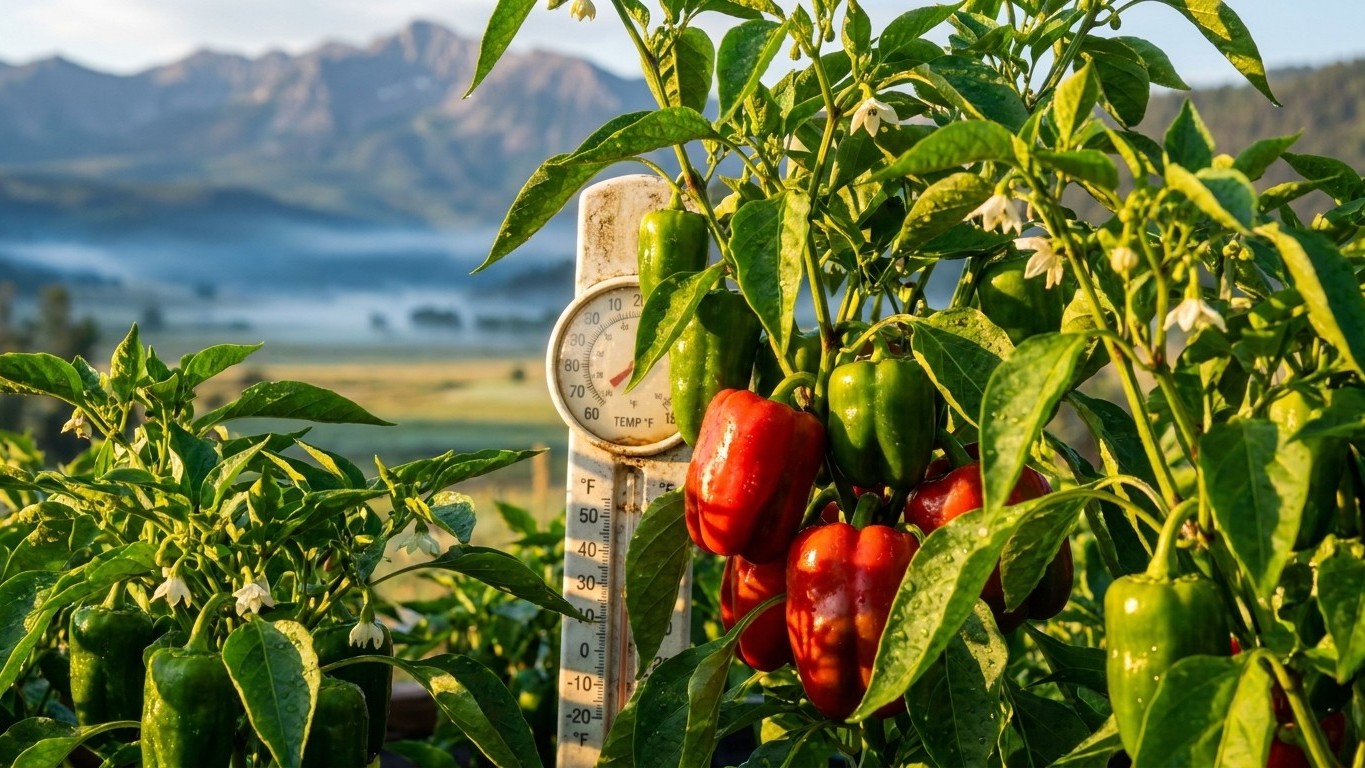

Colorado peppers face pressure from both directions: heat that can shut down pollination on the plains, and cool nights that do the same thing in valleys and higher elevations. Denver averages 39.6 days a year at or above 90 F, but night minima aren’t tracked on this site, so growers have to watch their own thermometer. When to Start Pepper Seed in Colorado: start seed 8 to 10 weeks before transplanting after frost, once soil hits 60 F.
The short answer

Start with the number that actually drives most pepper failures on Colorado’s Front Range and eastern plains: 39.6 days a year at or above 90 F, according to NOAA NCEI Climate Normals for 1991-2020 at the Denver reference station. That’s not an average summer temperature, it’s a count of how many days push into the range where pepper flowers begin to abort. Utah State University Extension is direct about the mechanism: pepper fruit set fails once daytime temperatures climb above 90 F, because the plant drops blossoms rather than commit resources to fruit it can’t finish forming in that heat. For a fuller look at Why Peppers Fail to Set Fruit in Colorado, this heat threshold is the single biggest culprit. With nearly forty such days on the calendar in a typical Denver-area year, a gardener who plants peppers expecting steady fruit through July and August needs to plan for stretches where the plant simply stalls.
The other side of that same equation gets ignored more often, and it shouldn’t be. The same Utah State source is just as clear that pepper fruit set also fails when nights drop below 55 F. That threshold matters in Colorado precisely because the state’s terrain is so uneven. A garden on the eastern plains, a foothills lot outside Boulder, and a high mountain valley can all sit under the same daytime heat dome and still have wildly different nighttime lows. This site tracks the hot end of that equation through the 90 F day count, but it does not carry summer night minima for any Colorado location. That’s not a gap to guess around. Don’t infer a night low from elevation, from latitude, or from how cold the coldest month of the year runs. Those numbers don’t translate into a July or August overnight low, and treating them as if they do is how gardeners misdiagnose a fruit-set problem as disease or poor pollination when it’s really a cold night doing the damage.
The practical move is a cheap min-max thermometer placed near the pepper bed, checked through the growing season. If nights are regularly dropping under 55 F even in midsummer, that’s a local microclimate issue, common in mountain valleys and some foothill pockets, and it explains stalled fruit set as clearly as a 90 F afternoon does. Peppers planted in a spot that gets both, hot afternoons and cool nights, are working against the crop’s biology from two directions at once, and no amount of fertilizer fixes either one. Choosing from Pepper Varieties That Ripen in a Colorado Season can at least tilt the odds back in the grower’s favor.
When to start seed here
The timing math is straightforward once you have your own frost date, but it has to be done in the right order. Work backward from the field, not forward from a seed packet’s generic calendar.
- Find your last spring frost date. For the Denver-area reference station (USW00003017), NOAA NCEI’s 1991-2020 normals put the 32 F freeze probability window between May 1 and May 11. Mountain towns run far shorter seasons than that and can see frost into July; the western slope follows its own separate pattern. Use your own county’s number, not Denver’s, if you’re anywhere outside the immediate metro area.
- Wait for soil, not just air, to warm. Utah State University Extension sets the transplant trigger at 60 F soil temperature, measured after the frost date has passed. Air temperature can feel warm on a sunny April afternoon while the soil underneath is still too cold for pepper roots to establish.
- Count back 8 to 10 weeks from that transplant date. That’s the indoor seed-starting window Utah State recommends for peppers, which germinate and grow more slowly than tomatoes or squash.
- Do the subtraction for your own date. Using the Denver-area range as an example: if soil hits 60 F and frost risk has passed around May 1, counting back 8 weeks lands near early March, and counting back 10 weeks lands near mid-February. If your transplant date is closer to May 11, the same math shifts the seed-starting window a week and a half later. A mountain garden with a June transplant date pushes indoor seed starting into April.
- Re-check soil temperature before moving transplants outside. A calendar date is a starting estimate, not a guarantee; a cold, wet spring can leave soil under 60 F well past the average frost-free date, and pepper transplants set out too early into cold soil often sit stalled for weeks rather than actually dying, which wastes the head start entirely.
What goes wrong here
- Blossom drop. This is the single most common complaint from Colorado pepper growers, and it runs in both directions. Utah State University Extension attributes it to daytime temperatures above 90 F, which the state’s plains and Front Range hit an average of 39.6 days a year, and separately to nighttime temperatures below 55 F. The remedy for the hot end is patience plus consistent watering; the plant typically resumes setting fruit once temperatures moderate, so don’t pull it out mid-heat-wave. For the cool end, since this site doesn’t track night lows, the fix starts with monitoring: put a min-max thermometer in the bed, and if nights are consistently running cold, a floating row cover pulled over the plants in the evening can trap enough ground heat to push the low back above the threshold.
- Sunscald. Colorado’s elevation means more direct solar radiation reaches plants than at sea level, and fruit exposed after aggressive pruning or leaf loss can develop pale, papery patches on the side facing the sun. The remedy is to leave enough foliage cover intact to shade developing fruit rather than pruning peppers heavily the way some gardeners do with tomatoes, and to use light shade cloth over exposed rows during the most intense midday sun in July and August.
- Blossom-end rot. This shows up as a sunken, leathery dark patch at the fruit’s blossom end, and it’s tied to inconsistent water delivery rather than a soil-quality problem in most home gardens. The remedy is even, regular watering, ideally with mulch to buffer soil moisture swings between waterings, since Colorado’s dry air and wind pull moisture out of garden beds faster than gardeners moving from wetter climates tend to expect.
Checking this against your own county
Everything above is built from statewide and Denver-reference-station data, and Colorado’s terrain makes local variation the rule rather than the exception. A garden in Grand Junction, a foothills lot near Colorado Springs, and a high mountain valley can each have a meaningfully different frost date, soil-warming timeline, and night temperature pattern, even under the same statewide 90 F day count.
Colorado State University Extension, at extension.colostate.edu, maintains county-level offices across the state that track local frost dates, soil temperature trends, and planting guidance specific to each region’s elevation and microclimate. Before locking in a seed-starting date, it’s worth checking with your county’s extension office directly, especially if you’re gardening outside the immediate Denver metro area or at any real elevation change from the plains.
Common questions
Can peppers recover after a hot spell causes blossom drop?
Yes. Utah State University Extension notes that fruit set resumes once temperatures drop back out of the range that caused the drop; the plant isn’t damaged, it’s just pausing reproduction during heat stress.
Does Colorado’s day count of 90 F days mean peppers can’t grow here?
No. The 39.6-day average is a planning number, not a barrier. It tells you to expect stretches of blossom drop during the hottest weeks and to build watering and monitoring habits around that reality, not to avoid the crop.
Why isn’t there a night-temperature number for my area on this site?
Summer night minima aren’t part of the dataset this site carries for Colorado. Since night lows below 55 F affect fruit set just as much as hot days do, and they vary sharply with elevation, they need to be checked locally with a thermometer rather than estimated from any published state or regional figure.
Is Denver’s frost date the same as mine?
Only if you’re near the Denver reference station. The May 1 to May 11 window comes from NOAA NCEI’s 1991-2020 normals for that specific station. Mountain towns can see frost into July, and the western slope runs on its own separate pattern, so check your county’s extension office for a local figure.