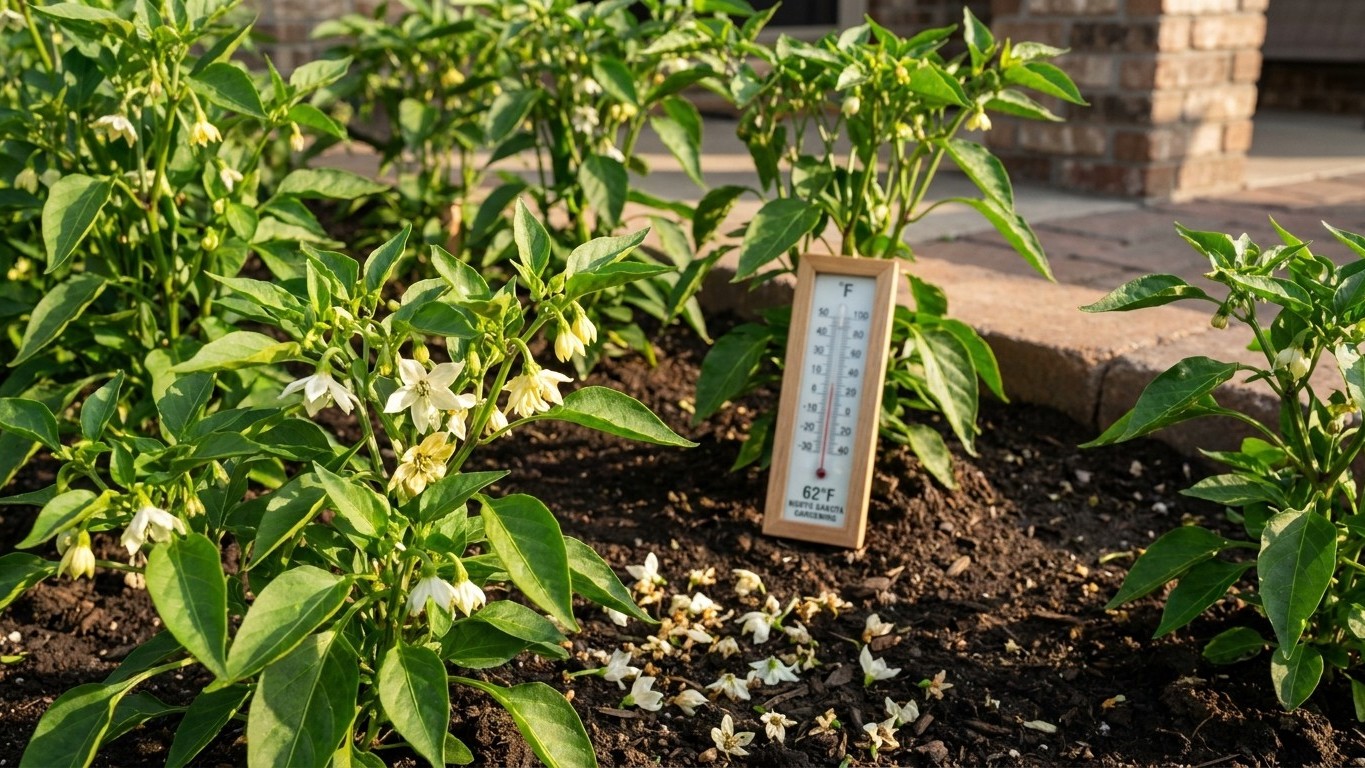

Pepper fruit set in North Dakota comes down to a narrow window: soil warm enough and air mild enough to hold flowers on the plant, but not so hot that the plant drops them before pollination finishes. The state’s own heat data and the transplant math below give you the framework, but the finer point (how cold your specific nights actually get) is something no regional dataset can answer for you.
The short answer

Fargo’s reference station logs an average of 11.7 days a year at or above 90 F, according to NOAA NCEI Climate Normals for 1991-2020. That’s not a huge number compared to states further south, but it’s not zero either, and pepper flowers don’t care about averages. A single stretch of 90-degree afternoons during bloom is enough to cause blossoms to drop before pollen ever sets fruit. If your garden sits in a spot that traps heat, a driveway-adjacent bed, a south wall, a patio pot on concrete, you can hit that threshold on days the airport station never records.
The other failure point runs the opposite direction. Utah State University Extension is direct about this: pepper fruit set fails at both ends, with nights below 55 F causing the same kind of blossom drop as excessive daytime heat. This is the half of the equation that trips up a lot of North Dakota gardeners, because spring and even early summer nights in this state can dip into the 50s well after the last frost has passed. A plant can look perfectly healthy, be flowering heavily, and still refuse to set fruit if the nights it’s flowering in are running cool.
Here’s the part that matters for how you use this information: this site tracks days above 90 F for North Dakota, but it does not carry summer night minimum data for your area. That figure isn’t something to guess at from a map or a general sense of how far north you live. Night temperatures vary by elevation, by whether you’re in a river valley or on open prairie, by how close you are to the moderating effect of a lake, and by local microclimate factors no statewide dataset captures at the resolution a garden needs. If you want to know whether your July nights are running above or below that 55 F line, a cheap min-max thermometer set outside near your pepper bed will tell you more than any regional average.
Put those two thresholds together and you get the real shape of a North Dakota pepper season: a relatively short stretch where nights have warmed past 55 F but days haven’t yet started spiking past 90 F. That window is when fruit actually sets, and understanding Why Peppers Fail to Set Fruit in North Dakota is the key to timing your garden around it, starting with When to Start Pepper Seed in North Dakota. Everything else in growing peppers here, the seed-starting schedule, the variety choice, the siting decisions, exists to get as many flowering days as possible to land inside that window, which is why choosing from Pepper Varieties That Ripen in a North Dakota Season matters as much as timing your transplants.
When to start seed here
Working out a start date is arithmetic, not guesswork, and it starts from the transplant end and works backward. Utah State University Extension recommends starting pepper seed 8 to 10 weeks before transplanting, and transplanting only after frost has passed and soil has reached 60 F.
- Find your frost date. NOAA NCEI’s 1991-2020 climate normals put the last spring frost at the Fargo reference station somewhere in the May 4 to May 15 window, based on 32 F freeze-probability data. That’s a station reading, not a guarantee for your yard. Suburban and rural gardens routinely see their last frost land one to two weeks later than the airport figure, and gardens at higher elevation can run later still.
- Add the soil-temperature check. Frost passing doesn’t mean the soil is ready. Cold ground slows pepper roots and stalls transplants even when the air feels warm enough. Wait until soil at planting depth reads 60 F on a soil thermometer, which in North Dakota often trails the frost-free date by a week or two depending on how much sun the bed gets and how wet the ground has been.
- Set your transplant date around whichever comes later. If your last frost typically falls in mid-May but your soil doesn’t hit 60 F until early June, early June is your real transplant date, not mid-May.
- Count back 8 to 10 weeks from that transplant date. If you’re transplanting in the first week of June, an 8-week schedule puts your seed-starting date in early April; a 10-week schedule pushes it back to late March.
- Build in a hardening-off week. The 8-to-10-week window is indoor growing time before the plant goes in the ground, but plan a final week of gradually increasing outdoor exposure before transplant day itself, so the seedling isn’t shocked by direct sun and outdoor air all at once.
Redo this math for your own county rather than borrowing the Fargo dates outright. If your frost-free date and 60-degree soil date land later than Fargo’s, which is likely almost anywhere outside the immediate metro area, shift your indoor seed-starting date later by the same margin. Starting too early just means leggy, root-bound seedlings sitting in trays waiting for ground that isn’t ready yet.
What goes wrong here
- Blossom drop from a hot spell. When daytime temperatures push into the 90s during flowering, plants shed blossoms rather than push them into fruit. This matches directly to the 11.7 average days per year North Dakota’s reference station spends at or above 90 F. The remedy is timing bloom to avoid the hottest stretch when possible, and providing afternoon shade cloth over plants during any heat spike that lands mid-season.
- Blossom drop from a cool night. The same dropped-flower symptom shows up when nights fall below 55 F during bloom, per Utah State University Extension. Since this site doesn’t track night minima for your area, the fix starts with monitoring: keep a thermometer near the bed through your flowering weeks. If nights are running cool, delaying transplant by another week or two the following season, or using row cover on unexpectedly cold nights, keeps blossoms on the plant longer.
- Sunscald on exposed fruit. North Dakota’s open, high-sun summer days can scorch pepper fruit that isn’t shaded by foliage, showing up as pale, papery patches on the side facing direct sun. The remedy is leaving foliage intact rather than over-pruning, and using light shade cloth during the sunniest stretch of midsummer on plants that have thin leaf cover.
- Blossom-end rot on developing fruit. This shows up as a dark, sunken patch on the bottom of the fruit and typically comes from inconsistent watering rather than a soil deficiency alone. The remedy is even soil moisture: mulch to hold water steady between waterings, and avoid letting the bed swing between bone-dry and soaked, especially during the hot, dry stretches that come with those 90-degree days.
Checking this against your own county
Everything above is built from statewide and reference-station data, useful for planning but not a substitute for what’s happening in your specific soil and yard. Frost dates run later outside city centers, night temperatures depend on terrain this dataset can’t see, and local extension staff track conditions at a resolution no statewide normal can match.
The North Dakota State University Extension service is the right next stop for county-level frost records, soil temperature monitoring guidance, and variety performance notes specific to your part of the state. Their county offices are the resource built to answer exactly the local questions this article can’t.
Common questions
Can I speed up fruit set by starting seed earlier than 10 weeks before transplant?
Starting earlier than the 8-to-10-week window recommended by Utah State University Extension usually backfires, producing leggy, stressed seedlings that transplant poorly rather than plants that fruit sooner.
Do I need to worry about the 90-degree days if I only see a handful each summer?
Yes, if any of them land during flowering. The 11.7-day average from NOAA NCEI’s Fargo station is spread across the season, but even a short cluster during bloom can cause blossom drop.
How do I know if my nights are too cold for fruit set?
Set an outdoor min-max thermometer near your pepper bed during flowering. If readings are dropping below 55 F on multiple nights, that’s likely behind stalled fruit set, since this site doesn’t carry local night-minimum data to check against.
Is blossom-end rot caused by North Dakota’s soil?
Not directly. It’s tied to uneven watering rather than a specific regional soil issue, and consistent moisture through mulching addresses it regardless of soil type.