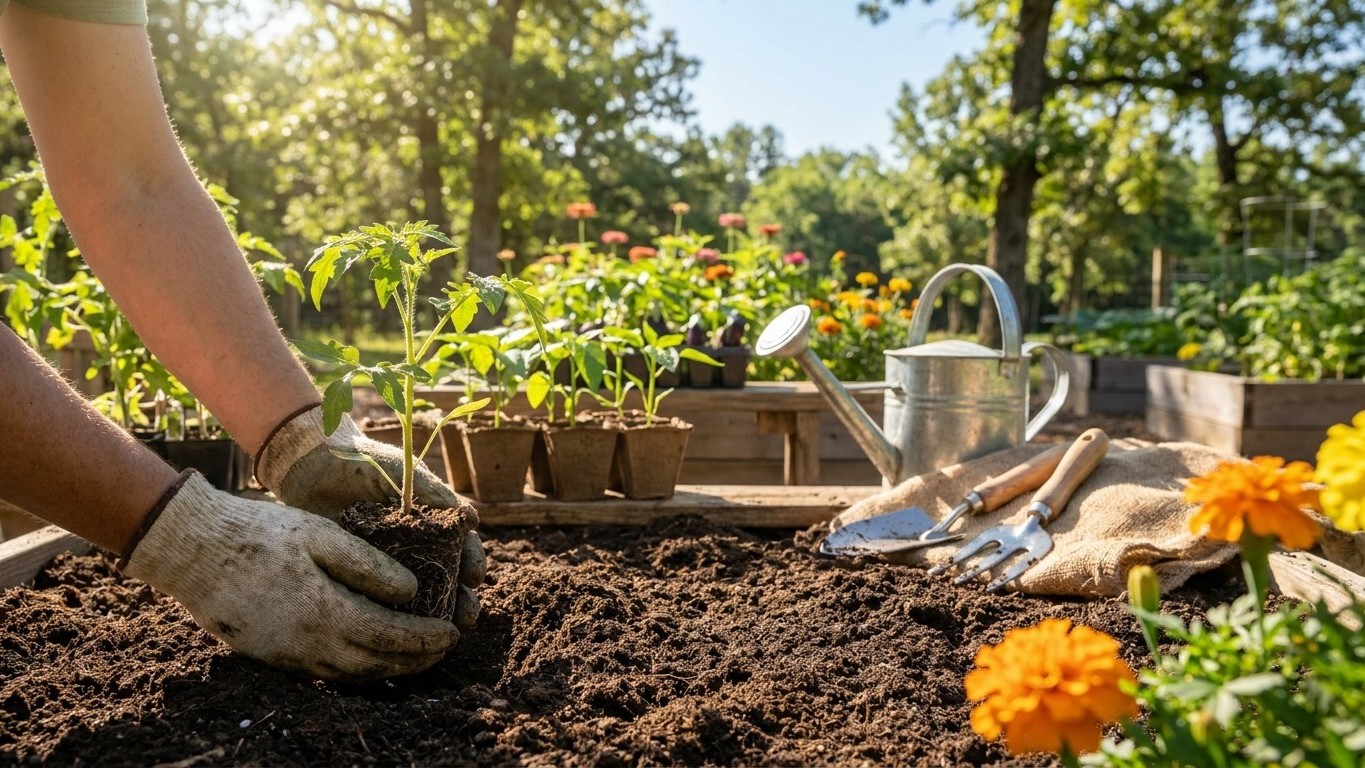

May is the month Arkansas gardens shift into full gear. The state’s last spring frost, based on 32F freeze probabilities, falls between March 12 and March 28, and the tighter 36F light-frost window that tender plants actually need closes by April 3 in Little Rock. By May, both dates are behind you, which means warm-season crops can go into the ground with confidence rather than caution.
What goes in the ground in May

Soil temperature, not the calendar page, decides what survives here. Tomatoes, peppers, and eggplant transplants want soil consistently above 60F at a four-inch depth before their roots will do anything but sit and sulk. By May, most of Arkansas has cleared that bar, especially in the Delta and along the Arkansas River Valley, where soil warms faster than in the Ozark and Ouachita highlands.
Direct-sow beans, both bush and pole, along with corn, squash, cucumbers, melons, and okra. These germinate poorly in cold, wet soil, so a dry stretch with warm nights matters more than the date on the seed packet. Sweet potato slips go in now too, once nighttime temperatures stay reliably above 55F. Basil, another crop that sulks in cold soil, can go outside alongside the tomatoes.
Tomato, pepper, and eggplant transplants started indoors earlier in spring move outside this month, after a proper hardening-off period of seven to ten days in filtered sun and wind. Skipping that step is one of the fastest ways to lose a flat of seedlings to sunscald or wind whip.
Higher ground changes the math. Gardeners in the northwest corner of the state, up in Ozark elevations, should watch overnight lows through the first half of the month rather than assuming the statewide frost window applies evenly. A cold pocket in a valley can sit several degrees below a ridge a few miles away, and that difference is exactly the kind of thing a statewide date range cannot capture.
For gardeners who still have room, herbs like rosemary, thyme, and oregano can go into the ground as perennial plantings this month, since they’ll have a full growing season to establish roots before the first fall frost arrives in November.
What to start under cover
Most of the spring indoor-starting work is done by May, but there’s still a reason to run a seed tray this month: succession planting timed toward the other end of the season. Arkansas’s first fall frost lands between November 7 and November 20. Count backward from that window and the arithmetic gets useful fast.
Take a fall tomato crop as an example. A variety that needs 70 days to maturity, plus three to four weeks growing indoors before transplant, plus a buffer for the plant to settle in after the move, adds up to roughly 12 weeks from seed to first ripe fruit. Working backward from the earliest fall frost date of November 7 puts the seed-starting date for that fall tomato crop right around mid-May. Miss that window and the plant runs out of season before it finishes fruiting.
The same backward count applies to a second round of winter squash or pumpkins for a fall harvest, since those crops also need a long runway before cool weather shuts them down.
The two ways this goes wrong are familiar to anyone who’s started seeds before a set date instead of a calculated one. Start too early and the seedlings sit in trays too long, get rootbound, and stall out the moment they hit the ground. Start too late and the plant is still flowering when frost hits, with no time left to finish. Working backward from the fall frost window, rather than from a fixed date on the wall calendar, keeps both mistakes off the table.
What is ready to pick
May harvests come from what went into the ground back in late winter and early spring. Lettuce and spinach are at their peak now, and both need daily attention as daytime heat climbs, since lettuce bolts and turns bitter fast once temperatures push into the 80s. Pick outer leaves in the morning while they’re crisp, rather than waiting for a full head.
Spring-planted radishes should already be pulled or on their way out, since they turn woody and hollow if left too long in warming soil. Peas, both snap and shelling types, hit their stride this month; the tell for readiness is a pod that’s filled out and glossy but not yet bulging or losing its bright green color.
Strawberries planted the previous fall or earlier in spring come into full production in May across most of the state. Fruit is ready when it’s fully red to the tip, since strawberries don’t continue ripening once picked the way some fruits do.
Asparagus beds established in prior seasons are winding down their harvest window by late May; once spears start coming up thinner than a pencil, it’s time to stop cutting and let the plant put energy into its ferns for next year. Green onions and early cabbage plantings round out what’s typically coming off the beds this month.
The jobs that matter this month
Staking and caging tomatoes needs to happen before the plants sprawl, not after. A tomato left to flop across the ground is far more likely to develop soil-borne diseases and slug damage, and trying to wrangle a mature plant into a cage after the fact usually snaps branches loaded with fruit.
Mulch goes down now, while soil is still holding spring moisture. A two- to three-inch layer of straw, shredded leaves, or wood chips around warm-season crops slows evaporation as June heat approaches and keeps weed pressure down at the same time. Skipping this step means more watering and more weeding for the rest of the summer.
Watering rhythm matters more than watering volume. Deep, infrequent watering that soaks six inches down encourages roots to grow deep and drought-resistant; light daily sprinkles keep roots shallow and the whole planting vulnerable the moment a hot, dry week hits.
Succession sowing keeps the harvest coming instead of arriving all at once. Beans, corn, and summer squash all benefit from a new round planted every two to three weeks through late spring and early summer, so the kitchen isn’t flooded with zucchini one week and empty the next.
Pest scouting starts in earnest this month. Squash vine borer moths begin flying as temperatures rise, and the window to catch them before they lay eggs at the base of squash stems is narrow. Colorado potato beetles and their orange egg clusters on the undersides of leaves also show up now on potato and eggplant plants. Checking the undersides of leaves twice a week costs a few minutes and often saves an entire planting.
What not to do in May
The most common mistake is trusting warm air over cold soil. A string of 80-degree afternoons can feel like permission to rush warm-season crops into the ground, but if the soil itself hasn’t warmed to match, seeds rot before they germinate and transplants sit stunted for weeks. Check soil temperature with an actual thermometer rather than judging by how the air feels on your skin.
Pulling row covers or cold frames off too early after a mild stretch is another classic error, particularly for gardeners in the Ozark highlands where a late cool snap can still slip through even after the statewide frost window has technically closed. Leave protection in place a few extra days for tender seedlings if the forecast looks uncertain, rather than betting on a run of nice weather holding.
Overdoing nitrogen on tomatoes and peppers early in the season is a mistake that doesn’t show up until it’s too late to fix easily. Heavy nitrogen feeding pushes lush, dark green foliage at the expense of flowering and fruit set, leaving gardeners with a jungle of leaves and little to show for it at harvest. A balanced fertilizer, or one slightly lower in nitrogen relative to phosphorus and potassium, does more for fruit production once plants are established.
Finally, resist the urge to water on a fixed daily schedule regardless of rainfall. Arkansas spring weather swings between soaking rains and dry stretches, and watering on autopilot either drowns roots after a storm or leaves plants thirsty during a dry week. Check soil moisture with a finger before turning on the hose.
Checking this against your own county
A statewide planting month is a starting point, not an instruction written for your backyard specifically. Elevation shifts frost timing by weeks, not days, and the difference between the Ozark highlands in the northwest and the Delta lowlands in the east can mean a full growing season gap in some years. The USDA Plant Hardiness Zone Map places Arkansas across zones 6b to 8a, based on a single measure, the average extreme minimum winter temperature, and that range alone signals how much the terrain varies from one end of the state to the other.
For a planting window built around your actual county, the University of Arkansas Cooperative Extension Service maintains local planting guidance that accounts for these regional differences far than any statewide date range can.
Common questions
Is it too late to plant tomatoes in Arkansas in May?
No. May is squarely inside the safe window for setting out tomato transplants across most of the state, since both the 32F frost window (March 12 to March 28) and the tighter 36F light-frost date of April 3 in Little Rock have already passed by then.
Can I still direct-sow corn and beans this month?
Yes, and May is one of the better months to do it, since soil has typically warmed enough for reliable germination. Succession sowing every two to three weeks through late spring keeps the harvest spread out rather than arriving all at once.
What happens if I plant warm-season crops too early in a cool spring?
Seeds often rot in soil that hasn’t warmed sufficiently, and transplants set into cold soil tend to stall, showing purpling on leaves or simply sitting without new growth for weeks even after conditions improve.
Does the frost date differ much between north and south Arkansas?
Yes. The statewide 32F frost window of March 12 to March 28 is a range precisely because elevation and latitude shift the actual date at any given location. The Ozark highlands in the northwest typically see later frost risk than the Delta lowlands in the east, which is why checking local extension guidance matters more than relying on a single statewide date.