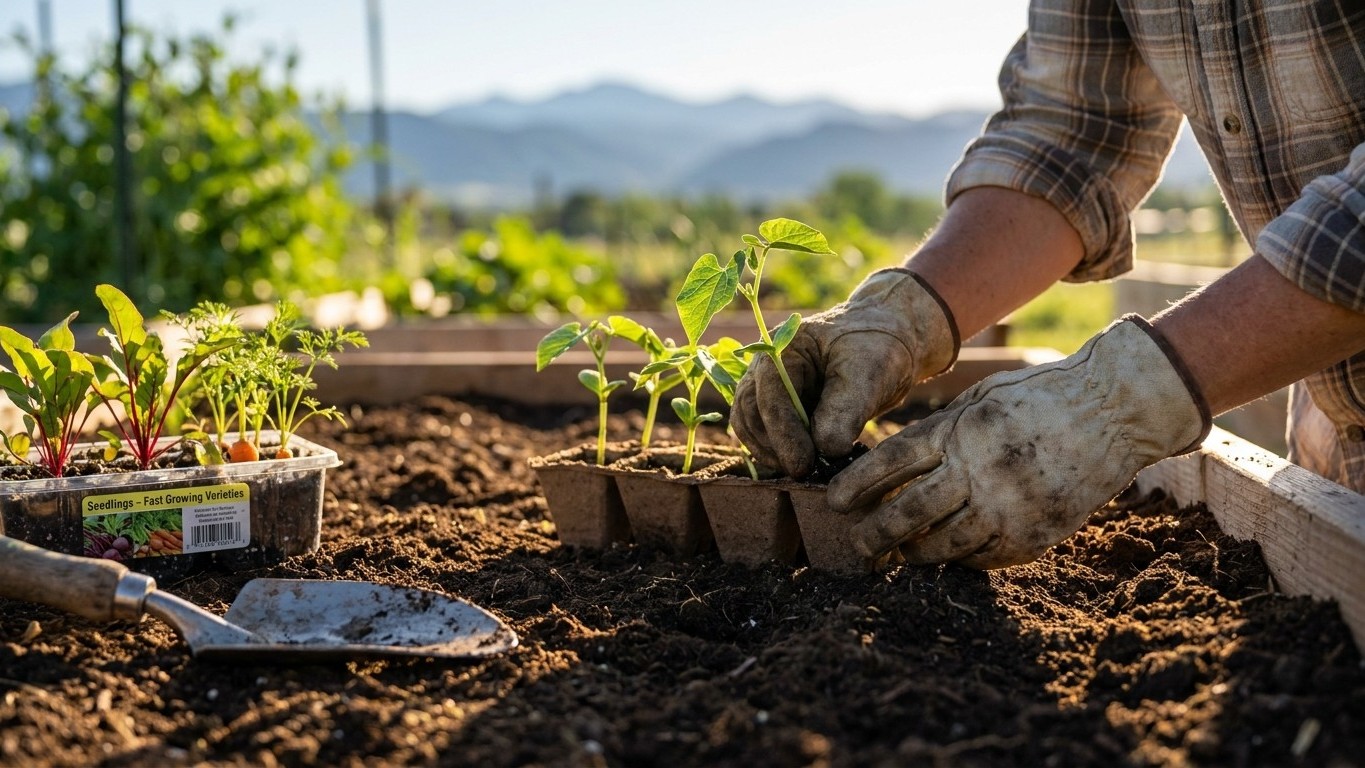

By July, Colorado’s frost window has closed almost everywhere on the plains and Front Range, and the answer to what goes in the ground shifts from “wait” to “hurry.” Warm-season crops are already established. The real decision now is which fast-maturing vegetables still have time to finish before the first fall frost returns, and which fall crops need to start indoors this week to make that same deadline.
What goes in the ground in July

Denver’s last spring frost falls between May 1 and May 11, and the first fall frost doesn’t arrive until September 30 to October 12, based on NOAA’s 1991-2020 Climate Normals for station USW00003017. That leaves roughly 140 days of frost-free growing on the plains and Front Range corridor, most of which has already been spent by the time July opens. The math that matters now isn’t “has it frosted,” it’s “how many days does this crop need before the fall frost window arrives.”
Bush beans, beets, carrots, and quick radishes can still go into the ground through early-to-mid July and finish comfortably before the fall frost band opens. Summer squash and cucumbers planted in the first week of July will produce, though later than a May planting would have. Corn started now is a gamble outside the earliest days of the month, since most varieties need 60 to 100 days and the clock is already running short for anything but the fastest-maturing types.
Winter squash and pumpkins are the crops most likely to disappoint a July planter. Most varieties need 90 to 120 days to mature, which means seed going into the ground after the first week or two of July risks running into the fall frost before fruit is fully ripe and cured on the vine.
| Crop | Typical days to maturity | Safe to plant in July? |
|---|---|---|
| Bush beans | 50-60 days | Yes, through mid-July |
| Beets, carrots | 55-70 days | Yes, through mid-July |
| Summer squash | 45-55 days | Yes, first two weeks |
| Sweet corn | 65-100 days | Only the earliest week |
| Winter squash, pumpkins | 90-120 days | Risky after early July |
Mountain towns are a different climate entirely. At higher elevation, a frost can still show up in July, and the frost-free season may run only eight to ten weeks total rather than the four-plus months Denver enjoys. Gardeners above roughly 7,500 feet should treat any July planting decision as a local call, not a state-wide one, and lean on cold frames or row cover as insurance even in midsummer.
What to start under cover
The crop to start indoors or under shade cloth in July is the fall brassica family: broccoli, cabbage, and cauliflower. Counting backward from the September 30 to October 12 fall frost window, a broccoli variety needing 70 days to maturity, plus two to three weeks to establish as a transplant, needs to go into seed trays in the first half of July to have any margin before frost risk returns.
The two ways this goes wrong both come from ignoring that arithmetic. Start too early, in the punishing heat of early July with no shade protection, and seedlings often bolt or stall, sitting rootbound in a cell tray while outdoor soil temperatures stay too hot for a young brassica to transplant successfully. Start too late, past the middle of the month, and the transplant goes into the garden with too few weeks left to size up before frost cuts the season short.
Lettuce and other fall greens follow a gentler version of the same rule. Seed started indoors in a cool, shaded spot in mid-to-late July, then hardened off and moved outside in August, times out well against the October frost window. Direct-seeding lettuce outdoors in July soil, which regularly runs well above the 75-degree range that lettuce germination prefers, tends to fail outright, so starting under cover with some cooling (a basement, a shaded porch) is the more reliable path this month.
Gardeners at higher elevation should shift this whole calendar earlier by two to three weeks, since their fall frost risk returns sooner than the Front Range dates above.
What is ready to pick
Garlic and early onions are the definitive July harvest across most of Colorado. Garlic is ready when the lower third to half of the leaves have browned and fallen over; pulling it too early sacrifices bulb size, waiting too long risks the wrapper splitting and the cloves separating in storage. Cure garlic in a dry, shaded, ventilated spot for two to three weeks before trimming and storing.
Onions signal readiness the same way: necks softening and tops flopping over on their own. Forcing this by bending the tops early doesn’t speed curing and can shorten storage life, so it’s worth waiting for the plant to make that call.
By late July, the first tomatoes, zucchini, cucumbers, and bush beans planted earlier in the season start coming in steadily, and raspberry canes planted in prior seasons are usually fruiting. On the Western Slope, early peach varieties often begin ripening in this window as well, though exact timing depends heavily on the specific orchard’s elevation and microclimate.
Checking stored crops matters just as much as harvesting fresh ones. Any potatoes or onions held over from a prior season should be inspected now for soft spots or sprouting, since Colorado’s dry summer heat can accelerate spoilage in a poorly ventilated storage space faster than gardeners expect.
The jobs that matter this month
Watering rhythm is the single job most likely to make or break a Colorado garden in July. Low humidity and high elevation both pull moisture out of soil faster than gardeners coming from wetter climates anticipate, and a shallow daily sprinkle trains roots to stay near the surface where they dry out fastest. A deep soak two to three times a week, delivering water down six to eight inches, builds the deeper root system that actually survives a dry spell.
Mulching pays for itself directly against that same problem. A two-to-three-inch layer of straw or shredded bark around tomatoes, peppers, and squash cuts evaporation and keeps soil temperature from swinging as wildly between the intense daytime sun and cool high-elevation nights.
Staking and caging need to happen before, not after, plants sprawl. A tomato left unsupported until it’s already flopped across the bed is much harder to lift and tie without breaking stems than one staked while still upright.
Succession sowing keeps the harvest coming rather than arriving all at once. Beans, beets, and carrots planted every two to three weeks through mid-July extend the picking window well into fall, using the fast-maturing window this month still offers.
Pest scouting deserves a weekly walk-through. Squash bugs lay clusters of copper-colored eggs on the undersides of squash leaves and are far easier to remove by hand at that stage than once they’ve hatched. Spider mites thrive in exactly the hot, dry conditions Colorado summers deliver, showing up first as fine stippling on leaves before webbing becomes visible.
What not to do in July
Planting winter squash, pumpkins, or long-season corn late in the month is the classic July mistake. The days-to-maturity numbers on the seed packet aren’t a suggestion; a 110-day pumpkin planted in late July is still counting down toward a harvest date that lands well past the fall frost window, regardless of how warm the weather feels at planting time.
Watering on a fixed daily schedule, rather than checking actual soil moisture, wastes water and weakens plants. A quick finger test two inches down tells more than a calendar ever will, and it prevents both the underwatering that stresses plants in a heat wave and the overwatering that invites root rot in a cooler, cloudy stretch.
Feeding a heavy dose of high-nitrogen fertilizer to tomatoes, peppers, or squash once they’re already flowering and setting fruit backfires. Nitrogen late in the fruiting cycle pushes leafy growth at the expense of the fruit the plant is trying to produce, delaying ripening rather than speeding it up.
Uncovering cold-sensitive transplants too early after a mild stretch, or skipping row cover on newly set fall brassica transplants, ignores the fact that Colorado weather can turn quickly, particularly at elevation, where a clear night can drop temperatures faster than the daytime warmth suggests.
Checking this against your own county
The dates above describe the Denver area specifically, and Colorado’s terrain makes that a starting point rather than a rule. A hardiness zone range of 3b to 7b, per the USDA Plant Hardiness Zone Map, spans everything from high mountain valleys to the warmer river corridors of the Western Slope and southeastern plains, and elevation alone can shift a frost date by weeks in either direction over a distance of just a few miles.
| Region | General elevation pattern | Season length vs. Denver |
|---|---|---|
| Eastern Plains / Denver corridor | ~4,500-5,500 ft | Reference season |
| Western Slope valleys | ~4,500-6,500 ft | Similar to slightly shorter |
| Mountain towns | 7,500+ ft | Much shorter, frost possible even in July |
For a planting calendar built around a specific county or elevation band, Colorado State University Extension publishes local guidance at extension.colostate.edu.
Common questions
Can tomatoes still be planted in Colorado in July?
A tomato transplant set out in early July can still ripen fruit before the fall frost window opens between September 30 and October 12, but it will produce a smaller harvest than a plant set out in May, and it needs consistent watering to establish through the hottest weeks of summer.
Is it too late to plant a vegetable garden in Colorado in July?
No. Fast-maturing crops like bush beans, beets, carrots, and summer squash planted in early-to-mid July can still finish well before the fall frost, and fall brassicas started indoors this month will be ready to transplant in August.
Why do plants dry out so fast in Colorado in summer?
Low humidity combined with elevation increases evaporation from both soil and plant leaves, which is why a deep, infrequent watering schedule outperforms light daily watering for most Colorado gardens through July.
Do mountain towns in Colorado follow the same July planting rules as Denver?
No. Elevations above roughly 7,500 feet can still see frost in July and typically have a much shorter frost-free season than the Denver area, so gardeners there should check local frost history rather than relying on Front Range dates.