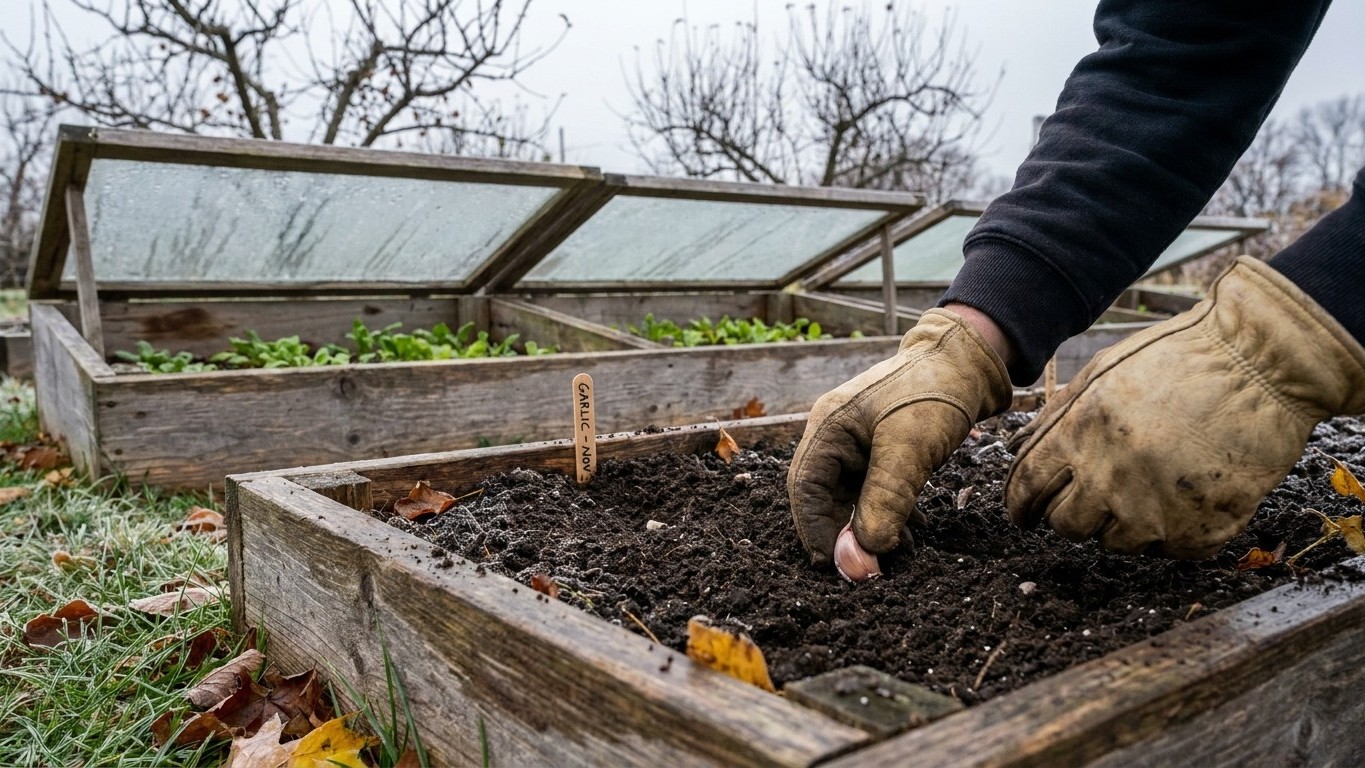

Garlic and shallots are still the main event in Delaware gardens this month, going into ground that hasn’t frozen yet. Cold frames and low tunnels keep hardy greens alive. Bare-root fruit trees and berry canes can go in while dormant. Everything else outdoors has mostly wrapped up for the season, since the state’s first fall frost lands somewhere between October 26 and November 7.
What goes in the ground in November

The calendar says November, but the soil doesn’t care what the calendar says. What decides whether something survives this month is soil temperature and where a given garden sits relative to that first fall frost window of October 26 to November 7. For most of Delaware, that window has already closed by the time November gets underway, which means the door for anything tender, and for most warm-season crops, shut weeks earlier.
Here’s the honest version: for open, unprotected ground, there isn’t much new planting left to do this month in the way people mean when they picture a spring garden. That’s not a failure of the gardener, it’s just where the season sits. What still makes sense is narrower and more specific.
Garlic and shallots top the list. Both want roughly six to eight weeks of root establishment before the ground locks up hard, and as long as the soil is still workable, and not soaked or frozen, cloves and sets can still go in. Push planting later than that and the bulbs risk heaving out over winter instead of rooting down.
Cold frames and low tunnels extend the window for a short list of cold-hardy greens: spinach, mache, and claytonia can be direct-sown under cover even after the open-ground season has ended, since the structure buys several degrees of protection and slows moisture loss.
Bare-root and dormant plantings are the other real option. Fruit trees, grapevines, and berry canes sold bare-root are typically shipped and planted while fully dormant, and cool, moist November soil suits root establishment better than a hot spring planting does. Indoors, this is also the month to force chicory roots in a dark spot for winter chicons, or to pot up a rhubarb crown for forcing near a window. Neither needs open garden soil at all.
What to start under cover
Counting backward from spring, rather than forward from today, is the only arithmetic that holds up. Delaware’s last spring frost falls between April 3 and April 14 at the reference weather station, and most seed packets tell you how many weeks before that date a given crop wants to be started. Onions from seed, for instance, typically want ten to twelve weeks of indoor growth before transplanting, which lands their start date in mid-January, not November. Tomatoes and peppers want six to eight weeks, pointing to February. Run that math for November and almost nothing spring-bound lines up yet, which is exactly why starting now would be a mistake, not a head start.
What November under cover is actually good for is different: sprouts and microgreens on a windowsill or under a grow light, which run on a ten-day cycle rather than a season, and cold-frame sowings of the same hardy greens mentioned above, timed for a late-winter harvest rather than a fall one.
The two failure modes worth naming plainly. Start spring transplants too early, in November instead of January or February, and they sit indoors for months, get rootbound in their cell trays, stretch toward whatever light they can find, and go into the ground in spring already stressed and leggy. Start too late, on the other hand, and a crop like onions never bulks up enough of a root system before it needs to face outdoor conditions, and the harvest suffers all season for it. November’s job under cover is patience: get the sprouting and the cold-frame greens going, and leave the spring seed trays in their packets for another two months.
What is ready to pick
Outdoors and unprotected, November harvests are thin. Most tender crops are already finished, cut down by the frost that arrived sometime in that late October to early November window. But a few things keep producing, and a few more keep quietly waiting.
Overwintered kale is the standout: frost actually improves its flavor, converting starches to sugars, and a plant that looked ragged in October often keeps yielding leaves through the darker months as long as it isn’t smothered by heavy, wet snow. Leeks behave the same way, standing in the ground under a layer of mulch and staying pullable well past when most root crops have been dug. Brussels sprouts follow the same frost-sweetened logic and are often better picked now than they were a month ago.
Cold frames carry the rest of the fresh-eating load: lettuce, spinach, and other quick greens sown earlier in fall keep cropping under cover long after the open beds are done. Indoors, sprouts and microgreens fill the gap entirely on their own schedule, needing no outdoor season at all.
The other job this month is checking what’s already in storage. Winter squash, potatoes, and onions all deteriorate from the inside before it shows on the outside, so it pays to go through the storage crates by hand: a squash with a soft spot near the stem, a potato that’s started to sprout, an onion that’s gone soft at the neck. Pull those out now and use them first, before they spread rot to the crops sitting next to them.
The jobs that matter this month
The garden work in November doesn’t stop just because the planting slows down. If anything, this is the month where the behind-the-scenes tasks decide how next season starts.
In the beds and orchard
Dormant pruning of fruit trees and berry canes can begin once the leaves are down and the plant has gone fully dormant, focusing on removing dead, damaged, or crossing wood rather than heavy shaping, which is better saved for deeper winter. Mulching garlic beds and any overwintering perennials with straw or shredded leaves now, while the ground is still workable, insulates roots before the hardest freezes arrive. Cleaning up spent plant debris, especially anything that showed disease or pest damage over the season, removes overwintering sites for both.
Soil, tools, and planning
Soil testing and amending pays off disproportionately this month, because materials like lime need months of contact with soil moisture to shift pH before spring planting, and fall application gets ahead of that timeline. Turning the compost pile, even just once, keeps decomposition active through the cooler weeks. Cleaning and sharpening tools before they sit unused for winter, rather than after, means they’re ready the moment spring work starts. And ordering seed now, rather than waiting until late winter, matters more than gardeners expect: popular varieties, especially newer or regionally suited ones, do sell out from catalogs before the season even turns. Sketching out next year’s crop rotation on paper, while this season’s layout is still fresh in memory, is a ten-minute job now that saves real guesswork later. Finally, walk the fencing and raised bed frames for anything that shifted or rotted over the growing season. Repairs are far easier on dry ground in November than on frozen or muddy ground in February.
What not to do in November
The most common mistake this month is misreading a warm afternoon as a season change. A stretch of 60-degree days doesn’t mean the frost risk has passed, since Delaware’s fall frost window runs from October 26 to November 7 at the reference station, and a hard freeze can still follow a mild spell with little warning. Planting anything warm-season now, on the strength of a nice afternoon, is planting for a loss.
The second mistake is the opposite instinct: pulling row covers or cold frame lids off too early because a warm day feels like relief. Hardy greens under cover are counting on that protection to buffer the next cold snap, and uncovering them even for a day during a thaw invites damage the moment temperatures drop again.
Feeding nitrogen this month is also poorly timed. Nitrogen pushes soft, leafy new growth, and that growth is exactly what frost damages fastest. Any fertilizing that needs to happen on perennials or fall-planted garlic is better done with a balanced or lower-nitrogen approach, or simply held off until active spring growth resumes.
Tender bulbs left in the ground are another classic slip. Dahlias, gladiolus, and similar bulbs that aren’t cold-hardy need to be dug and stored indoors before a hard freeze reaches them, not left in place on the assumption that mulch alone will save them.
Working wet soil rounds out the list. Tilling or turning beds while the ground is saturated compacts the structure for the whole following season, undoing a chore that was meant to help.
Checking this against your own county
Everything above is built on a single reference weather station, and Delaware is a small state but not a flat one in climate terms. Coastal Sussex County in the south tends to stay milder later into fall than inland New Castle County to the north, and low-lying spots collect cold air on clear nights in ways nearby higher ground doesn’t. A frost date built from one airport’s records is a starting point, not a guarantee for a specific backyard.
The most reliable way to adjust these windows for a particular property is to work with the University of Delaware Cooperative Extension, which tracks local conditions and planting guidance at a finer scale than a single statewide date can offer.
Common questions
Is it too late to plant garlic in November in Delaware?
Not usually, as long as the soil is still workable and hasn’t frozen solid. Garlic wants roughly six to eight weeks of root growth before hard winter sets in, so early November plantings still have time to establish before the coldest stretch arrives.
Can I still start vegetable seeds indoors in November?
Spring transplants like tomatoes, peppers, and onions are started far too early in November, since their timing counts back from the April 3 to 14 last-frost window, landing their start dates in January or February. Sprouts and microgreens, which run on a short cycle rather than a season, are the practical indoor project this month.
What USDA hardiness zone is Delaware in?
Delaware spans USDA Plant Hardiness Zones 7a to 8a, based on the USDA Plant Hardiness Zone Map, which measures average annual extreme minimum winter temperature. Where a specific property falls within that range depends on local elevation and proximity to the coast.
Do I need to cover overwintering kale and leeks in November?
A layer of straw or shredded leaf mulch helps insulate roots and moderate soil temperature swings, but both crops tolerate cold well on their own. Covering matters more as deeper winter sets in than it does in the early frost period.