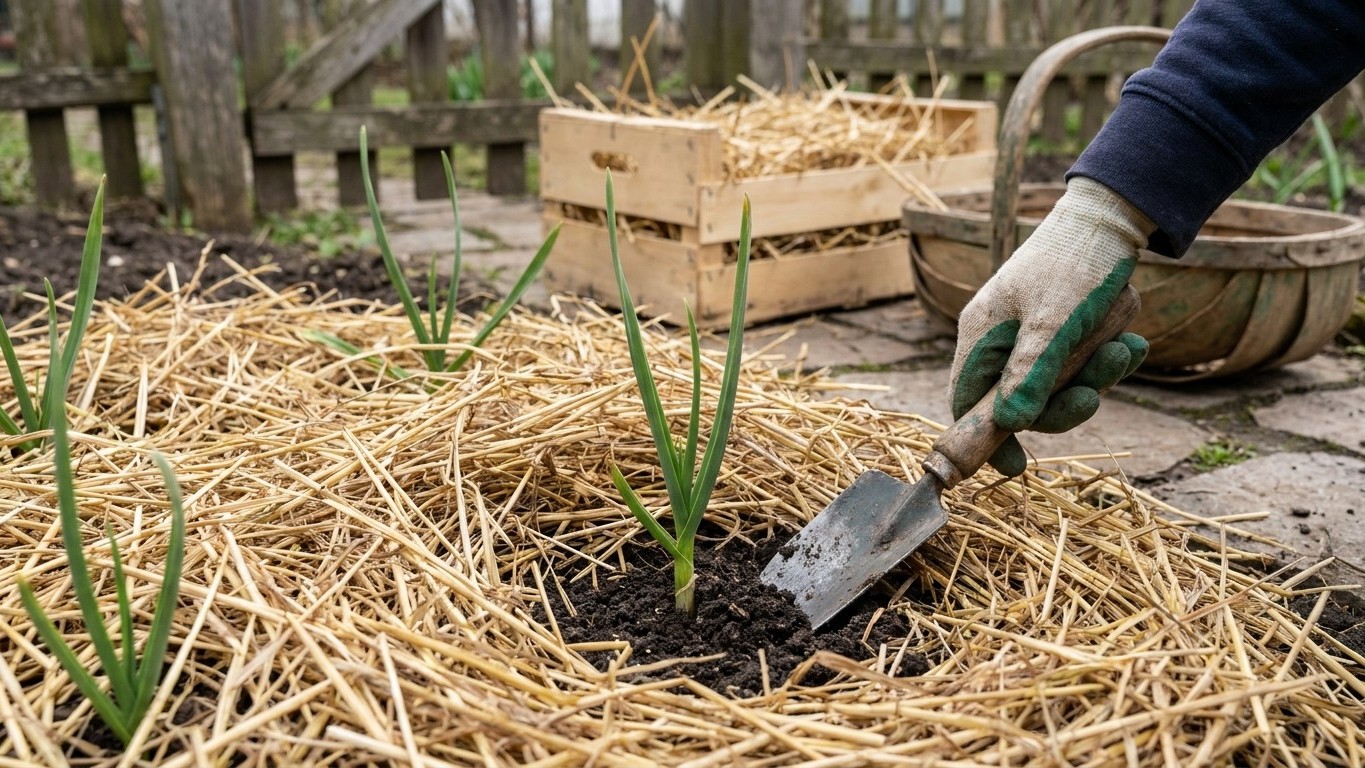

How thick should your garlic mulch be? Enough that you can’t spot bare soil between the cloves anymore, spread across the whole bed and put down once the ground has cooled in fall but before it locks up hard. Come spring, that same mulch has to move — pulled back gradually as green shoots start pressing up against it, not on a date you circled in advance. So the first thing to do is walk your bed now and check whether soil is still showing through.
Why this matters for garlic

Garlic sits in the ground for roughly nine months between planting and harvest, which means a mulching mistake made in October does not show itself until the bulbs come up in summer. Skip mulch entirely in a region with real winter cold, and repeated freeze-thaw cycles can heave cloves partway out of the soil, exposing roots that then dry out or freeze. The clove survives, but the bulb it produces is often smaller and more lopsided than it should be, and you will not know why until you are standing in the bed at harvest wondering what went wrong months earlier.
Too much mulch causes a different, quieter failure. A thick, wet mat can smother the shoot before it ever breaks the surface in spring, or it can hold enough moisture against the clove that rot sets in before the plant even gets going. Either way, the damage is invisible from the surface until you notice a gap where a plant should be. Garlic does not forgive a bad start the way a fast annual does. There is no second planting window once the season is underway, so the fall decision on mulch is the one you live with all year.
When to do it
Mulch goes down after planting, once the soil has cooled enough that active top growth has slowed or stopped for the season, but before the ground freezes solid. The exact timing shifts a great deal by region, and sources disagree on how precisely to peg it. Some growers wait for the first hard frost as their cue, reasoning that mulch applied too early can trap warmth and encourage soft, tender growth that then gets hit hard by the first real cold snap. Others mulch immediately after planting to protect against erratic early freezes and thaws, particularly in areas where winter arrives unevenly rather than settling in at once.
What both camps agree on is the goal: mulch should be in place before the ground goes into a hard, sustained freeze, not after. If you have already worked through planting depth and spacing in Growing Garlic, treat mulching as the very next step in the same sequence rather than a separate task to circle back to later. Waiting until the soil is already frozen means the mulch cannot do its main job, which is buffering the soil temperature swings that cause heaving, not insulating an already-frozen bed.
Removal is a spring decision, not a fall one, and it is driven by the plant rather than the thermometer. Pull mulch back gradually as soon as you see the first green shoots pressing up against it, checking every week or so once temperatures start trending upward. In regions with a long, cold spring, this can mean partial removal over several weeks rather than one clean pass.
How to do it
Loose, weed-free organic material works best. Straw is the most common choice because it stays airy and does not mat down into a dense layer the way grass clippings or leaves can. Chopped fall leaves and pine straw are both reasonable substitutes if you keep the layer loose rather than compacted.
Choosing a material
| Material | Cost | Weed risk | Breaks down by |
|---|---|---|---|
| Straw (not hay) | Low to moderate | Low if certified weed-free | End of season |
| Chopped leaves | Free if you have trees | Low | Slower, can carry into next year |
| Pine straw / needles | Low | Low | Very slow, adds slight acidity over time |
| Grass clippings | Free | Moderate to high | Fast, mats down if applied wet |
Note the distinction between straw and hay: hay is cut whole from a field and usually carries a load of weed and grass seed with it, which you will be pulling out of the garlic bed all spring. Straw is the stalk left after grain is threshed and carries far less seed. If a supplier cannot tell you which one you are buying, assume it is hay and treat it accordingly.
Spread the material over the whole bed, not just around individual cloves, working it in between rows as well as over the planting line. The layer should be loose enough that water still drains through it rather than pooling on top, and thick enough that you cannot see bare soil anywhere in the bed once you are done. Avoid packing it down by hand or walking on it, since compaction is what turns a breathable mulch layer into a soggy mat that holds moisture against the clove.
Keep an eye on soil moisture under the mulch through the fall, since a thick layer changes how quickly the bed dries out after rain. This connects directly to irrigation decisions covered in Watering Garlic: How Much, and the Date You Should Stop, since a well-mulched bed needs watering far less often than a bare one, and overwatering a mulched bed is one of the more common ways growers accidentally invite rot.
What goes wrong
The most common failure is mulch left on too long in spring, smothering shoots that cannot push through a mat that has settled and compacted over winter. This shows up as bare or thin patches in a bed that was fully planted, usually noticed weeks after the surrounding garlic is already up and growing. By the time you spot it, the delayed plants are already behind and often stay smaller through the rest of the season.
The opposite failure, mulch that is too thin or skipped altogether in a cold-winter region, tends to surface as heaved cloves in late winter or early spring, roots partly exposed to open air. Growers sometimes miss this because the plant often survives and keeps growing, so the real cost, a reduced bulb size at harvest, is not visible until months later when it is far too late to correct.
Rot from moisture buildup
A less obvious problem is rot caused by mulch holding too much moisture against the clove through a wet fall or a mild, damp winter. This one is nearly invisible until harvest, when a grower pulls what should be a firm bulb and finds it soft, discolored, or hollowed out at the base. Because the damage happens underground and slowly, there is rarely a clear warning sign beforehand. Checking soil drainage before mulching, and choosing a loose material over a dense one, is the main defense.
Weed pressure from hay used in place of straw is the fourth common issue, and it shows up gradually through spring as unwanted seedlings compete with garlic for light and moisture. It rarely kills the crop outright but adds hours of hand-weeding to a bed that should have needed almost none, and can attract pests that are easier to spot and manage using the guide in Garlic Pests: The Few That Matter, and What They Look Like.
How this changes across the country
Growers in states with long, cold, snow-covered winters, such as Minnesota, North Dakota, or northern New England, generally rely on mulch as real winter insurance, since freeze-thaw cycling is the main driver of heaving in those regions and a thick, well-settled layer stays in place under snow cover for months. In these areas the removal window in spring also tends to be later and more gradual, since the ground stays cold longer and shoots emerge over a more drawn-out period.
In milder regions, including much of the coastal Southeast, the Gulf Coast, and coastal California, winter cold is rarely severe enough to cause heaving, and mulch there serves a different purpose entirely: retaining soil moisture and suppressing weeds rather than insulating against deep freezes. Growers in these areas often use a thinner layer and remove it earlier, sometimes leaving it in place through much of the growing season instead of pulling it back all at once.
Because the right approach depends heavily on your regional winter pattern and your local frost timing, check with your state’s extension service or land-grant university for guidance specific to your area rather than relying on a single national rule. A practice that protects a bed in Vermont can smother one in Georgia, and the reverse is just as true.
Common questions
Do I need to mulch garlic at all if my winters are mild?
Not for frost protection, no, but a thin layer still helps hold soil moisture and keep weeds down through the growing season. In a genuinely mild climate, treat mulch as a moisture and weed tool rather than winter insurance.
Can I use the same mulch all the way through to harvest?
You can, but most growers thin it out or remove it once the weather warms and the plant is actively growing, since a heavy mulch layer left on through the wet part of spring can trap too much moisture around the bulbs. Whether to remove it fully or just thin it depends on your local rainfall pattern.
What if I already mulched too early and it’s warm again?
A brief warm spell after mulching is not usually a problem, since the mulch buffers temperature swings in both directions rather than just trapping cold. What matters more is whether the mulch is staying dry enough underneath, so check soil moisture if you get an unusually warm, wet stretch.
How do I know if my mulch is too thick versus just right?
If you cannot easily push a finger down through it to feel the soil, it is probably too dense and should be fluffed up or thinned. The goal is full soil coverage with a loose, airy structure, not a compacted mat.