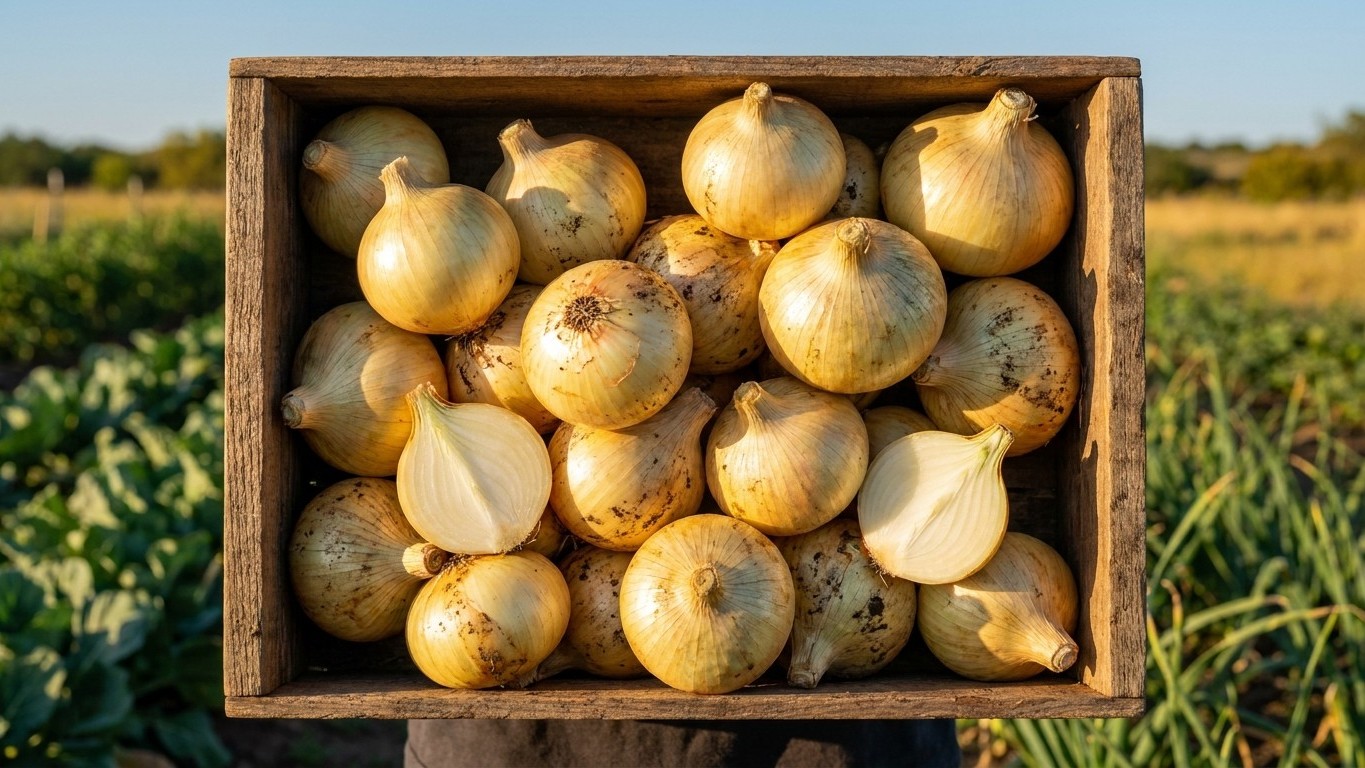

Texas 1015Y is a short-day onion built for the Deep South and the lower Southwest, bulbing reliably between 25 and 35 degrees north latitude. Its name is literally an instruction: plant it October 15 in Texas, the Y standing for yellow. Expect a mild, sweet straw-yellow globe around a pound in weight, ready 110 to 115 days after transplant, and good in the kitchen for about two to three months before it starts to soften and sprout.
Will Texas 1015Y bulb where you are

Latitude decides everything with this onion, and the mechanism behind that fact surprises a lot of gardeners the first time they hear it. An onion doesn’t bulb because the weather turns warm. It bulbs because the number of daylight hours crosses a threshold that its genetics are tuned to detect. Short-day types like Texas 1015Y respond to roughly 10 to 12 hours of daylight, a length that shows up in spring at southern latitudes but never quite arrives at northern ones before the season runs out the other way. That’s why long-day onions belong in the far north, where summer days stretch long, and short-day onions belong in the Gulf Coast states, where day length peaks lower.
The published range for Texas 1015Y is 25 to 35 degrees north latitude. Inside that band, roughly the line from the southern tip of Florida up through central Texas, the Gulf Coast, and into the lower reaches of the Southeast, the plant reads the daylight signal at the right calendar moment and puts its energy into a bulb. Outside that band, the plant does not simply make a smaller onion. It makes no bulb at all. The daylight trigger never fires, or it fires too late, and the plant keeps building leaves instead of storage tissue. Come harvest time, or worse, come storage time, what looks like a modest onion in the ground turns out to be mostly neck and no bulb, and it rots rather than cures.
A reader gardening in central Georgia, southern Louisiana, or most of Texas sits comfortably inside the range. A reader closer to the northern edge, say the Carolinas’ upper reaches or the fringe of Tennessee, is in blurred territory. The bulb may form but form small, or form late enough that the plant runs out of season before the tops mature and fall. That’s not a firm no, but it isn’t a confident yes either, and treating it as one invites disappointment. The continuum runs the other direction too: gardeners well south of 25 degrees, into deep South Florida or coastal areas further south, are also at the edge, just from the opposite side.
| Position relative to 25-35°N | What typically happens |
|---|---|
| Comfortably inside the range | Reliable bulbing on schedule |
| Near the northern or southern edge | Blurred outcome: smaller or late bulbs, inconsistent results |
| Well outside the range | No bulb forms; leaves grow, then rot in storage |
What Texas 1015Y is like
The bulb itself is a large deep globe, straw-yellow on the skin with off-white flesh inside, and it can reach up to 6 inches across when growing conditions cooperate. Catalogue figures put the typical weight around a pound, which is on the larger side for a home garden onion, and maturity lands at 110 to 115 days from transplant. That gap matters more than it looks. A gardener who counts on the earlier figure and plans a harvest around day 110 may find the necks haven’t started to fall yet, and pulling too soon leaves the bulb smaller and less cured than it should be. Planning around 115 days is the safer bet.
Flavor is where this onion earns its reputation. It’s described as very sweet and mild, with very little of the sulfur compound that makes eyes water when you slice into a storage onion. That’s genuinely pleasant raw, in a salad or on a burger, and it holds up fine sliced, grilled, or cooked into a dish where you want onion flavor without sharpness.
The trade-off is not incidental, and it’s worth understanding rather than just accepting as a rule of thumb. The same sulfur compounds responsible for a sharp, eye-watering onion are the compounds that act as a natural preservative inside the bulb, slowing the breakdown that leads to sprouting and rot. A variety bred low in those compounds for sweetness is, by the same chemistry, bred short on shelf life. Texas 1015Y keeps for 2 to 3 months, not longer, and no amount of careful curing will stretch a sweet onion’s storage life to match a pungent one. That’s a fair trade for flavor, but it’s not a keeper onion, and it shouldn’t be planted with that expectation.
In the kitchen it’s suited to:
- Fresh salads, where its low sulfur content means no lingering bite
- Raw slices on sandwiches and burgers
- Grilling, where the sugars caramelize well
- General cooking, wherever a mild onion flavor is wanted rather than a sharp one
One published disease note applies here: resistance to pink root, a soil-borne fungal disease that stunts root growth. Resistance is not immunity, and it doesn’t protect against other onion diseases or pests, but it does give this variety an edge in soils where pink root has been a recurring problem.
When to plant it
Planting season for onions is set by day-length group, and that single fact flips the calendar depending on where you garden, which trips up a lot of gardeners moving from one region’s advice to another’s. Long-day onions in the north go into the ground in late winter or early spring, timed so the plant has grown enough top growth before the long summer days trigger bulbing. Short-day onions like Texas 1015Y run on the opposite schedule. In mild-winter areas they’re planted in autumn, overwinter as small plants, and bulb up as day length increases through late winter and spring, with harvest landing in late spring.
The variety’s name spells this out directly: October 15 in Texas is the traditional planting date, and it’s not an arbitrary marker. It reflects the timing that gives the plant enough weeks of mild fall and winter growth to build a decent-sized top before the daylight trigger arrives the following spring. A gardener elsewhere in the 25-35 degree latitude band should adjust the exact date to local frost patterns, but the season stays the same: fall planting, spring bulbing, late-spring to early-summer harvest, not the late-winter planting a northern long-day grower would use.
The test that matters more than any date on a calendar is the size of the plant at the moment day length triggers bulbing. Onion bulb size is set almost entirely by how much leaf growth the plant has accumulated before that trigger fires, not by how much time is left afterward. A plant that goes into the ground too late, or struggles through a cold snap and stalls, hits the daylight trigger as a small, thin-leaved seedling and produces a small bulb no matter how well it’s tended afterward. A plant that gets in early enough to build a sturdy cluster of leaves before the trigger fires has the reserves to build a full-sized bulb once bulbing starts. That’s the real reason the October planting window matters more than it might seem: it’s not about beating the cold, it’s about banking growth before the daylight clock takes over.
Growing it well
Onions have shallow, sparse root systems, and that single fact explains most of what goes wrong in a home onion bed. A shallow root can’t reach far for water or nutrients, and it can’t out-compete weeds crowding in from the sides. Left unweeded, an onion bed doesn’t just look untidy, it produces measurably smaller bulbs, because every bit of moisture and nutrient a weed pulls from the topsoil is moisture and nutrient the onion’s thin roots never reach. The same goes for dry spells: an onion that goes thirsty during the leaf-building weeks before bulbing simply can’t recover that lost growth later, since bulb size is locked in by the plant’s size at the moment day length triggers bulbing, described above.
Bolting is the other risk worth watching for. A stressed plant, one that goes through a cold snap after it’s already sized up, or suffers a dry spell followed by a wet one, can send up a flower stalk instead of channeling energy into the bulb. A bolted onion still produces a bulb, but that bulb has already shifted its energy toward reproduction rather than storage, and it will not keep. The practical response isn’t to pull the flower stalk and hope, it’s to flag any bolting plants and pull and use them first, well ahead of the rest of the crop, rather than setting them aside for storage where they’ll be the first to spoil.
Beyond weeding and watering, the published facts here don’t include specific spacing or fertilizer figures for this variety, so it’s worth checking regional extension guidance for those details rather than guessing at numbers that aren’t confirmed for Texas 1015Y specifically.
Harvesting and keeping it
The onion tells you when it’s ready, and the signal is visual, not a date circled on a calendar. As the bulb finishes sizing up, the tops weaken at the neck and fall over on their own, usually a handful at a time rather than all at once. That collapse is the plant’s own signal that it has stopped pulling energy up from the roots and finished storing it in the bulb. Pulling before the tops fall means catching an onion that hasn’t finished bulking up, and waiting long past the fall risks the necks staying too moist heading into curing.
Curing is the step most home gardeners skip, and it’s the single biggest reason home-grown onions rot in storage within weeks instead of lasting the expected two to three months. After pulling, the bulbs need to sit somewhere warm, dry, and well ventilated, out of direct rain, until the outer skins turn papery and the necks dry down tight. A neck that’s still soft and green when the onion goes into storage is an open door for rot organisms, no matter how nice the bulb looks otherwise. This typically takes a couple of weeks, though the exact timing depends on humidity and airflow more than a fixed number of days.
Once cured, Texas 1015Y keeps for 2 to 3 months. In practical terms, that means a spring or early-summer harvest carries a household through midsummer and maybe into early fall, but it won’t stretch into winter storage the way a pungent, long-keeping onion would. That’s not a flaw so much as the flip side of the sweetness that makes this variety worth growing in the first place, and it argues for using these onions steadily through the season rather than setting them aside for later, since later is exactly when they’ll start to soften.