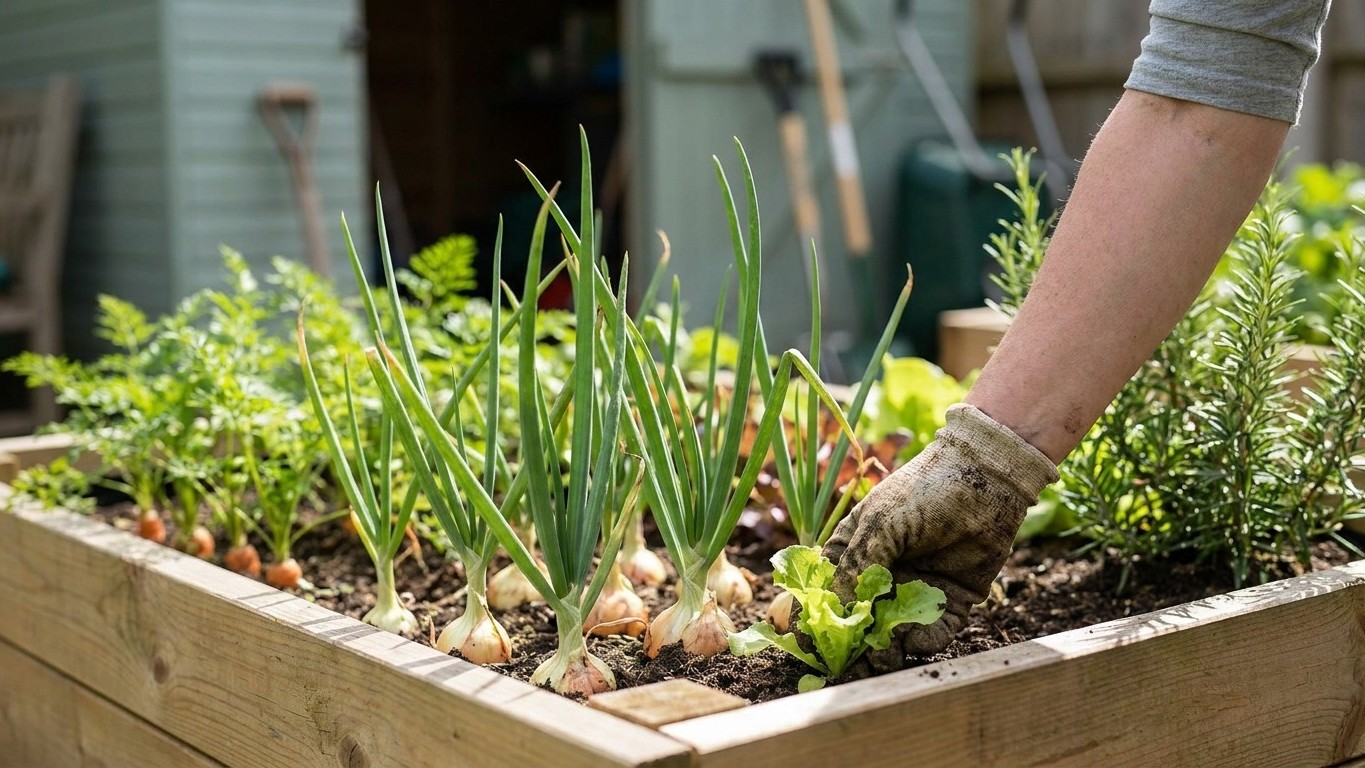

Onion roots stay shallow and sparse, and the upright leaves throw almost no shade, so the plant next to them should be quick and low, clearing out before the onion needs the room. A fast lettuce, radish, or spinach crop works well for that reason, since none of them are still standing when the onion starts to bulk up. Judge every candidate by one test: does it take the onion’s water, light, or space before harvest, and if it does, move it further down the row.
What to Plant Next to Onions
The plants that work best next to onions are the ones that ask for almost nothing while they share the bed: quick lettuces, radishes, spinach, and other greens that germinate fast and come out before the onion needs full width. Onions have shallow, sparse roots and thin, upright leaves that barely shade the row beside them, so the real question isn’t which plant “likes” an onion. It’s which plant will leave before it starts competing for water, light, or root room.
Judge by competition, not chemistry
Most of what circulates as companion planting for onions is tradition rather than measured result. The charts that pair onions with tomatoes, carrots, strawberries, or roses as if some chemical exchange happens between their roots are garden folklore passed down through generations, not the outcome of controlled trials. That doesn’t make them useless outright, but it does mean any claim that a pairing “helps” or “repels” deserves some skepticism. The one mechanism that actually holds up is competition: whether the neighbor takes resources the onion needs, or it doesn’t.
Carrots turn up in almost every companion chart paired with onions, on the theory that each crop’s scent confuses the other’s pests. That claim isn’t something you can verify in your own bed, and it isn’t the reason to plant them together or apart. What matters instead is that carrots typically need 65 to 75 days or more to size up, so they occupy the ground for nearly the onion’s whole season instead of clearing out early. That makes carrots a much closer call than a radish or a lettuce, competing for root room the entire time rather than stepping aside.
| Crop (example cultivar) | Days to maturity | Growth habit |
|---|---|---|
| Radish, ‘Cherry Belle’ | about 24 to 30 days | low, compact root, harvested young |
| Leaf lettuce, ‘Black-Seeded Simpson’ | about 45 days to a full head, sooner for baby leaf | low rosette, shallow roots |
| Spinach, ‘Bloomsdale Long Standing’ | about 45 to 50 days | low rosette, shallow roots |
Those figures come from seed packet catalogs and count from sowing, not from transplant, and they’ll run a week or two either way depending on the season. Treat them as a scheduling guide, not a due date carved in stone.
On the other end, sprawl is the failure mode to avoid. Squash, pole beans, sprawling cucumbers, and anything else that vines or bushes out will eventually reach over the row and shade the onion’s leaves. Since onion leaves are what build the rings that make the bulb, a shaded onion isn’t sick, it’s simply smaller than it would have been otherwise. The same goes for anything with a deep, thirsty root system that pulls water out of reach of the onion’s shallow one.
The other fact worth carrying into bed planning has nothing to do with neighbors at all: onions should not follow onions in the same ground the next season, because soil-borne problems build up locally when the same crop repeats in one spot. Rotate the bed even in years when nothing else grows near the onions. For a fuller look at the crop’s needs before planning what surrounds it, see onions.
How to do it

Start with the row itself. Check how wide the onion bed needs to be at full size using how far apart to plant onions, then treat everything outside that footprint as available ground for a quick neighbor. Onions don’t need the full width until the bulbs start sizing up, so the edges of the bed are open early in the season.
Steps in order
- Map the bed first. Mark where the onion rows will sit at full spacing, not where the transplants go in on day one.
- Sow the quick crop the same week as the onion sets or transplants go in, using the open ground between and around the rows.
- Thin the companion crop as it grows so it doesn’t crowd itself, let alone the onions beside it.
- Water for the onion, not the neighbor. Onions want steady, even moisture at a shallow depth. Don’t let a thirstier crop pull that moisture down and away from them.
- Harvest the quick crop as soon as it’s ready, even a few days early if the onion canopy is closing in. Every extra day it stays is a day it competes.
- Record the bed. Note where onions grew this year so next year’s onions go somewhere new, since onions should not follow onions in the same soil.
If you’re choosing an onion variety with a longer season, check its maturity window before you commit. Some types size up slowly and hold the ground far longer than others, which changes how much room you actually have for a companion crop in the first place. The onion varieties guide breaks down which types bulb early and which run long, and that timeline is what any neighbor crop has to work around.
If you’re not sure how much edge space you’ll actually have, run a trial the first year. Sow the companion crop along one section of the row and leave another section bare as a control, then compare bulb size between the two at harvest. That tells you more about your own soil, spacing, and timing than any general chart ever will. One more practical point: don’t tighten the onion’s own spacing to squeeze a companion in. If fitting a lettuce or radish planting means cramming the onion rows, skip the companion. The onion’s spacing needs come first, and a neighbor is only worth planting if it fits in space the onion wasn’t using anyway.
What goes wrong
The most common failure is simple: the neighbor crop outgrows its welcome and the onion rows underneath stay thin and pale by midsummer. If you pull back the leaves of a sprawling squash or bean planting and find onion necks that never thickened, that’s shade damage, not disease. The fix at that point is limited. Cut back or remove the offending vine right away to let light back onto the onion foliage, and accept that the bulbs on that side of the row will finish smaller than the rest. There’s no way to recover ring growth once the leaf was shaded during the weeks it mattered most.
Recognizing the failures
- Stunted, pale onion tops next to a taller crop: shade competition. Remove or cut back the taller plant now, don’t wait for harvest.
- Wilted onion foliage in dry spells when a deep-rooted neighbor is nearby: water competition. Water the onion row directly rather than relying on a shared soaking.
- A quick crop left too long, bolting or overgrown, shading the row it was supposed to clear: harvest it immediately, even past its prime, to free the space back up.
- A patchy, uneven onion stand right after germination: the companion crop was sown too close and crowded the sets before either was established. Thin the companion harder and give the onion row priority.
A second failure shows up at the start of the next season rather than this one: onions planted in the same bed as last year’s onion crop, without rotation, run into soil-borne problems that build up in that ground over time. If that mistake has already been made and the bed is planted, there’s no in-season fix, only watching for trouble and making sure the bed moves next year. Keep a simple written plan of what grew where for the next few seasons, since that’s the real defense against repeating the same ground too soon.
Finally, don’t mistake a slow-bulbing variety for a competition problem. Some onion types simply take longer to size up regardless of what’s planted nearby, and pulling a companion crop early won’t speed that along. If the bulbs are small but even across the whole row, check the variety’s expected maturity window before blaming whatever was growing beside it.