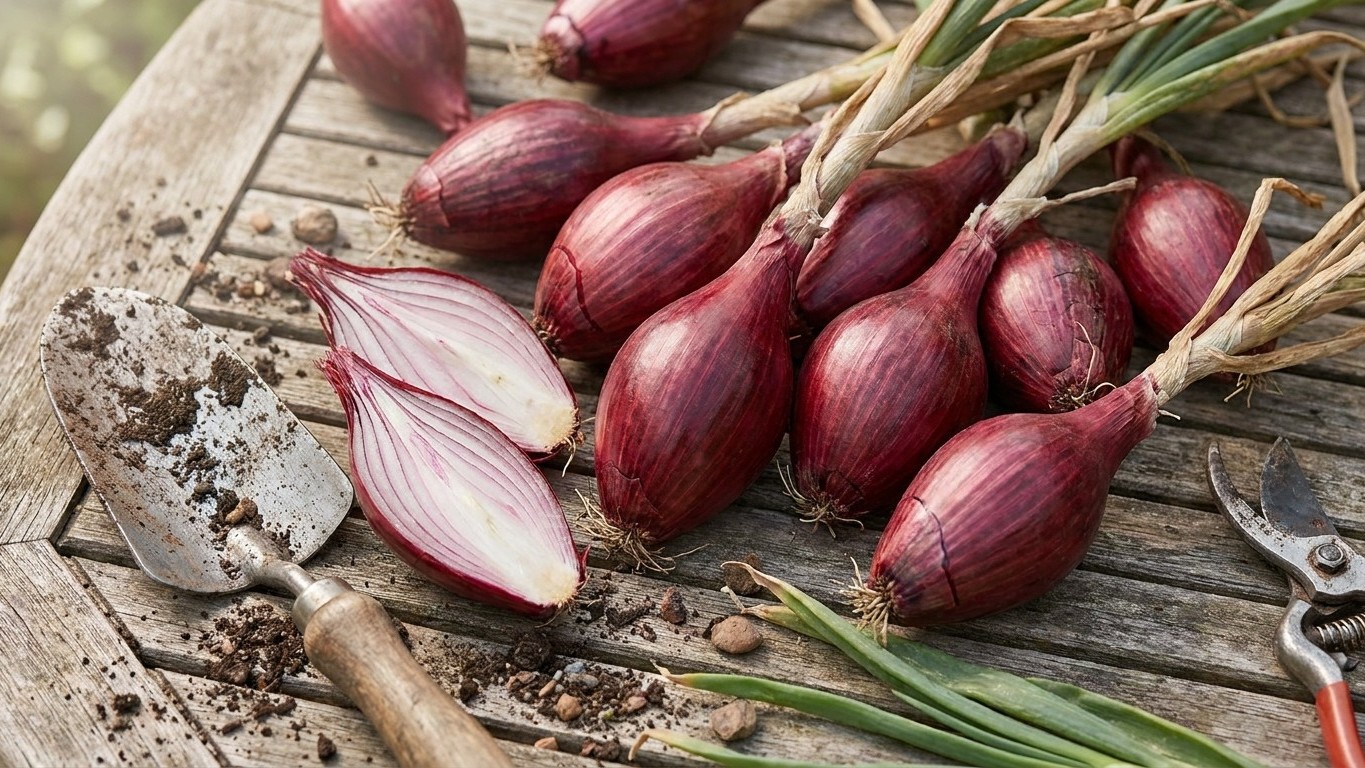

Red Long of Florence is an intermediate-day onion, which means it bulbs reliably between about 38 and 50 degrees north latitude. Below that range it may never form a real bulb at all. Above it, results grow unpredictable. Once it does bulb, expect a red, elongated onion ready in 90 days from transplant, sweet enough to eat raw, but built to last only about a month in storage. That single fact should shape how you plant, when you harvest, and how fast you use it up.
Will Red Long of Florence bulb where you are

Start here, because nothing else in this guide matters if the plant cannot do the one thing it’s grown for. Red Long of Florence belongs to the intermediate-day group, and it bulbs correctly between 38 and 50 degrees north latitude. That band runs roughly from northern California and the mid-Atlantic states up through the Great Lakes and into southern Canada. Inside it, the plant reads the summer daylight correctly and switches from growing leaves to swelling a bulb. Outside it, something else happens, and it is not a smaller onion.
Onions do not bulb because the weather turns warm. They bulb because of how many hours of daylight the plant is exposed to each day, a switch triggered by photoperiod rather than temperature. This runs against most gardeners’ instincts, since warmth is what pushes nearly every other vegetable along. An onion planted far south of its day-length range will keep pushing out leaves right through the season a northern gardener would be pulling bulbs in, because the days there never stretch long enough to flip the switch. Planted far north of its range, the opposite problem shows up: the plant may try to bulb too early, before it has built enough leaf mass to size up properly.
Reading your own latitude
A gardener in Virginia, Kansas, or coastal Oregon sits comfortably inside the 38-to-50-degree band and can expect this onion to behave as described. A gardener in Georgia or south Texas sits well below it, and should expect thin necks, minimal bulbing, and rot in storage rather than onions worth keeping. Near either edge, treat the range as a gradient rather than a hard line. A garden at 36 or 37 degrees north might bulb in a warm, long-day summer and fail the next year under different conditions. That is the blurred zone, and it deserves an honest “it depends” rather than a confident yes or no.
What Red Long of Florence is like
Once conditions are right, this variety gives a distinctive onion: red-skinned, long rather than round, and ready to pull about 90 days after transplanting. The catalogue traits are worth knowing before you commit a row to it, since they decide how it fits your kitchen more than how it grows in the ground.
- Color: Red
- Days to maturity from transplant: 90
- Flavor: On the sweet side, with relatively few sulfur compounds
That sweetness is the part most gardeners notice first, and it’s also the part that comes with a trade-off nobody warns them about. The pungency of a sharp onion and its ability to sit in a pantry for months are not two separate traits. They are the same trait, seen from two angles. The sulfur compounds responsible for a strong bite are the same compounds that discourage decay organisms and slow moisture loss once the bulb is cured. Breed the sulfur down for a milder, sweeter onion, and the storage life comes down with it. There’s no way around that chemistry, and no variety, however well grown, escapes it.
That is why Red Long of Florence is best treated as a season onion rather than a pantry onion. It keeps for about a month, which is plenty of time to work it into salads, quick pickles, and grilled dishes while it’s at its best, but it is not the onion to count on for January soups. Growers chasing a red onion that both eats sweet and stores through winter are asking for something that doesn’t exist in a single bulb. Grow this one for the plate, not the root cellar.
When to plant it
Planting time for onions follows the day-length group, not a fixed calendar date, and that catches a lot of first-time growers off guard. Short-day onions go into the ground in autumn across mild-winter regions of the South and are harvested the following late spring. Long-day onions go in during late winter or early spring across the northern tier, where summer daylight stretches long enough to trigger bulbing later in the season. Red Long of Florence, sitting in the intermediate-day group, follows the pattern used across most of the temperate United States: transplants or sets go in during early to mid spring, once the soil can be worked and hard freezes have passed.
Size at the moment of the switch
The exact planting date matters less than a condition the plant needs to meet before day length flips its bulbing switch. Whatever leaf growth the plant has built up at that moment is roughly what determines final bulb size, because the bulb is largely made from stored sugars produced by the leaves. A transplant that’s still small and stunted when the days grow long enough will bulb anyway, since the trigger is daylight, not size, but the bulb it produces will be small and disappointing. That’s the practical reason to get onions in early and keep them growing steadily rather than planting late and hoping they catch up.
Gardeners near the northern or southern edge of the 38-to-50-degree range should pay closer attention to this timing than gardeners in the middle of it. A late start in a marginal zone leaves less margin for the plant to build size before the switch flips, and less margin means a smaller harvest even in a year when the onion does bulb successfully.
Growing it well
Onions have a shallow, sparse root system, and they compete poorly against weeds and neighboring plants for both water and nutrients. That’s not a minor inconvenience; it shows up directly in the size of the bulb at harvest. A bed left weedy for even a few weeks in early summer, right as the plant is building the leaf mass that will later become the bulb, tends to produce onions that stay noticeably undersized compared to a clean, consistently watered bed. Keep the row weeded through the season, and keep the soil evenly moist rather than letting it swing between dry and soaked.
Watch for bolting
A stretch of unusually cold weather early in the season, or a plant that’s simply stressed, can trigger bolting, where the onion sends up a flower stalk instead of putting all its energy into the bulb. A bolted plant still forms a bulb of sorts, but that bulb has already redirected resources into the flower stalk and will not keep in storage the way an unbolted one would. It’s still perfectly edible. The practical move is to spot bolted plants as soon as the flower stalk appears, pull them first, and use them right away rather than setting them aside for later, since “later” isn’t really an option for a bulb that’s already started to break down internally.
Beyond weeding, watering, and watching for bolt-ers, this variety doesn’t ask for anything unusual. It grows the way most onions grow: steady moisture, clear competition, and a full season of undisturbed leaf growth before the bulb starts to swell.
Harvesting and keeping it
The signal that Red Long of Florence is ready has nothing to do with the calendar and everything to do with the plant itself. When roughly half the tops in a row have fallen over on their own, the bulbs beneath them have stopped growing and started to mature. That’s the cue to begin harvest, not a date circled 90 days after transplant, even though 90 days is a useful ballpark for planning around.
What happens after the tops fall over decides whether the harvest actually gets used or ends up soft and moldy within a couple of weeks. Curing is the step most home gardeners skip, and it’s the single biggest reason home-grown onions rot faster than the ones sold in a grocery store.
- Watch the rows until roughly half the tops have fallen over naturally, without help.
- Pull the bulbs gently, keeping the tops and roots attached rather than trimming them off right away.
- Spread the bulbs in a single layer somewhere warm, dry, and out of direct sun, with good airflow around each one.
- Let them cure for one to two weeks, until the outer skins are dry and the necks feel papery rather than moist or fleshy.
- Trim the roots and tops once cured, then move the bulbs into storage in a cool, dry, well-ventilated spot.
Given the roughly one-month keeping time for this variety, storage is really just a short bridge, not a long-term pantry solution. An onion that keeps six months carries a household through winter and into spring, but this one is meant to be eaten in season, not stockpiled. Plan meals around it soon after curing rather than tucking it away and forgetting about it, since the sweetness that makes it good eating is exactly what limits how long it will wait for you.