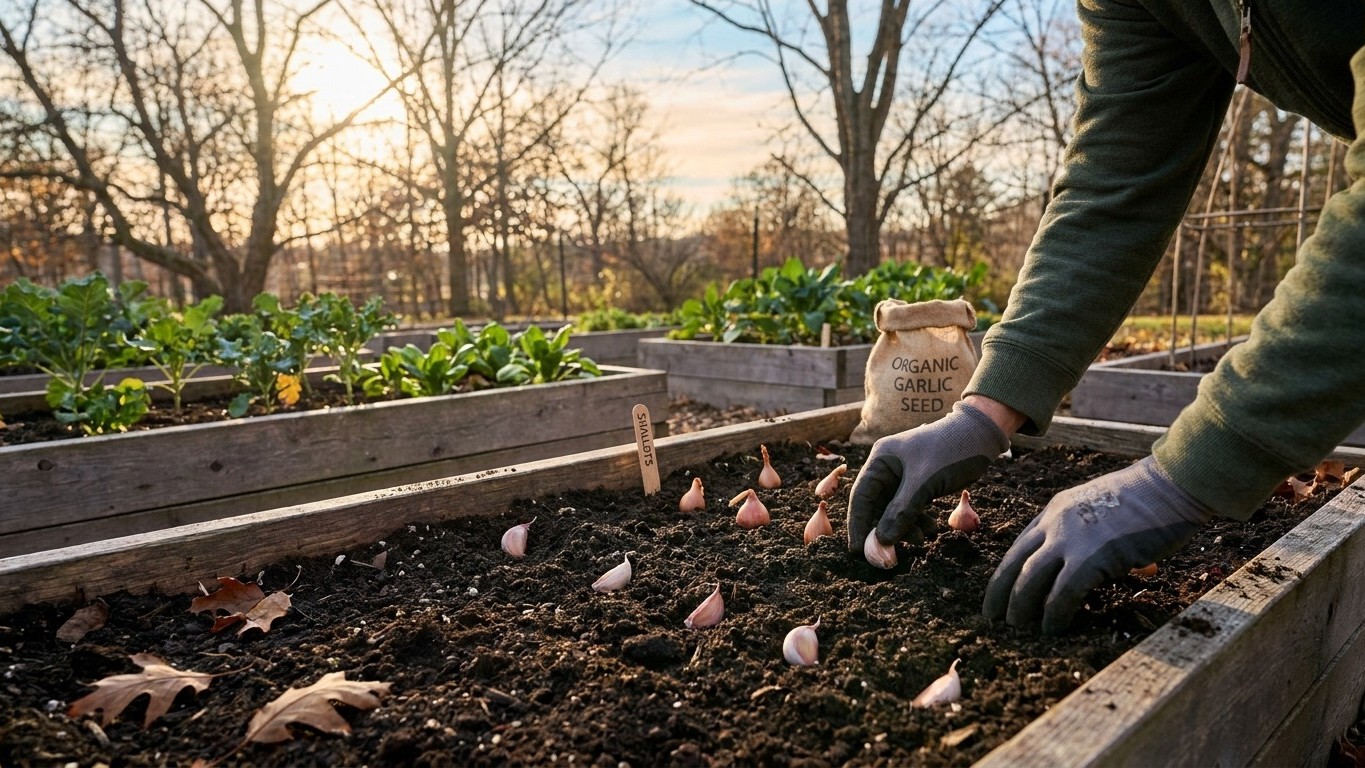

November in Georgia still has open-ground planting days ahead of it. Direct-sow garlic, shallots, hardy greens and English peas; set out short-day onion transplants in the southern half of the state; and get cover crops into any bed sitting empty through winter. The first fall freeze at the Atlanta reference station lands somewhere between November 13 and December 1, so much of the month is pre-frost work, not post-frost cleanup. What’s safe to plant depends on where in Georgia you’re standing.
What goes in the ground in November

The decision this month isn’t the calendar, it’s soil temperature and how close you are to that first freeze window. Georgia spans USDA hardiness zones 6a through 9b, according to the USDA Plant Hardiness Zone Map, and that range matters more in November than in almost any other month, because a gardener in the north Georgia mountains is already past a hard frost while someone on the coastal plain may not see one for weeks. The Atlanta reference station puts the first fall freeze between November 13 and December 1, but that number comes from an urban airport site that runs warmer than the surrounding countryside, so treat it as a midpoint, not a border.
Direct-sow candidates
Where the ground is still workable and frost hasn’t settled in, these crops handle a light freeze without much drama:
- Garlic cloves and shallot sets, pushed into loosened, well-drained soil
- Spinach, lettuce and mustard greens for a fast, cold-tolerant crop
- Kale, collards and turnip greens, all of which sweeten after a freeze
- Radishes, for a harvest in as little as three to four weeks
- English peas and snow peas in the milder parts of the state
Onions, cover crops and bare-root planting
South Georgia growers have long used November and early December to set out short-day onion transplants, timing the planting so bulbs form before the heat of late spring pushes them to flower instead of size up. Cover crops belong in every bed that’s finished for the season: crimson clover, cereal rye and winter wheat all germinate in cool soil and hold the ground against erosion until spring turn-under. It’s also bare-root season for asparagus crowns, strawberry crowns and dormant fruit trees or cane fruit, since the plant isn’t actively growing and transplant shock is lower. None of this replaces checking your own ground first. A bed that’s still 60°F and draining well can take garlic today; a waterlogged clay bed after a cold rain needs another week regardless of what the calendar says.
What to start under cover
The useful math here runs backward from the last spring frost, not forward from today. NOAA’s climate normals put that last frost at the Atlanta reference station between March 11 and March 29. Onions and leeks started from seed indoors need roughly 10 to 12 weeks before they’re ready to go out as transplants, and gardeners typically move them outdoors four to six weeks ahead of the last frost date, while they’re still small and cold-hardy. Working that backward lands the seed-starting window for these crops squarely in November, which is why seed catalogs push onion and leek starts this month even though spring feels distant.
Cold frames and unheated low tunnels are the other piece of “under cover” this month. Sowing lettuce, spinach and Asian greens into a frame now sets up a harvest through the coldest stretch, since the cover buys several degrees of frost protection and cuts wind that would otherwise shred tender leaves.
The two ways this goes wrong are opposite failures. Start onion or leek seed too early and you’re nursing tall, rootbound seedlings in small cells for months, with weak stems that flop when finally transplanted. Start too late and the plants are still pencil-thin when the safe outdoor window opens, so they lose ground they never make up. Marking the sowing date on a calendar counted back from your own local last-frost range, rather than a fixed date, keeps both mistakes off the table.
What is ready to pick
Georgia’s pecan harvest runs through fall into November, and it’s one of the more satisfying jobs of the season since the state grows more pecans than any other in the country. Nuts are ready when the shucks split and the pecans drop on their own with a light shake of the branch; picking too early means soft, underfilled kernels.
In the garden
Fall-planted collards, kale, turnip greens and mustard are usually big enough to start cutting, and a light frost only improves their flavor by converting starches to sugar. Lettuce and radishes sown in September or early October should be finishing up. Late peppers and eggplant, if they’ve dodged frost so far, are worth a final picking before the first freeze settles the question for good. Cabbage and broccoli planted for a fall crop are heading up in many parts of the state.
What’s in storage
Sweet potatoes harvested earlier in fall should be through their curing period and ready to check for soft spots or shriveling. Winter squash and stored onions deserve the same look: firm skin and no give under light thumb pressure means they’re good; anything soft, weeping or sprouting should come out before it spreads rot to the rest of the bin.
The jobs that matter this month
Georgia gardens don’t shut down in November, they shift into a different kind of work, and skipping it costs real ground come spring.
Soil, mulch and protection
Mulch beds heavily once cooler weather sets in, both to insulate roots and to suppress the winter weeds that get a head start in the state’s mild climate. In south Georgia, satsuma and other cold-sensitive citrus plantings need a plan for covering on freeze nights, since a hard freeze without protection can kill wood, not just fruit. Pull soil samples now and send them to your local extension office; results come back in time to amend beds before the ground freezes solid further north or before spring planting begins in the south.
Pruning, planning and cleanup
Hold off on pruning fruit trees until they’re fully dormant, usually after several hard frosts, since cutting too early can push new growth that a later freeze kills. Order seed for spring now, particularly for popular varieties that sell out over winter. Turn compost piles before cold weather slows the microbes down, clean and sharpen pruners and hoes before they sit unused, and walk the fence line and raised bed frames for repairs while the garden is quiet enough to notice them. Rake and shred fallen leaves into the compost pile or straight onto beds as mulch rather than bagging them for the curb.
What not to do in November
The most common mistake is trusting a warm afternoon over the soil thermometer. A stretch of 70-degree days doesn’t mean it’s safe to set out tomatoes or peppers; the ground several inches down cools far more slowly than the air, and a warm-season transplant put in now sits in cold soil it can’t use, then dies at the first freeze anyway. Wait for spring, not for a warm spell.
Uncovering cold frames or pulling row cover after a few mild days is the second trap. South Georgia and the coastal plain especially see swings where a 65-degree afternoon is followed within a week by a hard freeze, and greens that were hardened off under cover get caught exposed. Leave protection in place through the freeze window rather than reacting to a single warm forecast.
Feeding nitrogen late in fall is the third classic error. High-nitrogen fertilizer pushes soft new growth right when the plant should be hardening off for winter, and that tender growth is exactly what a freeze kills first. If a bed needs feeding this month, a balanced or lower-nitrogen application, or simply compost, does less harm than a nitrogen boost timed wrong.
Checking this against your own county
A state-wide answer for a state that runs from zone 6a in the mountains to 9b on the coast is a starting point, not an instruction. Elevation in north Georgia pushes frost weeks earlier than the Atlanta reference date; the coastal plain and far south Georgia run milder and later. The table below gives a rough sense of how that split plays out.
| Region | General zone band within the state’s 6a-9b range | Fall frost timing relative to the Atlanta reference window |
|---|---|---|
| North Georgia mountains | Toward the cooler end, 6a-7b | Typically earlier than the Nov 13-Dec 1 window |
| Piedmont / Atlanta area | Middle of the range, around 7b-8a | Matches the stated Nov 13-Dec 1 window, with urban heat-island effect |
| Coastal plain / south Georgia | Toward the warmer end, 8b-9b | Typically later than the Nov 13-Dec 1 window |
For a planting calendar tuned to your county, the University of Georgia Cooperative Extension is the source to check before finalizing any November planting.
Common questions
Is it too late to plant garlic in Georgia in November?
No. Garlic cloves generally go into the ground in fall for a summer harvest, and November is well within that window for most of the state, particularly where the ground hasn’t frozen or turned to mud.
Can I still plant grass seed in November in Georgia?
Cool-season grasses like fescue can still be seeded early in the month in many parts of the state, but warm-season lawns are dormant and shouldn’t be seeded until spring; check soil temperature before committing seed to the ground.
Will a light frost kill my fall greens?
Kale, collards, turnip greens and spinach tolerate a light frost well and often taste better afterward; tender crops like lettuce and late peppers are more vulnerable and benefit from row cover on freeze nights.
Should I prune fruit trees in November?
Wait until the tree is fully dormant, usually after several hard frosts have passed, rather than pruning on the first cool day; cutting too early can trigger new growth that a later freeze damages.
Gardeners who plant by the Moon can check the November 2026 moon planting calendar, a tradition rather than a proven method.
Related guides
Elsewhere? See what to plant in November in every state and province.