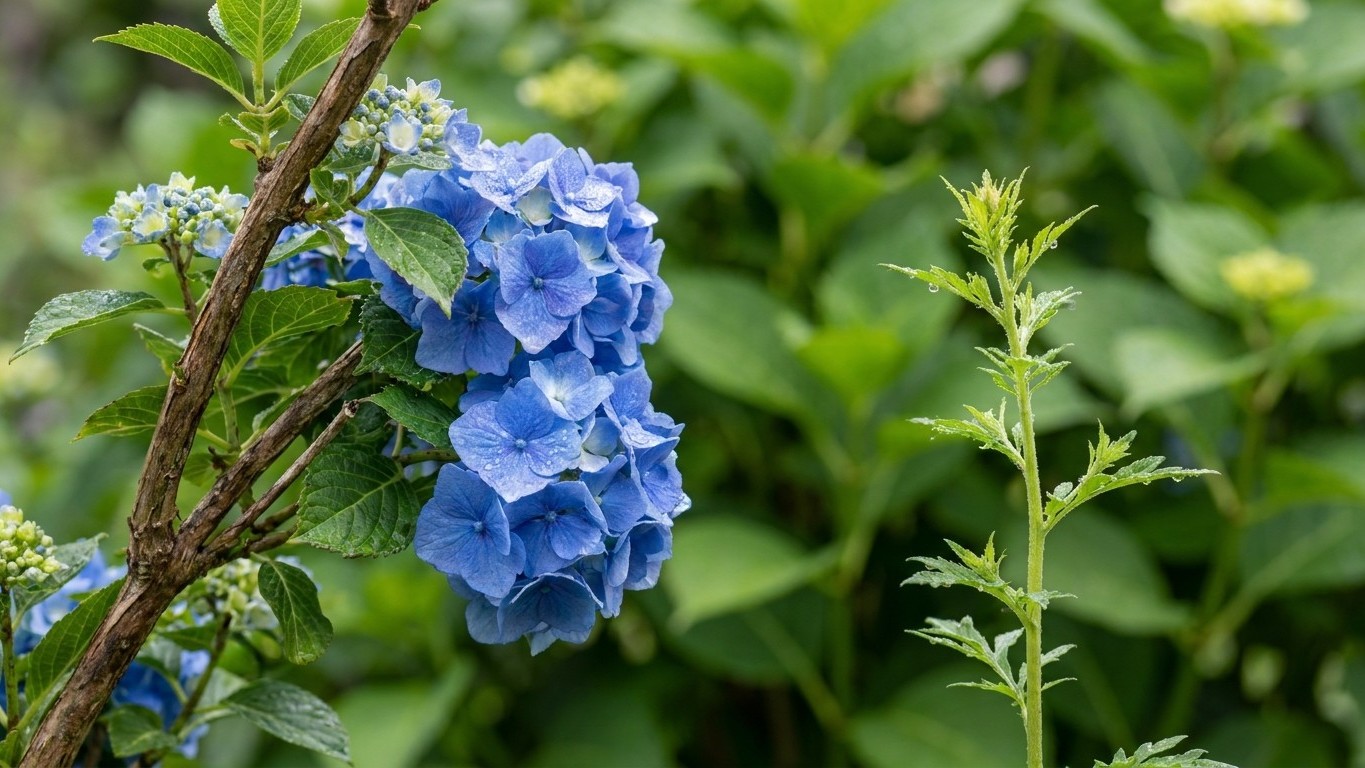

Hydrangeas turn pink in Georgia when the soil keeps aluminum out of the plant’s reach, and that happens more often than the state’s red clay would suggest. Bigleaf hydrangeas build blue pigment only when roots can absorb aluminum, which takes acidic soil that is low in phosphorus. Lime near foundations, old lawn treatments and phosphorus-heavy fertilizer all push the color toward pink. The fix works only on certain species and usually takes a full growing season.
What this comes down to in Georgia
Pink hydrangeas in Georgia are a soil-chemistry problem with a calendar attached: the plant takes up aluminum only while it is actively growing, and at Atlanta, the reference city for every date in this article, that season runs from a last spring frost of March 11 to March 29 to a first fall frost of November 13 to December 1. Inside that stretch you can steer the color. Outside it, the plant is mostly waiting.
Why red clay still gives you pink
Native Piedmont clay is typically acidic, so blue should be the default across much of the state. Yet pink shows up constantly, because a suburban yard is not native soil. Builders bring in fill and grade subsoil to the surface. Concrete footings and mortar leach lime into the bed beside them. Decades of lawn liming drift into the planting beds. Irrigation water from some sources adds alkalinity every time you run the hose.
Fertilizer is the other half of the story. The middle number on a fertilizer bag is phosphorus, and in the soil it binds with aluminum and ties it up. A gardener who feeds hydrangeas with a high-phosphorus blend, or who shares a bed with a heavily fertilized lawn, can get pink flowers in soil that would otherwise grow blue ones.
Which hydrangeas can change at all
Only bigleaf hydrangeas (Hydrangea macrophylla) and their close relative the mountain hydrangea (Hydrangea serrata) respond to soil chemistry. Oakleaf, smooth and panicle hydrangeas will not turn blue no matter what you pour on them. White bigleaf cultivars stay white. And when a white panicle bloom blushes pink in late summer, that is the flower aging, not your soil. Check which type you own before buying a single bag of amendment. The growing hydrangeas in Georgia guide covers how to tell them apart.
Working it out for your own garden
A recipe that says “add aluminum sulfate in spring” fails the first time your soil, your water or your weather differs from the author’s. The method below survives a move or an odd year.
Start with a number, not a guess
A soil test gives you a pH reading, and pH decides the color. Blue flowers generally need a pH at about 5.5 or lower. Pink is favored at roughly 6.5 and above, and the range between tends to produce purple or a mix of both on the same shrub. Your county University of Georgia Extension office can send a sample to the state lab. Ask for the phosphorus reading as well, since high phosphorus is a quiet cause of pink.
One detail changes your expectations. The pH scale is logarithmic, so each whole unit is a tenfold change in acidity. Moving a bed from 6.5 to 5.5 is a bigger job than it sounds.
Do the timing arithmetic
Treat the growing season as your working window. At Atlanta, the last spring frost ends somewhere between March 11 and March 29, and the first fall frost arrives between November 13 and December 1. Start once the spring window has passed and new growth is moving. Counting from late March to the start of the fall window leaves roughly seven months of active growth, a range rather than a fixed span, since both ends shift from year to year.
Take a first example. Your test reads about 6.5 and phosphorus is moderate. You switch to a low-phosphorus fertilizer, apply aluminum sulfate or elemental sulfur according to the label, and repeat as the label allows through the season. Sulfur works slowly because soil microbes have to convert it, and they work faster in warm soil. Seven months is enough to pull the pH down and see a partial shift. Expect the first convincing blue in the following summer’s bloom.
Now a case that does not finish in one season. The shrub sits against a concrete foundation and the test reads near neutral. Every rain washes fresh lime out of the concrete, undoing your work as fast as you apply it. A full season of treatment may only nudge flowers from pink toward lavender. Here the honest answer is a large container with acidic potting mix, or a bed moved away from the wall.
What changes across the state
Atlanta is an urban airport heat island, so its frost dates run milder than the countryside around it. North Georgia and the mountains freeze several weeks earlier in fall, which shortens the window for treatment. The coastal plain runs milder and gives you more time. The USDA Plant Hardiness Zone Map spans 6a to 9b across the state, a range built on average annual extreme minimum temperature alone, so a single zone number says little about your yard.
Soil matters as much as climate, and it varies in a predictable way.
| Region | Soil tendency | What it means for color |
|---|---|---|
| North Georgia mountains | Acidic, often rich in organic matter | Blue comes easily; the shorter season matters more than the chemistry |
| Piedmont (Atlanta area) | Acidic red clay, heavily altered by construction and lawn care | Pink mostly comes from lime and phosphorus you added, not from native soil |
| Ridge and Valley, northwest | Limestone-influenced | Pink is the natural default; blue takes sustained effort |
| Coastal plain | Sandy, and in places shell-influenced | Amendments act quickly in both directions, so retest often |
Sandy soils deserve a separate note. They hold little buffering capacity, so a dose of sulfur can swing pH fast, and the effect can fade just as fast. Clay holds on to its chemistry and changes slowly, which is a headache going in and a blessing once you are there.
The mistakes this state punishes
Buying aluminum sulfate before testing the soil tops the list. Overdoing it can burn roots and push pH lower than the plant tolerates. Applying it to a bed that was already acidic changes nothing except your budget, and in that case the culprit is almost always phosphorus.
Feeding with a high-phosphorus fertilizer comes second. Bloom-booster formulas are the usual offenders. Choose a blend with a low middle number and leave bone meal out of hydrangea beds.
Third, treating the wrong plant. A panicle or oakleaf hydrangea will not respond, and gardeners often spend two seasons finding that out.
Fourth, trusting an early warm spell. Georgia can send a week of mild weather in early March, then a freeze inside the last-frost window of March 11 to March 29. Buds pushed out early get damaged, and no soil treatment brings them back. Wait for the window to pass before starting amendments or heavy feeding, and keep frost cloth handy until then.
Fifth, late-season feeding. Pushing tender growth in fall, as the November 13 to December 1 window approaches, sets up new shoots for cold damage. The same goes for pruning at the wrong time, which can remove the flower buds that carry color. See When to Prune Hydrangeas in Georgia and Protecting Hydrangeas Through a Georgia Winter for the timing that protects those buds.
Checking this against your county
The frost window here comes from Atlanta, and a state-wide figure is only a starting point. Your own yard may sit weeks off it, and your own soil may differ from your neighbor’s across the fence. Your county Extension office can run the pH test and tell you what is typical for local soils. The growing hydrangeas in Georgia guide covers the rest of hydrangea care, including siting, watering and variety choice.
Common questions
Will every hydrangea in my yard turn blue if I acidify the soil?
No. Only bigleaf and mountain hydrangeas respond to soil pH. Oakleaf, smooth and panicle types ignore it, and white cultivars stay white.
How long does it take to see blue flowers?
Plan on a full growing season at minimum. In Atlanta that means the stretch between the March 11 to March 29 last-frost window and the November 13 to December 1 first-frost window. The first clearly blue blooms often show up the summer after you start, and stubborn, lime-rich soils can take longer.
Is aluminum sulfate the only way to get blue flowers?
No. Elemental sulfur lowers pH more slowly and gently. A low-phosphorus fertilizer and acidic mulch help too. For a single plant in a bad spot, a container of acidic potting mix is often the simplest route.
Can I turn a blue hydrangea back to pink?
Yes, though it takes the same patience in reverse. Raising pH with garden lime and cutting back on aluminum-rich amendments pushes flowers toward pink. Test first so you do not overshoot, since too much lime can cause its own nutrient problems.