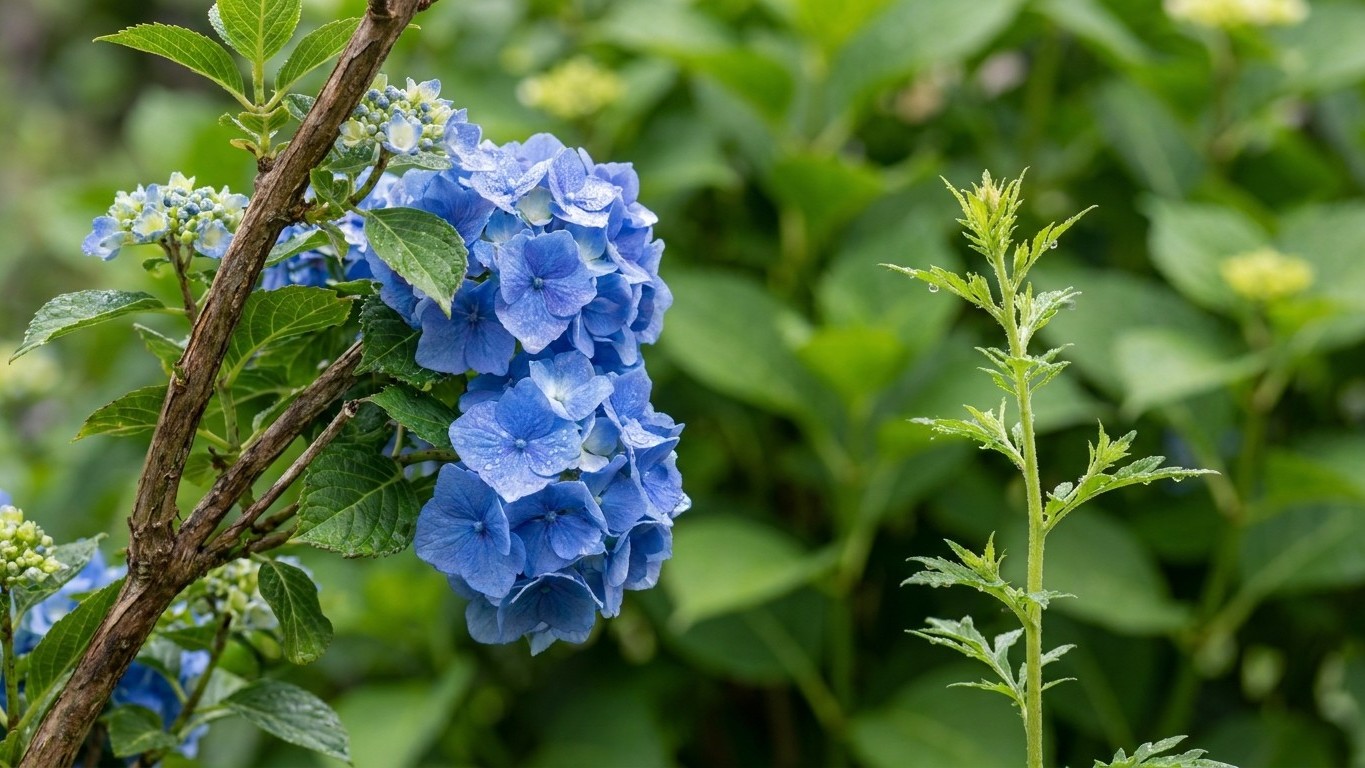

Prune hydrangeas in Georgia by the wood that carries the flowers, not by the calendar. Bigleaf, mountain and oakleaf types bloom on stems grown the year before, so they get trimmed right after flowering in summer. Panicle and smooth types bloom on stems grown this spring, so they get cut in late winter. Nearly every pruning disaster comes from swapping the two groups, and Georgia’s early springs and warm February spells make the swap easy.
What this comes down to in Georgia
In Atlanta, the reference city for the frost figures here, the last spring freeze falls between March 11 and March 29, and the first fall freeze between November 13 and December 1 (NOAA NCEI Climate Normals, the 30 to 70 percent probability band for a 32 F freeze). Late-winter pruning of new-wood hydrangeas has to finish before that spring window closes, and summer pruning of old-wood hydrangeas has to finish long before the fall one opens.
The reason is bud timing. Old-wood hydrangeas set next year’s flower buds in late summer and carry them, fully formed, through winter. Cut those stems in January and you are throwing away the entire summer’s bloom. New-wood hydrangeas build their flower buds on fresh shoots after spring growth starts, so a winter cut only decides where that growth begins.
| Type | Blooms on | Best pruning time in Georgia |
|---|---|---|
| Bigleaf and mountain | Old wood (reblooming cultivars also on new wood) | Right after the first flush fades, in summer |
| Oakleaf | Old wood | Right after flowering, and only lightly |
| Panicle | New wood | Late winter, before buds break |
| Smooth | New wood | Late winter, before buds break |
Old-wood types: after the flowers fade
Bigleaf, mountain and oakleaf hydrangeas want a light hand. Snip off spent blooms, take out stems that died over winter, and thin one or two of the oldest canes at the base if the shrub is crowding itself. Do it in summer, soon after the flowers go, because the buds for next year begin forming as the season turns. Reblooming bigleafs, the Endless Summer type being the best known, flower on both old and new wood, which makes them forgiving but not immune to a February buzz cut.
New-wood types: late winter, ahead of leaf-out
Panicle hydrangeas (Limelight is the familiar example) and smooth hydrangeas (Annabelle) are the ones you can prune boldly. Both are cut while dormant, after the deepest cold and before buds swell. For the Atlanta window, that means roughly mid-February into mid-March. If you are still sorting out which types do well where you live, Which Hydrangeas Survive a Georgia Winter covers the cold-hardiness side.
Working it out for your own garden
A date copied from a neighbor works until you move forty miles north. A method works anywhere, and for hydrangeas it has two steps: identify the wood, then anchor the timing to your own frost window or bloom time.
Start with the new-wood group. Take the last spring frost window, March 11 to March 29 in Atlanta, and count backward two to four weeks. March 11 minus four weeks lands in the middle of February; March 29 minus two weeks lands in the middle of March. The answer is a range, not a day: roughly mid-February to mid-March. Within that range, lean earlier in a mild winter and later when February has been hard, because the goal is to cut after the worst cold and before sap starts to move.
Now work one plant end to end. A panicle hydrangea in an Atlanta yard gets cut in that range, and it is fine: new shoots emerge, flower buds form on them, and a frost in late March only nips growth that is still small. Take a bigleaf hydrangea in the same yard and apply the same schedule. It does not survive the arithmetic. Its flower buds were set the previous fall and are sitting on the stems you just removed, so the shrub grows back healthy and green with no blooms at all.
For old-wood plants, anchor to bloom instead of frost. Prune within a few weeks after the flush ends, and treat early August as the outer edge. The later you wait, the more likely you are to remove buds that are already forming. In fall there is no safe pruning slot at all: a cut made ahead of the November 13 to December 1 window can prompt tender growth that the first freeze then burns.
If you do not know what you have, the plant will tell you. Check the tag or the nursery record if you have one. Without it, skip pruning for one season, note when it flowers and on what kind of stems (last year’s brown canes or this spring’s green shoots), then prune accordingly the following year. One unpruned season costs very little. One wrongly pruned season costs the blooms.
What changes across the state
Georgia runs from the Blue Ridge down through the Piedmont to the Coastal Plain, and the USDA Plant Hardiness Zone Map (a system built on a single variable, the average annual extreme minimum temperature) spans 6a to 9b across it. Those zones are a range for the whole state, not one number, which is why the dated guidance on this page is tied to Atlanta.
Atlanta itself is a warm spot. The airport station behind the frost window sits in an urban heat island, so it flatters the city compared with the countryside around it. North Georgia and the mountains freeze several weeks earlier in fall, and the coastal plain runs milder. The state-wide figure is a starting point, nothing more, and it is not published here for sub-regions.
Practically, that shifts the late-winter pruning window for new-wood types. In the mountains and foothills, buds break later and a cold snap in March is a real possibility, so hold off toward the later end of the window or beyond it. On the coast and in the southern part of the state, plants leaf out earlier, and pruning should happen earlier too, or you will be cutting into shoots that have already started.
The summer cut for old-wood types follows bloom, and bloom follows elevation. A bigleaf in the north Georgia hills flowers later than one near the coast, so its trimming comes later as well. Watch the plant rather than a calendar page, and the regional differences largely sort themselves out.
The mistakes this state punishes
The classic one is the winter tidy-up. A February weekend, a warm afternoon, a pair of loppers, and a bigleaf hydrangea goes down to knee height. The shrub looks neat and produces foliage only. Georgia’s mild winters make the urge worse, because the garden feels ready for work long before the plants are.
The opposite error is panic over dead-looking stems. A warm spell in late winter pushes buds, a freeze in the March window knocks them back, and stems turn brown and brittle. Cutting them out at that moment often removes wood that would have leafed out from lower buds. Wait until the shrub has had time to show where growth is coming from, then remove only what stays dead. Scratch the bark with a fingernail: green underneath means alive.
Fall pruning does its own damage. Cuts made in autumn encourage soft new shoots just ahead of the November 13 to December 1 freeze window, and for old-wood plants they take off buds that were set weeks earlier. Late-summer pruning of those same plants has the same effect, only earlier.
Two more habits are worth dropping. Shearing a bigleaf or oakleaf into a ball, as you would a boxwood, removes flower buds across the whole outer surface. And pruning will not change flower color, however often the idea comes up; that is a matter of soil, covered in Why Hydrangeas Are Pink in Georgia, and How to Turn Them Blue.
Finally, do not blame the pruners for every bloomless year. A bigleaf that gets no flowers after a hard freeze may have lost its buds to cold, not to your shears, and the fix is a better site or a more cold-tolerant type, not a different pruning date.
Checking this against your county
A state-wide frost window tied to Atlanta is a starting point, not an instruction. Your own yard may sit weeks apart from it. University of Georgia Extension runs an office in nearly every county, and agents there know your local last-freeze pattern and which hydrangea problems show up in your soil and microclimate. For everything outside pruning, from siting to watering, the state guide to growing hydrangeas in Georgia is the place to continue.
Common questions
Can I prune hydrangeas in the fall in Georgia?
It is best avoided. A fall cut can trigger tender growth ahead of the first freeze, which falls between November 13 and December 1 in Atlanta, and it removes the flower buds already set on old-wood types. Leave the stems standing and tidy up in late winter or after summer bloom.
My bigleaf hydrangea looks dead in March. Should I cut it back?
Not yet. Late freezes and warm spells leave stems looking lifeless long before the plant has finished waking up. Wait until the shrub has leafed out, then cut away only the wood that has no buds or green tissue under the bark.
What if I do not know which type I have?
Hold off pruning for a season and watch. If flowers appear in late spring on last year’s woody stems, it is an old-wood type. If they open on fresh green growth in summer, it is a new-wood type. A short list of reblooming cultivars flower on both, so a light trim after the first flush is the safe default.
How much can I cut off a panicle or smooth hydrangea?
These two take firm pruning in late winter. A common approach with panicle types is to shorten stems by up to roughly a third to control size and shape, while smooth hydrangeas tolerate being cut back much harder. Either way, make the cut above a pair of healthy buds, and finish before leaves open.