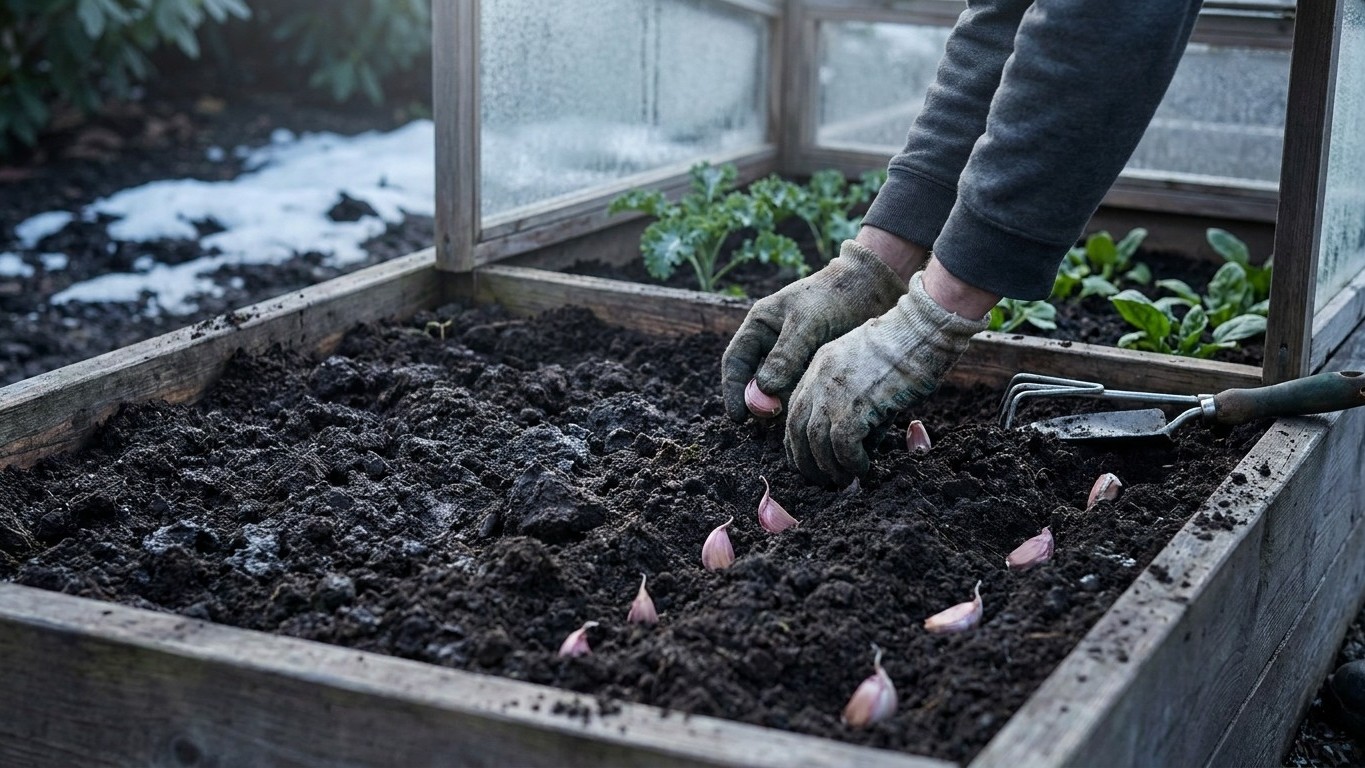

March in Idaho falls weeks before the last spring frost window, so the ground is still cold across nearly the whole state. What actually goes in now is limited to the hardest crops: garlic and shallots where soil is workable, peas and cold-tolerant greens in the lowest valleys, and a long list of jobs indoors and under cover that set up everything else.
What goes in the ground in March

The decision here is not the calendar, it’s the soil. Peas germinate once soil temperature holds near 40°F, spinach and kale tolerate the same range, and none of that has anything to do with what date the wall calendar shows. Boise’s last spring frost lands between April 23 and May 7, according to NOAA NCEI’s 1991-2020 Climate Normals for station USW00024131. March sits well before that window everywhere in the state, and most of Idaho is higher and colder than Boise’s valley floor, which pushes the safe planting window later still.
That means tender crops are simply not an option outdoors this month, full stop. What tolerates the cold is a short, specific list: garlic and shallot bulbs going into beds that are dry enough to work, snap and shell peas direct-sown once the topsoil has thawed and drained, and leaf crops like spinach, arugula, and loose-leaf lettuce sown thinly under a cold frame or low tunnel to buy a few extra degrees. Onion sets can go in alongside the peas in the same low valleys where soil has opened up.
Where in the state this actually applies
Idaho’s USDA Plant Hardiness Zones run from 3b to 7b across the state, a range built entirely on average annual extreme minimum temperature, and it matters here because a job that’s routine in one part of Idaho is reckless in another. Boise anchors the warmer end of that range; the mountain valleys of central Idaho and the Panhandle sit much colder, and soil there is often still frozen or waterlogged through the whole month.
| Area type | Soil status in March | What’s realistic |
|---|---|---|
| Low valley (Boise-area floor) | Often workable by late March | Garlic, shallots, peas, hardy greens under cover |
| Mid-elevation valleys | Cold, frequently wet | Bare-root planting, dormant work only |
| High mountain valleys / Panhandle | Frozen or snow-covered | Indoor starts and planning only |
Anywhere the ground is still frozen or too wet to work, skip direct sowing entirely rather than forcing it. Bare-root fruit trees, cane berries, and roses can still go into a hole that drains, and forcing rhubarb or chicory indoors in a dark box gives a harvest with none of the frost risk.
What to start under cover
Seed starting indoors runs on its own arithmetic, and it works backward from the frost window rather than forward from March 1. With Boise’s last frost falling between April 23 and May 7, and higher parts of the state landing later than that, the safe transplant date for tomatoes sits well into May across most of Idaho. Tomatoes need roughly six to eight weeks indoors before they’re ready to go out, which puts the seed-starting window in mid-March at the latest for a May transplant, and earlier still at higher elevation where the safe date slides later.
Peppers and eggplant run eight to ten weeks from seed to transplant-ready, so they typically get started before tomatoes do, often in late February or the first days of March depending on the target transplant date in a given county. Brassica transplants like broccoli and cabbage move faster, closer to five to six weeks, which gives more flexibility on the start date.
The two ways this goes wrong are opposite mistakes with the same root cause: guessing instead of counting. Start too early relative to the local frost window and the seedlings turn leggy and rootbound sitting on a windowsill waiting for soil that’s still too cold outside. Start too late, particularly in the shorter growing seasons found in Idaho’s colder zones, and there isn’t enough season left after transplant to mature a crop like a slicing tomato before fall frost arrives between October 7 and October 21. Counting backward from the actual local frost date, not from a fixed date on a seed packet, is what keeps both mistakes off the table.
What is ready to pick
Outdoors, the honest answer for March in Idaho is close to nothing. Whatever fed the household this month largely came from storage or from crops that spent winter in the ground under mulch. Kale and leeks planted the previous fall and buried under snow or straw can often still be dug once the ground softens enough to get a fork in, and their flavor after weeks of cold is sweeter than anything harvested in summer heat.
A cold frame or unheated hoop house changes the picture. Spinach, mâche, and arugula sown under cover in fall keep producing thin harvests right through this month, and a fresh sowing of the same crops under that same cover starts filling in behind them. Indoors, sprouts and microgreens fill the gap in a week or two from seed with no outdoor soil involved at all, useful when everything else in the garden is either dormant or still under snow.
The other job this month is checking what’s left in storage before it turns. Winter squash should feel firm with no soft spots near the stem; any give under light pressure means it’s on its way out and should get used first. Potatoes sprouting eyes in storage are still edible once the sprouts are broken off, but they’re declining fast and shouldn’t sit much longer. Onions gone soft at the neck or showing mold at the root end need pulling from the batch immediately, since one rotting onion spreads to its neighbors in storage far faster than most people expect.
The jobs that matter this month
Dormant pruning is the single biggest job on the calendar right now, and the deadline is real: fruit trees and cane berries need their pruning cuts made before buds swell and sap starts moving, because cuts made after growth begins waste the plant’s stored energy and slow the whole season down. Apple, pear, and stone fruit trees, along with raspberry and blackberry canes, should get thinned and shaped while they’re still fully dormant.
Seed ordering belongs on this list too, and it’s easy to underestimate how much this one costs a gardener who waits. Popular varieties, particularly of tomatoes, peppers, and anything marketed as disease-resistant, sell out from seed companies well before the outdoor planting window arrives, so ordering now avoids settling for whatever’s left on the shelf later.
Soil work pays off precisely because nothing is competing for the gardener’s time yet. A soil test taken now gives results back with enough lead time to source and apply lime, sulfur, or compost before beds need to be planted. Turning a compost pile that’s been sitting since fall speeds decomposition and gets finished material ready for spring beds. Cleaning and sharpening pruners, shovels, and hoes takes an afternoon and prevents dull-blade damage to plants once cutting season starts in earnest.
Beds and fencing deserve a walk-through before anything is growing to hide the damage. Winter frost heave cracks raised bed corners, and deer and rodent pressure tests fence lines all winter; repairing both now, while beds are empty, is far easier than working around live plants later. Rotation planning, deciding which family of crops goes where this season based on what grew there last, is a desk job that takes an evening and prevents disease buildup that shows up as a mystery problem months from now.
What not to do in March
The classic mistake this month is planting by feel instead of by soil temperature. A stretch of 60°F afternoons in March feels like spring, but the soil eight inches down is still holding winter’s cold, and warm-season seeds like beans, squash, and corn sown into that cold ground simply rot before they germinate rather than waiting patiently for warmer weather. If seed doesn’t sprout within its expected window, cold, wet soil is almost always the reason, not a bad seed packet.
Uncovering row covers, cold frames, or mulch too early after a mild spell is the same mistake in reverse. Idaho’s frost window runs into early May in the Boise area and later at higher elevation, and a week of warm days in March is not a signal that the risk has passed. Pulling protection off tender growth now, only to have a hard freeze move back in, undoes weeks of careful cold-frame work in a single night.
Fertilizing on the wrong schedule causes its own damage. A heavy dose of nitrogen applied to fruit trees or perennials this early pushes soft, tender new growth right when a freeze is still likely, and that new growth is exactly what frost damages first. Amending soil with compost or a balanced feed ahead of the growing season is useful; pushing a burst of nitrogen-driven growth before the frost risk has passed is not the same thing, and it’s the more common of the two mistakes gardeners make with fertilizer this time of year.
Checking this against your own county
Everything above is a state-wide starting point, not an instruction specific to any one yard. Idaho’s elevation swings, the difference between the Panhandle and the southern deserts, and local microclimates around lakes and rivers move frost windows by weeks in either direction from the Boise-area dates cited here. A garden at 5,000 feet in the mountains is working with a season that opens and closes on a completely different schedule than a valley floor plot near Boise.
For a planting calendar built around actual local conditions, the University of Idaho Extension service is the resource built for exactly that gap, with county-level guidance that accounts for elevation and regional climate differences the state average can’t capture.
Common questions
Can you plant tomatoes outdoors in Idaho in March?
No. Tomatoes are a warm-season crop that needs soil well above the range found in Idaho this month, and the last spring frost doesn’t clear until between April 23 and May 7 in the Boise area, later at higher elevation. Tomatoes started indoors now go outside after that window passes.
What vegetables can I direct sow in Idaho in March?
Peas, spinach, arugula, radish, and onion sets can go into soil that’s dry and workable, mainly in low valley locations. Higher elevation gardens should hold off until soil thaws and drains, which often takes longer.
When is the last frost date in Idaho?
For the Boise area, NOAA NCEI’s 1991-2020 Climate Normals put it between April 23 and May 7. Most of the rest of the state sits at higher elevation and stays colder longer, pushing that date back further.
What USDA hardiness zone is Idaho?
Idaho spans USDA Plant Hardiness Zones 3b through 7b, a range based on average annual extreme minimum temperature. That’s a wide spread across one state, and it means a planting date that works in a low southern valley can be weeks too early for a mountain community in the same state.