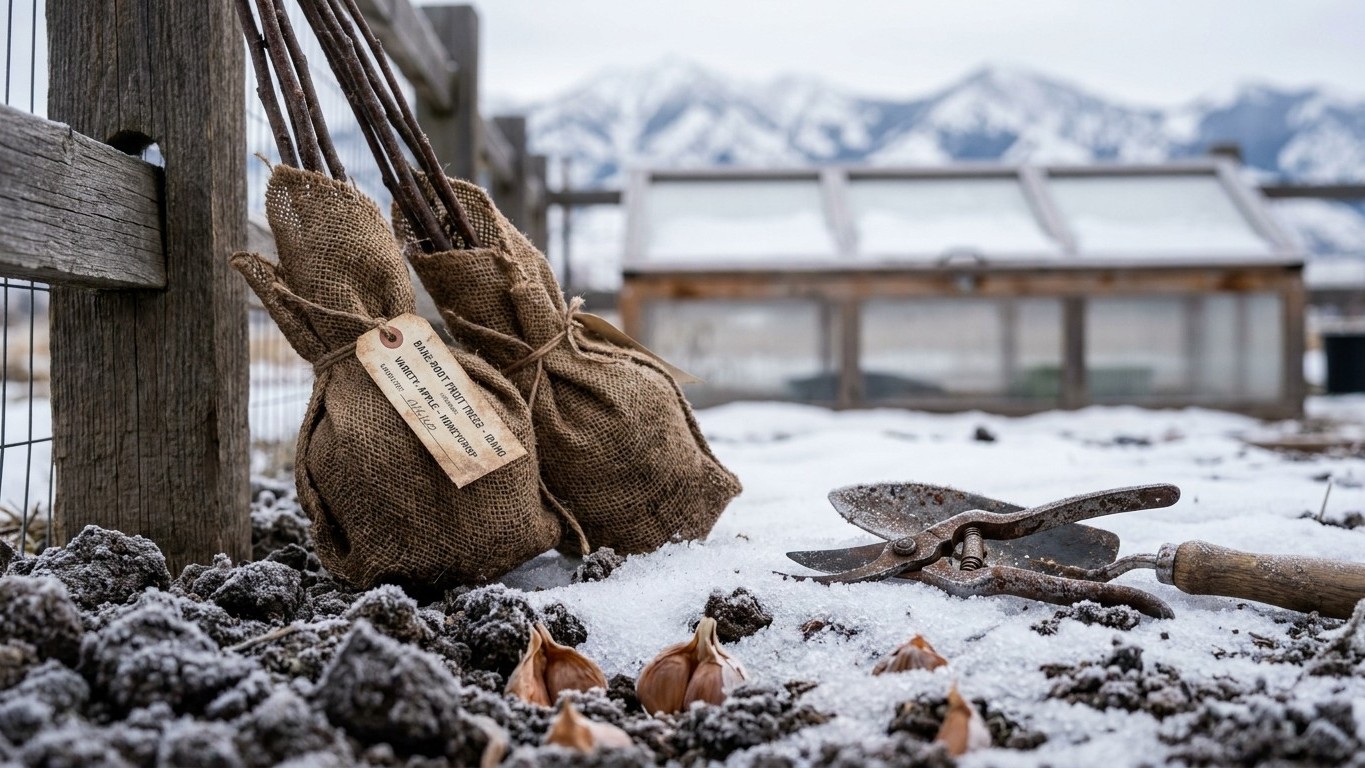

Almost nothing goes into open ground anywhere in Idaho this month. Even in the Boise valley, the state’s mildest growing pocket, the last spring frost doesn’t arrive until April 23 to May 7 on average, and most of the state sits higher and colder than that valley floor. February’s real work is dormant pruning, seed ordering, and indoor starts, not planting.
What goes in the ground in February

The decision here isn’t the calendar. It’s soil temperature and whether the ground is even workable. In February, most Idaho soil is frozen solid, snow-covered, or so saturated with meltwater that turning it does more harm than good. That’s the honest baseline before anything else gets said about this month.
The one exception is garlic and shallots, but only where they were planted in fall and are already dormant in the ground, or in the rare case where soil in a low valley thaws enough to work a bed. Garlic tolerates hard freezes once established; it doesn’t need coddling. If you missed the fall planting window, February is not the moment to try to make up for it outdoors.
Bare-root fruit trees, berry canes, and roses can go in if the ground is thawed and drains well when you dig the hole. Nurseries ship bare-root stock on a schedule that has nothing to do with your local frost date, so if a box arrives in February and the ground is frozen, pot the plants temporarily in moist material and hold them in an unheated garage or shed until the soil softens.
Where a cold frame changes the math
A cold frame or low tunnel buys several weeks. Under glass or plastic, soil warms faster than open ground, and hardy crops like spinach, mâche, and some lettuce varieties can be direct-sown there even while the surrounding garden is still locked up. Peas can go in the same protected space toward the end of the month if the frame has held above freezing consistently.
| Practice | Verdict for February | Condition required |
|---|---|---|
| Garlic and shallots | Fine, if already in ground | Fall-planted, dormant |
| Bare-root trees, canes, roses | Fine | Soil thawed and diggable |
| Cold frame greens and peas | Possible | Frame holding above freezing |
| Any warm-season crop, open ground | No | Not until well past frost window |
What to start under cover
Seed starting this month runs on backward math from the frost window, not from the date on the wall. In the Boise valley, work back from a last frost that lands April 23 to May 7. Onions and leeks want roughly 10 to 12 weeks under lights before transplant, which puts their start date squarely in February for anyone in that valley. Elsewhere in the state, where frost lingers weeks longer, push that start later rather than earlier, or you’ll be nursing rootbound onion starts on a windowsill for a month with nowhere to put them.
Cole crops (broccoli, cabbage, cauliflower) run 6 to 8 weeks indoors before they go out, which for a Boise-area last frost in early May means a February start is reasonable for the earliest crop, with a second batch a few weeks behind it to spread the harvest.
The two ways this goes wrong are opposite failures. Start too early and you get tall, thin, rootbound seedlings sitting in cups for weeks past when they wanted to move outside, stressed before they’ve even seen the garden. Start too late and the plant never reaches transplant size before the soil and air are warm enough to receive it, so the whole point of getting a jump on the season is lost.
Peppers and tomatoes are worth starting under lights this month only for gardeners in the mildest valley locations, and even then, count backward from early May, not from February 1. An 8-week-old tomato seedling waiting three extra weeks for frost risk to clear is a common, avoidable mistake.
What is ready to pick
Outdoors, the honest answer is close to nothing across most of Idaho this month. Snow cover or hard-frozen ground rules out fresh harvest in the open garden almost everywhere in the state.
Overwintered kale, leeks, and some hardy cabbage varieties left in the ground under mulch or snow cover are the exception. Snow acts as an insulator, and leeks in particular can be dug through it as needed; the flavor often improves after repeated freezes, which push more sugars into the leaves. Kale behaves the same way. Cold-frame greens (spinach, mâche, some lettuces) can be cut through the winter if the frame has kept them from freezing solid.
Indoors, the harvest is different
Sprouts and microgreens grown on a counter or under a small light fill the gap: mung beans, radish sprouts, pea shoots, and sunflower microgreens are ready in days rather than months and give fresh green food when the garden can’t.
Stored crops need a checkup this month. Winter squash, potatoes, and onions held in a root cellar or cool basement should be inspected for soft spots, sprouting, or a sour smell, all signs a piece is turning and needs to be pulled before it spreads rot to its neighbors. A single soft squash left in a bin can take down several others around it within a week or two.
The jobs that matter this month
Dormant pruning is the biggest job on the list, and February is close to the ideal window for it in Idaho. Apple, pear, and stone fruit trees, plus raspberry and blackberry canes, are still fully dormant, which means cuts heal cleanly without the sap flow and disease pressure that come with pruning after buds break. Wait too long and you’re cutting into live growth, which stresses the plant and invites problems through open wounds right as the tree is trying to leaf out.
Seed ordering has a real deadline attached to it, even if it doesn’t feel that way. Popular varieties, especially onions, peppers, and anything sold as an early-season or short-season type suited to Idaho’s shorter growing windows at elevation, sell out from seed companies by late winter. Ordering in February beats discovering in April that the variety you wanted is gone.
Soil testing and amending pay off now because amendments like lime or compost need weeks to integrate before spring planting starts. Pulling a sample while the ground is workable, or sending it to a lab, gives you time to act on the results before the rush of April planting crowds it out.
Turning compost, even a half-frozen pile, keeps the decomposition process moving and prevents it from going anaerobic and sour under snow load. Cleaning and sharpening tools, an easy job to skip, means pruners and shovels are ready instead of rusted when the real rush starts. Checking stored crops for rot, covered above, belongs on this list too, because a five-minute check now saves a whole bin later.
Fencing and raised bed repairs are easier to spot and fix while the garden is empty and nothing is underfoot. Planning next season’s crop rotation on paper, while last year’s layout is still fresh, avoids the common mistake of planting the same family in the same bed two years running.
What not to do in February
The classic mistake is trusting a warm afternoon over the soil thermometer. A 55-degree day in February doesn’t mean the ground six inches down has warmed to match; air temperature and soil temperature move on different clocks, and seeds or transplants that go into cold, wet soil often rot or sit stalled rather than germinate. Wait for the soil itself to warm, not just the air.
Uncovering cold frames or removing winter mulch after a mild stretch is another frequent error. Idaho’s February weather swings hard, and a week of 50-degree days can be followed by a hard freeze that catches newly exposed plants off guard. Mulch and frame covers should stay in place until the pattern actually shifts toward spring, not just for one warm week.
Feeding nitrogen too early is a smaller but real mistake. Dormant trees and canes don’t need a nitrogen push before they’ve broken bud; applying it now can encourage soft, early growth that a late frost then damages. Save nitrogen applications for when active growth is actually underway.
Finally, don’t try to force outdoor planting of anything beyond garlic, shallots, and bare-root stock just because seed catalogs and garden centers are pushing spring displays. The calendar on a seed rack doesn’t know your frost window.
Checking this against your own county
A statewide answer for February is a starting point, not an instruction. Idaho’s elevation range and the split between its warmer south and colder north move frost windows by weeks in either direction, and the numbers here are drawn from a single Boise-area weather station, not the whole state. Higher valleys and mountain towns run colder and later than everything described above.
Before acting on any of this, check it against your county through the University of Idaho Extension, which publishes local planting guidance suited to your specific elevation and region.
Common questions
Can I plant grass seed in Idaho in February?
No. Frozen or waterlogged soil across most of the state won’t let grass seed germinate, and seed sown on top of snow or frozen ground mostly washes away or rots before spring.
Is it too early to start tomato seeds indoors in February?
For most of Idaho, yes. Tomatoes need roughly 6 to 8 weeks indoors before transplant, and with the last frost not clearing until April 23 to May 7 even in the mildest valley locations, an early February start leaves seedlings waiting too long indoors.
What USDA hardiness zone is Idaho in?
Idaho spans USDA Plant Hardiness Zones 3b to 7b, based on the 2023 USDA Plant Hardiness Zone Map built on 1991-2020 average annual extreme minimum temperatures. That’s a wide range built on one variable, and it moves sharply with elevation across the state.
Should I prune fruit trees in February in Idaho?
Yes, this is one of the better windows for it. Trees are still fully dormant, so cuts heal without the disease and stress risk that comes with pruning after buds break.