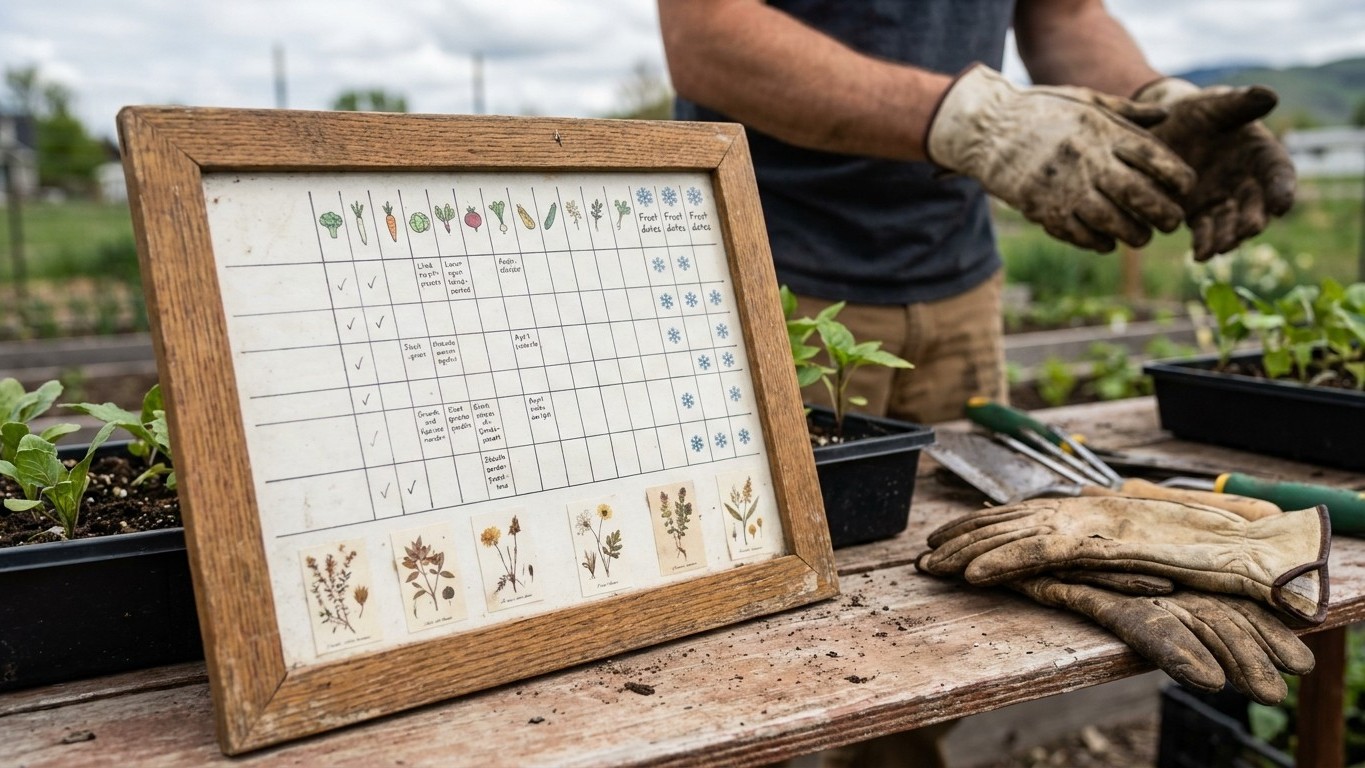

April 23 to May 7: that’s the spread for Boise’s last spring frost, with the first fall freeze landing somewhere between October 7 and October 21. Run the math on the widest and narrowest versions of that window and you get a growing season anywhere from 150 to 180 days, and you won’t know which one you’ve got until autumn’s already arrived. That range belongs to the Treasure Valley specifically — climb into central or northern Idaho’s mountain valleys and every one of those dates shifts.
The frost window in Idaho

NOAA’s National Centers for Environmental Information (NCEI) tracks freeze probabilities using 1991-2020 climate normals from a station near Boise. That data puts the last spring frost between April 23 and May 7, and the first fall frost between October 7 and October 21. Those two windows bracket the frost-free growing season for the Treasure Valley, and they’re the only local dates this guide can state with any confidence.
How long is Boise’s growing season, really?
Do the arithmetic and the frost-free window runs from about 150 days in a short year, last frost on May 7 and first frost on October 7, to as long as roughly 180 days in a generous one, last frost on April 23 and first frost on October 21. Most seasons land somewhere between those two figures, but the point of a range is that you won’t know which end you got until the season is already over.
Boise sits in a low, warm valley along the Snake River Plain, and that geography matters more than the state line does. Idaho’s elevation varies by thousands of feet between the plain and the mountain valleys of central and northern Idaho, and every rise in elevation tends to push both frost dates further apart from Boise’s: later in spring, earlier in fall. A garden in the Panhandle or in a mountain valley can lose a month or more of season compared to Boise, even inside the same state.
Local microclimates compound the difference. Cold air pools in low spots and drains downhill on clear, still nights, so a garden at the bottom of a slope can frost weeks after one sitting just partway up the same hill. None of that shows up in a single station average. Treat Boise’s dates as close to the mildest case Idaho offers, not as a number that applies statewide.
Cool-season crops
Peas, spinach, lettuce, brassica transplants and root crops like carrots and beets don’t wait for warm soil, and they don’t need to. These crops germinate in cool ground and tolerate a light frost on their leaves, so the trigger for sowing them is the last spring frost date, not a date on the calendar. In Boise, where NOAA’s 1991-2020 normals put that frost between April 23 and May 7, gardeners can consult a guide like What to Plant in Idaho in August or a month-by-month planting calendar like the one from href=”https://thehomesteadpost.com/idaho/garden/planting-calendar/november/”>What to Plant in Idaho in November or one focused on spring timing, or one such as What to Plant in Idaho in May or one from href=”https://thehomesteadpost.com/idaho/garden/planting-calendar/october/”>What to Plant in Idaho in October to plan the other end of the season, or a similar resource such as What to Plant in Idaho in September to plan ahead for later sowings, or one such as What to Plant in Idaho in March href=”https://thehomesteadpost.com/idaho/garden/planting-calendar/july/”>What to Plant in Idaho in July or one covering href=”https://thehomesteadpost.com/idaho/garden/planting-calendar/june/”>What to Plant in Idaho in June or one from href=”https://thehomesteadpost.com/idaho/garden/planting-calendar/january/”>What to Plant in Idaho in January or one that matches the local href=”https://thehomesteadpost.com/idaho/garden/planting-calendar/february/”>What to Plant in Idaho in February or one from href=”https://thehomesteadpost.com/idaho/garden/planting-calendar/december/”>What to Plant in Idaho in December to plan out cool-season sowing well ahead of the frost window.ef=”https://thehomesteadpost.com/idaho/garden/planting-calendar/april/”>What to Plant in Idaho in April to get peas, spinach and lettuce into the ground well ahead of that window, as soon as the soil has thawed and dried enough to work without turning to mud.
Timing by crop
- Peas and spinach: sow as soon as soil can be worked, well before the last frost date.
- Lettuce and other salad greens: sow or transplant ahead of the last frost, then succession-sow every couple of weeks after.
- Brassica transplants such as broccoli, cabbage and kale: start indoors and set out while some frost risk remains, since young transplants handle cold better than direct-sown seed does at this stage.
- Root crops such as carrots, beets and radishes: direct-sow ahead of the last frost, since transplanting disturbs the taproot.
The reason this works is biology, not tradition. These crops evolved in temperate climates where a hard freeze kills the plant but a light frost just slows it down. Spinach and kale actually convert starches to sugars when nights turn cold, which is part of why a spring or fall crop can taste sweeter than the same variety grown through summer heat. Pushing these crops in early doesn’t just save calendar days, it produces better-flavored food, because they’re doing something the plant does naturally in response to cold.
The real risk with cool-season crops in Idaho isn’t the light frosts, it’s a late hard freeze that drops well below the light-frost range after a mild stretch has already coaxed seedlings along. That kind of event falls outside NOAA’s 30-70% probability band and it can happen even after the average last frost date has technically passed. Keep row cover on hand for stands of lettuce or transplanted brassicas any time a hard drop in temperature is forecast, especially early in the frost window.
Warm-season crops

Tomatoes, peppers, squash, beans and corn don’t just need frost to be over, they need warm soil, and in Idaho those two conditions don’t always arrive on the same day. Frost-tender crops can rot or sit and sulk in soil that’s still cold even after the air has cleared the frost threshold. Wait until the soil itself has warmed, not just until the calendar shows the frost date has passed, before setting out transplants or direct-sowing beans and corn.
Matching days-to-maturity to Boise’s season
For tomatoes, that generally means setting transplants out from early May to late May in the Boise area, a window that opens after NOAA’s last-frost range of April 23 to May 7 has likely closed and gives the soil another week or two to warm. Working backward from that transplant window, seed started indoors typically needs about six to eight weeks to reach transplant size, which puts an indoor sowing date somewhere in the second half of March to early April for most catalogue varieties.
Catalogue days-to-maturity figures are counted from the transplant date, not from seed, and they shift by a week or two depending on the weather a given season actually delivers. Set against a Boise transplant window of early to late May and a first fall frost of October 7 to October 21, most tomato varieties have a wide margin to ripen a full crop.
| Variety | Days from transplant | Type | Approx. margin before frost |
|---|---|---|---|
| Sakura | 55 | Indeterminate | 84 days |
| Edox | 55 | Indeterminate | 84 days |
| Valentine | 55 | Indeterminate | 84 days |
| Glacier | 55 | Determinate | 84 days |
| Sun Gold | 57 | Indeterminate | 82 days |
| Supersweet 100 | 60 | Indeterminate | 79 days |
| Juliet | 60 | Indeterminate | 79 days |
| Amalfi | 68 | Determinate | 71 days |
| Cherokee Purple | 72 | Indeterminate | 67 days |
| Big Beef Plus | 72 | Indeterminate | 67 days |
| Tiren | 75 | Indeterminate | 64 days |
| Granadero | 75 | Indeterminate | 64 days |
| San Marzano II | 78 | Indeterminate | 61 days |
| Celebrity Plus | 78 | Determinate | 61 days |
Even the slowest variety on this list, at 78 days from transplant, still carries around 61 days of margin before Boise’s earliest expected fall frost. That cushion matters because ripening slows as nights cool in September, so a tomato that “should” finish by early August in ideal conditions often keeps producing well past that on the actual calendar. Peppers behave similarly and want the same soil-warmth threshold, while squash, beans and corn are usually direct-sown once the soil has warmed, since their roots resent disturbance from transplanting.
The fall planting window
Working backward from the first fall frost lets you plant a second round of cool-season crops with time to mature before the cold shuts the garden down. In the Boise area, NOAA’s 1991-2020 normals put the first fall frost between October 7 and October 21, so a fall crop needs to reach a harvestable size, plus a margin for the shorter, cooler days of September, before that window opens.
Doing the backward math
Count backward from the earlier end of the range, October 7, if you want a safety margin, or from the later end, October 21, if you’re willing to bet your garden runs closer to the mild side of Boise’s average. Take a crop’s days-to-maturity figure, add one to two weeks for the slower growth that comes with cooler soil and shorter daylight compared to the summer conditions the catalogue figure assumes, then count back from whichever end of the frost window you’re using.
Fast crops fit this window easily. Spinach, lettuce, radishes and most Asian greens mature quickly enough to be sown well into late summer and still finish before frost. Root crops like carrots and beets take longer but handle the season’s cooling end better than most summer crops, and many gardeners leave carrots in the ground under mulch past the first light frosts, since cold triggers the same starch-to-sugar shift that makes fall spinach taste better.
Crops that improve with cold
Kale, Brussels sprouts and other hardy brassicas actually improve after a light frost touches them, developing more sugar as a response to cold stress, and they often hold in the garden weeks past the average first frost without damage. That’s a useful trait in a state where the first fall frost swings by two weeks depending on where you sit relative to Boise’s valley floor, since even a late frost year eventually delivers the cold snap that improves their flavor.
Warm-season crops don’t get that grace period. A tomato plant still on the vine when a hard freeze hits is done for the season regardless of how many green fruits remain, which is why the margin figures in the warm-season table above matter: a variety with 60 or more days of cushion before the average frost gives you room to finish a full harvest even in a year when the first frost lands on the early side of Boise’s range.
Reading a planting calendar properly
A state-wide planting calendar is a starting point, not an instruction sheet, and Idaho makes a good case study for why. The frost dates in this guide come from a single NOAA station near Boise, at the bottom of a warm valley on the Snake River Plain. A garden two hours north in the Panhandle, or a few thousand feet higher in a mountain valley, can see its last frost weeks later and its first fall frost weeks earlier, shrinking the growing season well below Boise’s ranges.
What actually moves the dates
Elevation is the biggest single factor working against a statewide date, but it isn’t the only one. Urban areas hold heat overnight and can run warmer than surrounding open ground, part of why a city station reading tends to skew milder than nearby rural spots at the same elevation. Low-lying gardens near rivers or at the bottom of a slope collect cold air on clear, still nights and frost earlier and harder than a garden just uphill, even within the same town.
Other short-season states run into the identical problem for the identical reason. Gardeners working from the Montana planting calendar deal with even bigger swings between valley floors and mountain benches, and growers as far away as the New Brunswick planting calendar face the same gap between a coastal station reading and an inland frost pocket. A single frost date on a chart is always an average pulled from one weather station, never a promise about any particular yard.
What to track instead
Keep your own record for a season or two: the date of your last hard frost, the date the ground is workable in spring, and the date frost actually touches your garden in fall. After two or three years, that log will tell you more about your own microclimate than any regional chart can, and it lets you shift the ranges in this guide up or down to fit the spot you’re actually planting.
Local help
County-level frost dates, soil testing and crop advice tuned to your specific elevation are available through the University of Idaho Extension, which runs offices across the state and is the best resource for county-level numbers more specific than the Boise-based ranges in this guide. Get a soil test done before you plant if you’ve never had one, since fertility guidance depends on what’s already in your ground. For more on growing in other parts of the state, browse our other Idaho guides.
Common questions
Can I just use these Boise frost dates for my part of Idaho?
Not reliably. Boise sits in a low, warm valley, and NOAA’s 1991-2020 normals for that station run milder than most of the rest of the state. Higher and more northern parts of Idaho should expect a later last frost and an earlier first frost than the ranges given here, and the University of Idaho Extension is the place to check county-specific dates.
What’s the single average last frost date for Idaho?
There isn’t one worth using. Idaho’s elevation ranges from low valleys to high mountain basins, and a single statewide date would hide more than it reveals. This guide gives Boise’s NOAA-measured range of April 23 to May 7 as a reference point, not a number to copy directly onto a garden at a different elevation.
How do I know when the soil is warm enough for tomatoes?
Feel it, several inches down, rather than judging by air temperature or the calendar. Soil that’s still cold and damp at that depth will stall a tomato transplant even on a warm, sunny day, and a simple soil thermometer pushed into the bed gives a more honest reading than guessing.
Do I still need frost protection after the last frost date has passed?
Sometimes, yes. NOAA’s last frost window is a probability band, not a guarantee, and a late cold snap can still occur after the average date, especially in the earlier part of the range or at elevation. Keep row cover or old sheets on hand for tender transplants for a couple of weeks after you set them out.
When should I start tomato seeds indoors for an Idaho garden?
Count back six to eight weeks from your intended transplant date, which in the Boise area falls in the early May to late May window. That puts most indoor sowing somewhere in the second half of March to early April, though the exact week depends on the variety’s own catalogue timing and how warm your indoor setup runs.
Some gardeners layer an older custom on top of frost dates: planting by the moon, which we explain as almanac tradition, not fact.
Related guides
- Washington Planting Calendar: When to Sow and Plant, Frost Dates Included
- Oregon Planting Calendar: When to Sow and Plant, Frost Dates Included
- Montana Planting Calendar: When to Sow and Plant, Frost Dates Included