
Across Illinois, from Chicago down to Cairo, December means frozen or freezing ground for most gardeners, and that closes the door on new open-ground planting almost everywhere in zones 5a-7b. The real answer isn’t a list of vegetables to sow. It’s garlic beds finishing up where soil is still workable, cold frames doing the heavy lifting, bare-root dormant plantings going in before the freeze locks hard, and a backstage season of pruning, ordering, and soil work that pays off come spring.
What goes in the ground in December

The mechanism here isn’t the calendar, it’s soil temperature. Illinois sits in USDA hardiness zones 5a through 7b, and the state’s first fall frost (using the reference-city window of October 24 to November 3, per NOAA NCEI 1991-2020 Climate Normals) has already passed weeks before December opens. Soil at planting depth has cooled well below the range where roots grow, and in northern counties it may already be frozen solid at the surface. For most of the state, the honest answer is that nothing new goes into open ground this month.
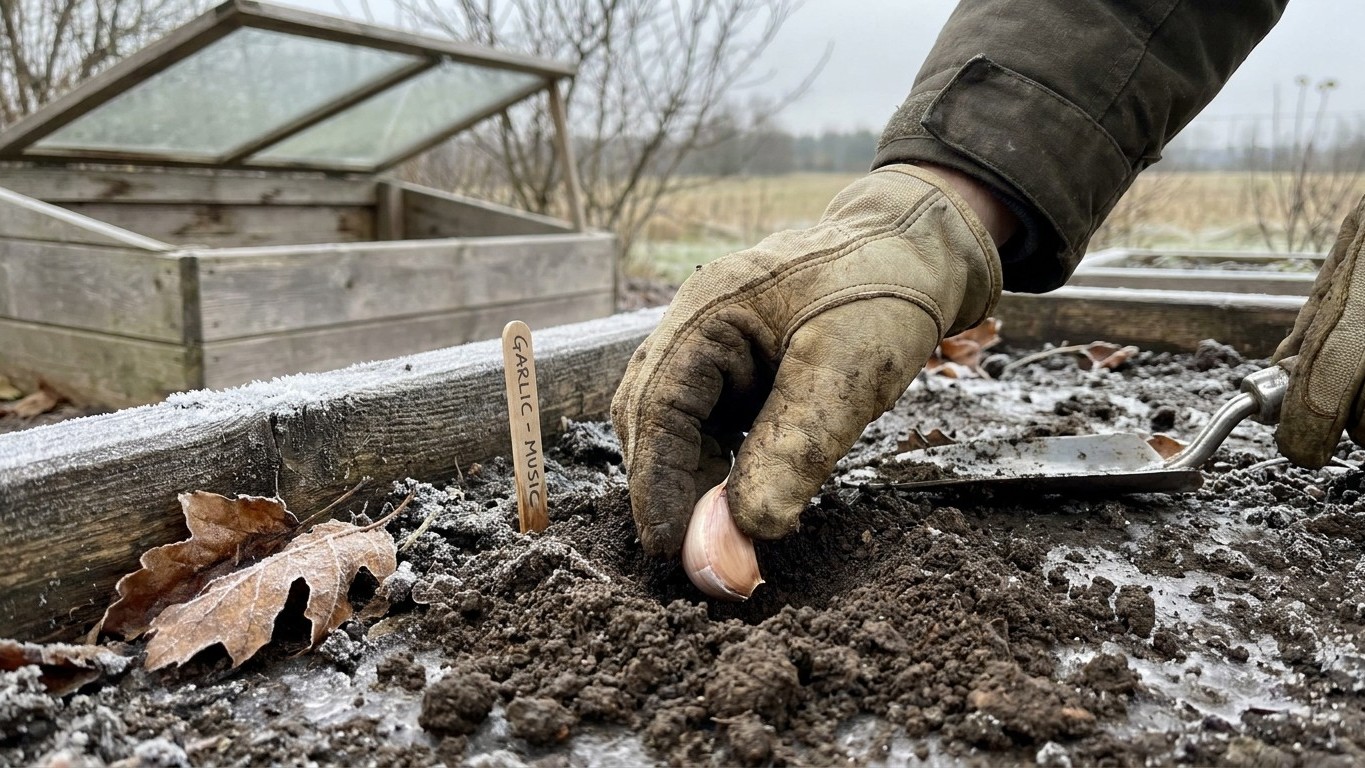
That said, a few things still make sense. Garlic and shallots planted in October or November can tolerate a late push into workable ground in southern Illinois, where zone 6b-7b winters keep soil looser longer, but this is a narrow window, not a rule. Where the ground hasn’t locked up, bare-root fruit trees, roses, and dormant perennial divisions can still go in, since the goal isn’t top growth but getting roots settled before a hard freeze seals things shut.
Cold frames and forcing
Cold frames and low tunnels are doing the real planting work in December. Hardy greens established earlier in fall, spinach, mache, claytonia, keep producing under cover, protected from the worst of the cold. Indoors, forcing rhubarb crowns or chicory roots in a dark, cool space produces tender stalks and blanched chicons within weeks, a genuinely productive use of dormant-season plant material that has nothing to do with waiting for spring.
What to start under cover
Timing indoor sowing by counting backward from the last spring frost window (April 11 to April 22 at the reference station) is more reliable than picking a date off a calendar. Onions and leeks are the classic December-into-January starts, because they need 10 to 12 weeks of growth before transplanting out, and counting back from the early end of that frost window lands seed-starting square in the darkest part of winter. Start too early and you get leggy, rootbound seedlings sitting under lights for months longer than they should. Start too late and they won’t have the root mass to handle transplant shock when the ground finally warms.
Peppers and some slow-growing flowers that need cold stratification can also begin now, since stratifying seed in a refrigerator or unheated space for four to six weeks before sowing is itself a December task, timed so the seed is ready to sow indoors as January turns to February. Sprouts and microgreens sidestep the frost math entirely, since they’re harvested in days rather than months and can be started on a kitchen counter regardless of what the thermometer outside says. The arithmetic that matters is simple: count the weeks a crop needs before transplant, subtract from the earliest date in the local last-frost window, and that’s the latest safe start. Push earlier only if there’s room to hold larger seedlings without them stalling.
What is ready to pick
Outdoors, December harvests are thin across most of Illinois, and pretending otherwise does readers no favors. What’s still coming out of the garden is what survived the season under cover or under snow. Overwintered kale, collards, and leeks often taste better after a hard frost, since cold triggers starches to convert to sugars, and a covering of snow acts as insulation rather than a threat. Brussels sprouts left standing in the field do the same thing, sweetening the longer they sit through cold snaps.
Cold-frame lettuce, spinach, and mache are the most reliable fresh pick of the month for anyone who set up protection in fall. Indoors, sprouts and microgreens fill the gap for households wanting something green on a plate without relying on stored produce.
Storage crops need checking now, not later. Squash should feel firm with no soft spots near the stem end; any give there means rot has started and that squash should be used first, not left to spread mold to its neighbors. Potatoes kept in a cool, dark spot should be checked for green-tinged skin or sprouting eyes, both signs it’s time to use them up. Stored onions that have gone soft at the neck or started sending up green shoots are past their storage life and belong in the kitchen this week, not back in the bin.
The jobs that matter this month
December’s real workload is dormant-season maintenance, and skipping it costs real ground come spring. Dormant pruning of fruit trees, grapevines, and cane berries is best done now, while the plant’s energy is stored in roots and the absence of leaves makes structure easy to see. Cuts made during dormancy heal faster and carry far less disease risk than pruning done when sap is running.
Seed ordering has a real deadline too. Popular varieties, particularly heirloom tomatoes and specialty peppers, sell out from mail-order catalogs well before spring, and waiting until February often means settling for whatever’s left rather than what was actually wanted. Pairing that order with a written rotation plan for next season, tracking which beds grew nightshades, legumes, or brassicas, prevents the soil-borne disease buildup that comes from planting the same family in the same spot two years running.
Soil, tools, and structures
Soil testing done now gives results back in time to amend before spring planting, rather than guessing at lime or fertilizer needs under time pressure in April. Turning compost, even a slow, cold pile, keeps decomposition moving and prevents it from turning anaerobic and sour. Cleaning and sharpening pruners, loppers, and shovels while they’re not needed daily means they’re ready and rust-free when the season starts. Fences, raised bed frames, and trellis posts damaged by summer storms or winter freeze-thaw cycles are easier to repair now, on frozen or bare ground, than later when new plantings are in the way.
What not to do in December
A mild stretch of December weather is the classic trap. Air temperatures in the 50s for a few days can feel like spring, but soil several inches down hasn’t warmed nearly as much, and any warm-season seed or transplant put in during that window will sit in cold soil and rot rather than germinate. The fix is patience: judge planting by soil temperature and the frost window, never by how the air feels on a given afternoon.
That same mild spell tempts gardeners to pull covers off cold frames and low tunnels early, assuming the cold is over. It rarely is. Illinois winters run through sharp cold snaps well past any warm stretch, and hardy greens that were fine under cover can be knocked back badly if exposed just before a sudden freeze returns.
Nitrogen fertilizer is another common misstep this month. Feeding dormant lawns, trees, or perennial beds with nitrogen in December pushes tender new growth right before a freeze kills it, wasting the plant’s stored energy on growth that won’t survive. Save nitrogen applications for when active growth resumes. Finally, walking on frozen or saturated garden beds compacts soil structure in ways that take a full season to undo, so staying off beds until they’ve dried and thawed protects root-zone structure for whatever gets planted there next.
Checking this against your own county
Everything above is built on one reference station’s frost data, and Illinois stretches roughly 400 miles from its northern to southern border, enough distance to shift both the last spring frost and first fall frost by weeks. Elevation changes, proximity to Lake Michigan’s moderating effect, and simple north-south geography all move these windows around. A county in the far south of the state may see workable soil weeks after one near the Wisconsin border has locked up hard. Before acting on any date here, check it against the University of Illinois Extension, which tracks local frost data and planting guidance specific to individual counties.
Common questions
Can I still plant garlic in Illinois in December?
Only where the ground hasn’t frozen yet, mostly in the southern counties within zone 6b-7b. Garlic planted this late is a gamble compared with the standard October-November window, since cloves need time to root before hard freeze locks the soil.
Will cold frame greens survive an Illinois winter without heat?
Unheated cold frames and low tunnels can keep hardy greens like spinach, mache, and kale alive and harvestable through most winter cold snaps, since the covering traps just enough ground heat and blocks wind chill. Extreme cold snaps below the teens can still damage exposed edges even under cover.
Is it too early to start onion seeds indoors in December?
Not necessarily. Onions and leeks need 10 to 12 weeks of growth before transplanting, and counting back from the early end of the last-frost window (April 11) puts a reasonable start date in late December or early January, depending on the variety’s stated days to transplant size.
Why does my lawn or garden bed look fine after a warm December but suffer later?
A mild stretch warms the air and the soil surface, but deeper soil and plant tissue often haven’t caught up, leaving new growth or exposed plants vulnerable when normal winter cold returns. That’s why fertilizing or uncovering beds during a warm spell tends to backfire once temperatures drop again.