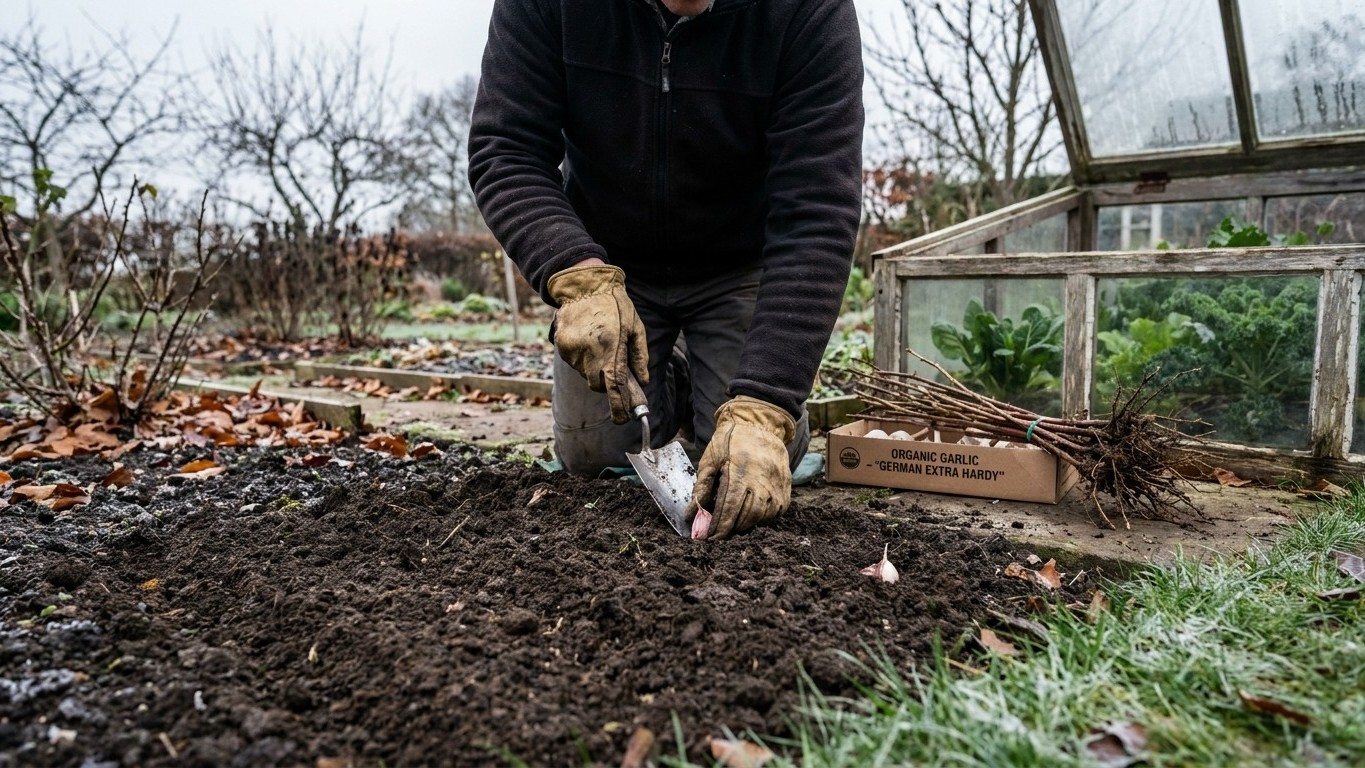

By November, most of Illinois has already crossed its first fall frost window, so this is not a month for tender crops in open soil. Garlic and shallots still go into workable ground, spring bulbs go in while the soil stays diggable, and cold frames keep hardy greens producing. Everything else moves to dormant planting, indoor starts, and the jobs that set up a stronger spring.
What goes in the ground in November

The reference climate station used by NOAA NCEI puts Illinois’ first fall frost between October 24 and November 3. That means by the time November arrives, most of the state has already had at least one freeze, and soil temperatures are sliding toward the range where root growth stalls. The calendar says November, but the decision was already made by the thermometer weeks earlier.
That doesn’t mean the garden is closed. Garlic and shallots are the exception worth planting now, as long as the ground still gives when you push a trowel into it. Both crops want six to eight weeks of cool soil before hard freeze to root in, and they’ll sit quietly through winter before pushing up in spring. Once the surface won’t yield to a shovel, that window has shut for the season.
Spring-flowering bulbs, tulips, daffodils, crocus, follow the same logic. Cool soil is actually what they need to start root development, so a diggable patch of dirt in early November is still fair game. Bare-root fruit trees, shrubs, and perennials can go in too, provided the nursery stock is truly dormant and the hole isn’t fighting frozen clumps.
What still works under glass or plastic
Cold frames and low tunnels are where the real November planting happens. Hardy greens, spinach, mâche, and some kale varieties, can be tucked under cover for a slow finish or an early spring restart. Forcing rhubarb or chicory indoors in a dark, cool space is another option that has nothing to do with outdoor soil temperature at all.
Zone-wise, Illinois spans USDA Hardiness Zones 5a to 7b, and that range matters here. Southern counties near the Zone 7 edge often keep workable soil into late November, while northern counties near Chicago, closer to Zone 5, can see the ground lock up well before the month ends.
What to start under cover
Counting backward from a frost date doesn’t work the same way in November as it does in spring, because the frost window (October 24 to November 3 at the reference station) has already passed. Starting seeds indoors now isn’t about racing a deadline anymore. It’s about deciding what still has a reason to germinate before the days get too short and too dark to support real growth.
Realistically, that shortlist is small. Sprouts and microgreens don’t care about outdoor light levels at all, since they’re harvested at the seedling stage under a grow light or a bright window, and they can be sown on a rolling schedule all month. Windowsill herbs, chives, parsley, a pot of basil kept warm, will keep producing if given enough light, though growth slows noticeably as daylight drops.
The two failure modes still apply, just shifted. Starting too early, in this case, means sowing a cold-frame crop of lettuce or spinach now expecting a harvest, when six to eight weeks of lead time should have happened in September. That seed will germinate, but it won’t size up before growth stalls in the cold and short days. Starting too late means missing the chance entirely, since anything meant to overwinter under cover needed real root development before temperatures dropped, not after.
The safer bet for indoor sowing in November is anything grown purely under artificial light with no outdoor transition planned until spring. That keeps the leggy-seedling problem off the table, because there’s no outdoor hardening-off step to fail.
What is ready to pick
Outdoors, the honest answer is little to nothing across most of Illinois. The first fall frost has already come through by the start of the month at the reference station, and anything that wasn’t frost-hardy is done for the season.
What survives is the cold-tolerant crowd. Kale, collards, and Brussels sprouts actually improve after a freeze or two, since the cold triggers the plant to convert starches to sugars, softening the bitterness that shows up in warmer weather. Leeks left in the ground under a layer of mulch or snow can be dug as needed well into winter, and they hold their quality better in the soil than in a refrigerator. Cold-frame greens planted in late summer may still be giving small, steady harvests if the cover is doing its job.
Indoors, sprouts and microgreens fill the gap for anyone wanting fresh, fast-growing food while the outdoor garden sleeps.
Storage crops need a check-in now too. Squash, potatoes, and onions pulled earlier in the season should be inspected for soft spots, mold, or sprouting. One bad squash in a bin can spread rot to its neighbors fast, so pulling the questionable ones out before they contaminate the rest is worth the five minutes it takes.
The jobs that matter this month
November earns its keep through maintenance, not planting, and there’s a real deadline attached to most of it.
Dormant pruning on fruit trees and cane berries can start once leaves have fully dropped and the wood is truly asleep, not just cool. Cutting into wood that’s still pushing sap invites disease and slows healing, so waiting for full dormancy, rather than jumping in on the first cold snap, protects the plant. Raspberry and blackberry canes that fruited over summer can be cut back now to keep next year’s growth manageable.
Seed catalogs are worth ordering from early, since the most popular varieties, particularly regionally adapted tomatoes and disease-resistant squash, sell out well before spring planting season arrives. Waiting until January often means settling for whatever’s left.
Soil testing and amending pays off more in fall than spring, because amendments like lime need months to change soil pH, and compost worked in now has all winter to break down before anything gets planted. Turning an existing compost pile also matters, since a pile left untouched through a Midwest winter can go anaerobic and slow to a crawl.
Tool maintenance is easy to skip and expensive to regret. Cleaning soil off blades, oiling moving parts, and sharpening pruners and hoes before storage keeps rust and dull edges from turning into a spring problem. Fencing and raised bed repairs are also easier to spot and fix now, with the garden cleared out, than in the rush of April.
Stored crops need a second pass beyond the initial check. Rot spreads, and a squash or onion that looked fine two weeks ago may not look fine now.
What not to do in November
The most common mistake is mulching too early. Piling straw or leaves over perennial beds while the soil is still warm traps heat, invites rodents looking for a cozy winter home, and can actually delay the dormancy plants need. The better move is waiting until the soil surface has frozen, which insulates the ground at a stable cold temperature rather than keeping it artificially warm.
Pruning during an unseasonably mild stretch is another trap. A warm afternoon in the middle of November can feel like an invitation to get ahead on dormant pruning, but if the tree hasn’t dropped all its leaves or the wood is still actively moving sap, a fresh cut is an open door for disease and cold injury once the temperature drops again.
Tender bulbs and tubers, dahlias, gladiolus, cannas, don’t belong in the ground after their foliage has been killed by frost. Leaving them in the soil hoping they’ll be fine invites rot once the ground freezes solid. Dig them, let them dry, and store them somewhere cool and dark instead.
Nitrogen fertilizer is the wrong input this month for anything meant to overwinter. Nitrogen pushes soft new growth, and soft new growth is exactly what a hard freeze kills fastest, weakening a plant right when it needs to be hardening off, not growing.
Finally, don’t assume a mild afternoon means it’s safe to uncover cold frames or pull back row covers for good. Illinois weather swings hard this time of year, and a 55-degree day is often followed within 48 hours by a hard freeze.
Checking this against your own county
Everything above is a state-wide starting point, not a set of instructions for any one backyard. Illinois covers USDA Hardiness Zones 5a through 7b, and the frost dates cited here (October 24 to November 3 for first fall frost) come from one reference weather station. Elevation, proximity to Lake Michigan, and simple north-south distance across the state can shift real frost timing by a week or two in either direction, and rural or low-lying gardens often see frost earlier than the station data suggests.
For a planting calendar tuned to local conditions, the University of Illinois Extension is the right next stop, with county-level guidance that accounts for exactly these regional differences.
Common questions
Can you still plant garlic in Illinois in November?
Yes, as long as the soil is still workable. Garlic and shallots need several weeks of cool soil to root before a hard freeze locks the ground, so early November is often still fine, especially in southern counties where the ground stays diggable longer.
What vegetables can survive winter in an Illinois garden?
Kale, collards, Brussels sprouts, and leeks handle freezing temperatures well, and leeks in particular can be left in the ground and dug as needed through much of winter if mulched. Cold frame greens like spinach and mâche can also hang on with protection.
When does the ground freeze in Illinois?
That’s not published in this data set, and it varies significantly by region, soil type, and snow cover. Northern counties near Chicago typically see hard-frozen ground well before southern counties near the Zone 7 edge of the state.
Is it too late to plant bulbs in November in Illinois?
Not necessarily. Spring-flowering bulbs like tulips and daffodils actually benefit from cool soil, so as long as the ground can still be dug, planting in early November is workable, particularly in the southern half of the state.
Gardeners who plant by the Moon can check the November 2026 moon planting calendar, a tradition rather than a proven method.
Related guides
Elsewhere? See what to plant in November in every state and province.