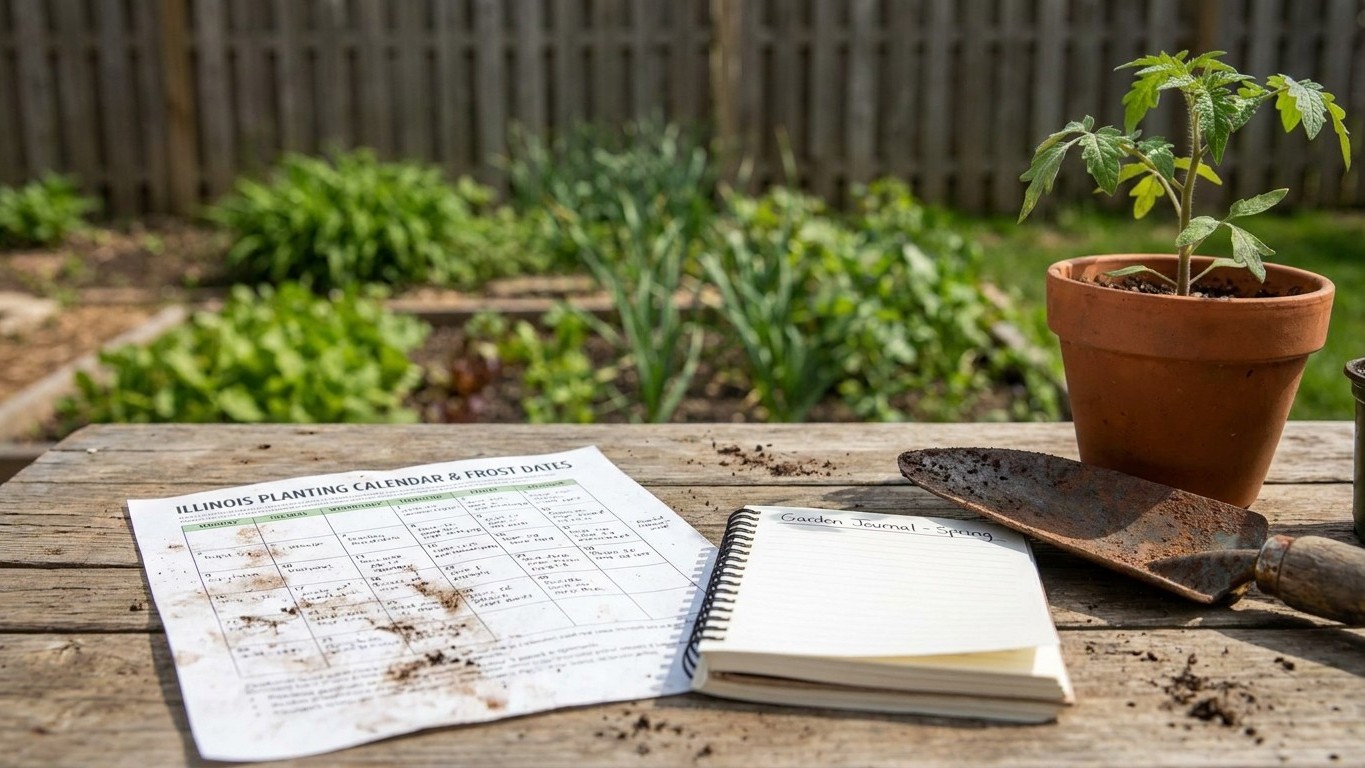

Illinois gardeners, mark mid-to-late April as your tomato line: frost near Chicago can still hit as late as April 22 most years, so going earlier is a gamble even on a warm afternoon. Your own yard has the final word, though, since low spots and shaded corners hold frost longer than the rest of the bed. Before you plant anything tender, crumble a handful of soil in your hand — if it clumps instead of falling apart, wait. If you’re catching up on what should have already gone in, our guides on What to Plant in Illinois in January, What to Plant in Illinois in February, and What to Plant in Illinois in March cover the earlier cool-season work, and for a full rundown of what to get in the ground this month, see What to Plant in Illinois in April, and once the frost risk passes, check out What to Plant in Illinois in May, What to Plant in Illinois in June, and What to Plant in Illinois in July to plan ahead.
The frost window in Illinois

NOAA’s 1991-2020 climate normals, compiled by the National Centers for Environmental Information from the Chicago-area station, put the last spring freeze in the 30-70 percent probability band between April 11 and April 22. The same data set puts the first fall freeze between October 24 and November 3. Those two ranges bracket the frost-free stretch that most warm-season crops need to finish a full harvest, and once the summer heat is at its peak, our guide on What to Plant in Illinois in August can help you keep the garden productive, then as summer winds down, our guide on What to Plant in Illinois in September can help you get fall crops started, then as that first fall freeze approaches, our guide on What to Plant in Illinois in October can help you plan your last harvests, while once that window closes, our guide on What to Plant in Illinois in November can help you plan for the season ahead, and for winter planning once the garden is fully dormant, see What to Plant in Illinois in December.
Do the arithmetic across the widest and narrowest combinations of those ranges and Chicago’s frost-free season runs somewhere between roughly 185 days, if spring frost lingers to April 22 and fall frost arrives October 24, and 206 days, if spring frost breaks early on April 11 and fall frost holds off until November 3. Most years land somewhere inside that band rather than at either edge.
Illinois runs more than 200 miles from the Wisconsin state line to the Ohio River, and a single airport station cannot describe all of it. The NOAA figures above come specifically from the Chicago-area station. Counties farther north and at higher ground typically see the last frost arrive later in spring and the first frost arrive earlier in fall than the Chicago numbers suggest, sometimes by a week or two. Southern Illinois, sitting well below Chicago’s latitude, generally warms up sooner in spring and holds its heat longer into fall, which stretches the growing season beyond what these figures describe. Gardeners closer to the Illinois-Indiana line may find the numbers in our Indiana Planting Calendar: When to Sow and Plant, Frost Dates Included a closer match than the Chicago figures above.
Even within the Chicago area itself, suburban and rural yards away from the lake and the pavement-driven urban heat tend to run colder at night than the airport reading. A garden in an outlying suburb can see a real last frost later than April 22, and a real first fall frost before October 24. Treat the NOAA window as a planning tool, not a guarantee, and keep row cover on hand for the week or two on either side of it. That 185-to-206-day window is long enough for nearly every warm-season vegetable sold in a northern seed catalog, provided slow-maturing types get started indoors rather than direct-seeded after the last frost.
Cool-season crops
Peas, spinach, lettuce, radishes, and the brassica family tolerate a light frost and germinate in cold soil, so they don’t wait for the last spring frost the way tomatoes do. The trigger is soil condition, not the calendar: as soon as a handful of garden soil crumbles instead of clumping into mud, these crops can go in, which in the Chicago area often means several weeks before the April 11 to April 22 last-frost window closes.
What goes in first
- Peas: direct-seeded as soon as soil can be worked, tolerates hard frost once up
- Spinach and lettuce: direct-seeded weeks ahead of last frost, bolts in early summer heat
- Radishes and carrots: direct-seeded in cool soil, radishes ready in about a month
- Broccoli and cabbage: started indoors and set out as transplants a few weeks before last frost
- Beets and turnips: direct-seeded early, tolerate a light frost on emerging leaves
Brassica transplants, broccoli and cabbage among them, handle a light frost once they have a few true leaves, but a hard freeze into the mid-20s can still kill young transplants outright. Setting them out a few weeks ahead of the last frost date, rather than waiting for it to pass, takes advantage of the cool weather these plants actually prefer. Once daytime temperatures climb into the 70s and stay there, lettuce and spinach bolt and turn bitter, so the cool-season window at the front end of the year is short and worth using fully.
Carrots and beets can be resown every couple of weeks through the cool part of spring for a continuous harvest, since both germinate in soil too cold for beans or squash. Once the ground warms and settles into the warm-season range, hold off on further lettuce sowings until late summer, when cooler air returns ahead of the first fall frost and bolting stops being a problem.
Hold off on anything genuinely tender, sweet corn, beans, squash seedlings, until well after this cool window closes. Mixing cool- and warm-season sowings by calendar date rather than by the frost window is the most common way Illinois gardeners lose a planting to a late cold snap.
Warm-season crops

Tomatoes, peppers, squash, beans, and sweet corn all die or stall in a frost, and most also stall in cold soil even without a freeze. Soil temperature, not just the last-frost date on the calendar, decides when these crops actually grow once they’re in the ground. A tomato transplant set into soil that’s still cold from a long winter will sit and sulk for weeks even if the air temperature is fine.
In the Chicago area, with NOAA’s last spring frost falling between April 11 and April 22, most gardeners wait a further one to two weeks before setting out tomato and pepper transplants, landing on a late April to early May planting window once soil has had time to warm. Direct-seeded beans, squash, and corn follow the same logic: they germinate poorly in cold, wet soil regardless of frost risk, so the same window applies to seed as well as transplants.
Counting back for indoor starts
Seed packets for tomatoes and peppers typically call for starting indoors six to eight weeks before transplanting outside. Counting back from a late April to early May transplant date puts the indoor seed-starting window at roughly early to mid March for most varieties. Starting earlier than that produces leggy, root-bound seedlings that transplant poorly, so resist the urge to jump the gun once the seed catalogs arrive in January.
The table below shows how that arithmetic plays out for a handful of named tomato varieties, using each variety’s published days-to-maturity figure counted from transplant, crossed with the Chicago-area transplant window above. Catalog days-to-maturity numbers assume average conditions and can shift by a week or so with the weather in a given season.
| Variety | Days to maturity (from transplant) | Transplant window | Approx. first ripe | Margin before first fall frost |
|---|---|---|---|---|
| Sakura | 55 | Late April to early May | Late June | ~116 days |
| Edox | 55 | Late April to early May | Late June | ~116 days |
| Valentine | 55 | Late April to early May | Late June | ~116 days |
| Sun Gold | 57 | Late April to early May | Early July | ~114 days |
| Juliet | 60 | Late April to early May | Early July | ~111 days |
| Cherokee Purple | 72 | Late April to early May | Mid July | ~99 days |
| San Marzano II | 78 | Late April to early May | Late July | ~93 days |
Every variety in that table finishes with three months or more of margin before Chicago’s first fall frost, even the longer-season paste tomato San Marzano II. That margin matters more in a cool, wet year when ripening slows down than in an ordinary one, so gardeners in a shorter-season pocket of the state should lean toward the 55-to-60-day end of that list rather than the 78-day end.
Peppers follow a similar transplant window to tomatoes but grow more slowly in cool soil, so a warm bed matters even more for them. Squash and cucumbers, direct-seeded, germinate faster once soil has genuinely warmed, and pushing them into the ground too early usually just means a longer wait for the same result a later sowing would have given anyway. Sweet corn seed rots in cold, wet soil rather than simply waiting, so a delay of a week or two past the frost date costs nothing if the ground is still cold.
The fall planting window
NOAA’s 1991-2020 normals put Chicago’s first fall frost between October 24 and November 3. Working backward from that range is how a second planting gets timed, rather than picking a date off a generic calendar.
Take the days-to-maturity figure printed on a fall crop’s seed packet, count it back from the earlier end of the frost range, October 24, and add a margin of roughly two weeks on top. Days shorten and light weakens through September, so a crop that matures in 50 days under the long daylight of June will often take 60 to 65 days to reach the same size in September. Skipping that margin is the most common reason a fall planting gets caught unfinished by frost.
Crops that improve after a light frost
- Kale and collards: leaves sweeten as starches convert to sugar in cold weather
- Brussels sprouts: sprouts firm up and taste milder after one or two light frosts
- Carrots and parsnips left in the ground: roots turn noticeably sweeter after cold exposure
- Spinach: cold-hardy enough to overwinter under a row cover in many Illinois gardens
These crops tolerate temperatures well below the 32-degree freeze point that defines NOAA’s frost dates, so a light frost in early to mid October does not end their season the way it ends a tomato plant’s. A hard freeze into the low 20s is a different matter and will still finish off even the hardiest kale eventually, so don’t leave a fall crop in open ground indefinitely once the season’s real cold arrives.
Quick crops like radishes and baby lettuce mixes, often ready in three to four weeks, fit easily into the fall window even when sown in early September, since their short days-to-maturity figures leave comfortable room before frost. For anything direct-seeded for fall, aim to have seed in the ground with enough runway that the days-to-maturity count, plus the two-week slowdown margin, lands before the earlier end of the Chicago frost range rather than the later end. A gardener outside the immediate Chicago area, where frost often lands earlier than the airport reading, should build in extra buffer rather than cut it close.
Reading a planting calendar properly
A state-wide planting calendar, this one included, describes an average drawn from one weather station over three decades. It is a starting point for deciding when to plant, not an instruction to follow blindly on a specific date.
What shifts the numbers where you actually garden
Lake Michigan moderates temperatures for a band of shoreline communities, delaying both the spring warm-up and the fall cool-down compared with inland areas at the same latitude. Elevation matters too: a garden in a low spot where cold air pools on a still night will frost before a garden on a nearby slope, sometimes by several degrees. Urban heat works the other way, with concrete and buildings holding warmth overnight so a downtown garden can stay frost-free days or weeks longer than an open field outside town measured by the same regional weather service.
A late cold snap is the scenario every one of these averages fails to predict. NOAA’s frost dates describe a 30 to 70 percent probability band, which means a freeze after the late end of that window, or even a hard freeze into May in an unusual year, is not outside the realm of possibility. Treat the calculated transplant windows as the middle of a range to watch, not a fixed appointment. The same logic on reading a calendar rather than following it blindly applies well north of Illinois too, as our Ontario Planting Calendar: When to Sow and Plant, Frost Dates Included lays out for growers working from an equivalent frost-probability method.
The most reliable check available to any gardener is the garden itself. Track the last morning frost actually shows on the grass each spring for a few years running, and the first morning it shows each fall, and that record will outperform any published average for a specific yard. A soil thermometer pushed a few inches into a bed tells more about whether it’s time to plant warm-season crops than any date on a calendar ever will.
Local help
Illinois Extension, part of the University of Illinois land-grant system, publishes county-level frost data and soil testing services that go well beyond the Chicago-area figures. Find your county office through Illinois Extension and request a soil test before spring planting starts, since drainage and soil temperature vary block to block in ways no state-wide calendar can capture. For more on growing conditions elsewhere in the state, see our other Illinois guides.
Common questions
Can I plant tomatoes outside in April in Illinois?
Generally not in the Chicago area. NOAA’s last spring frost window there runs April 11 to April 22, and soil is usually still too cold for tomatoes even after that date clears. Most gardeners near Chicago wait until late April to early May, and gardens outside the immediate metro area should check their own county’s frost history first.
What USDA hardiness zone is Illinois?
Illinois spans several USDA hardiness zones because the state runs a long way north to south, so there is no single zone number that applies statewide. Check the current USDA hardiness zone map for your specific county, or ask Illinois Extension, rather than relying on a number quoted for a different part of the state.
Is it too late to plant vegetables in June in Illinois?
Not for most warm-season crops. With Chicago’s first fall frost landing between October 24 and November 3 per NOAA, a June planting still leaves well over 100 days for a fast-to-mid-season tomato like Sun Gold or Juliet, both under 60 days to maturity from transplant. A long-season paste tomato pushed into the ground in June cuts its margin much closer, so check the variety’s days-to-maturity figure before assuming there’s time.
When should I start tomato seeds indoors for an Illinois garden?
Roughly early to mid March for the Chicago area, counting back six to eight weeks from a late April to early May transplant date. That’s a calculated range, not a fixed date, so adjust earlier if your county’s last frost typically runs later than Chicago’s.
Do frost dates really differ between northern and southern Illinois?
Yes, and the NOAA figures come from a single Chicago-area station, not a statewide average. Southern counties generally warm up earlier in spring and stay frost-free longer into fall than Chicago, while far northern counties and higher ground tend to run colder on both ends. Illinois Extension’s county offices are the place to check actual local records rather than assuming the Chicago numbers apply everywhere.
Some gardeners layer an older custom on top of frost dates: planting by the moon, which we explain as almanac tradition, not fact.
Related guides
- Wisconsin Planting Calendar: When to Sow and Plant, Frost Dates Included
- Iowa Planting Calendar: When to Sow and Plant, Frost Dates Included
- Indiana Planting Calendar: When to Sow and Plant, Frost Dates Included