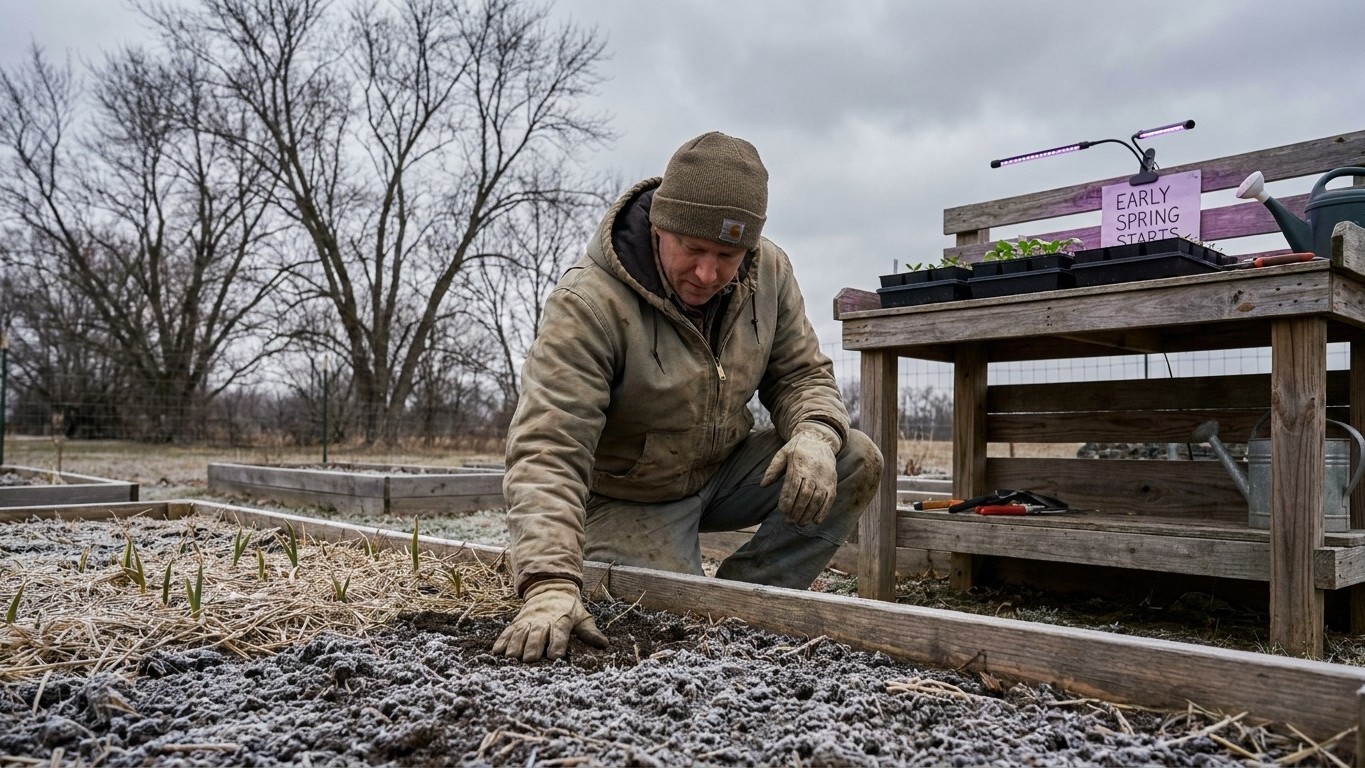

In February, the honest answer for Illinois is that almost nothing goes into open ground. Soil across the state’s 5a-7b hardiness range is frozen, waterlogged, or both, and the earliest measured last spring frost doesn’t arrive until April 11 to April 22. What the month is good for is the invisible work: dormant pruning, seed starting under cover, bare-root planting during a thaw, and getting ahead on the season before the ground even thinks about thawing.
What goes in the ground in February

The calendar says February, but the soil doesn’t care what the calendar says. What decides whether anything can go outdoors is soil temperature and how far the date sits from that April 11 to April 22 frost window, and for most of Illinois this month sits ten to eleven weeks ahead of it. That’s too early even for the tough stuff: spinach, peas, and hardy alliums that can shrug off a light freeze still need workable, thawed soil to germinate, and in most counties that soil is locked up until March at the earliest.
So the plain answer is that direct-sown and transplanted crops are off the table this month across the bulk of the state. That’s not a failure of planning, it’s just where the season is.
What is genuinely possible falls into a few narrow categories. Garlic and shallots planted the previous fall are already in the ground and don’t need anything from you right now except a check that mulch hasn’t blown off and exposed the cloves to open air. In the southern counties, where the 7a-7b end of the hardiness range gives a longer thaw window, an unexpected mild stretch can make the top few inches of soil workable enough for bare-root and dormant plantings: fruit trees, cane berries, roses, and other woody stock sold dormant by mail-order nurseries. These go in while they’re still asleep, which is exactly the point of buying them bare-root.
Cold frames and low tunnels are the other real option. A frame that was seeded with spinach or mâche back in fall can still be harvested and even resown in a sheltered corner, since the glazing buys several degrees over open ground. Indoors, this is also the month to force rhubarb crowns or Belgian endive chicons in a dark, cool basement or root cellar, both of which reward patience with fresh stalks or blanched shoots weeks before anything outdoors stirs.
What to start under cover
Seed starting in February works backward from the frost window, not forward from the first of the month. Count roughly ten to twelve weeks back from April 11 to April 22 and you land in late January to early February, which is exactly the window for the slow growers: onions, leeks, and celery from seed all need that much lead time to build a root system worth transplanting. Count back eight to ten weeks instead and you get a window running from early to late February, which is where peppers and early cabbage-family transplants for a cold frame belong.
| Crop | Weeks before last frost | Start window (working back from April 11-22) |
|---|---|---|
| Onions, leeks, celery | 10-12 weeks | Late January to early February |
| Peppers | 8-10 weeks | Early to late February |
| Early cabbage, broccoli (for cold frame) | 8-10 weeks | Early to late February |
| Tomatoes | 6-8 weeks | Late February into March |
Tomatoes sit at the edge of this month’s window rather than in the middle of it, so only start them under lights toward the very end of February, and only if you have strong grow lights, not a windowsill.
The two ways this goes wrong both come from ignoring that arithmetic. Start too early, without enough light or warmth to match the calendar, and seedlings stretch into pale, leggy stems that never really recover, or they outgrow their pots weeks before the ground is ready and sit rootbound on a windowsill losing vigor. Start too late, on the other hand, and slow crops like onions or celery never build enough size to transplant with confidence, leaving you buying starts instead of growing your own. Redo this math with your own county’s frost dates rather than the reference figures here, since a difference of even a week or two shifts every start date on the list.
What is ready to pick
Outdoors, the truthful answer is little to nothing across most of Illinois in February. That’s not the same as an empty kitchen, though. Kale, leeks, and Brussels sprouts left standing through winter often keep producing right through snow cover, and a hard frost usually improves their flavor rather than ruining it, since cold pushes plants to convert starches into sugars. Digging leeks out of frozen ground takes some effort, but the flavor payoff after a freeze is real.
Cold frames extend that further. Spinach, mâche, and hardy lettuces sown in fall and sheltered under glazing can still be cut a few leaves at a time, as long as the frame is vented on sunny days so the plants don’t cook under glass even in cold air.
Indoors, sprouts and microgreens fill the gap for anyone missing fresh greens: a tray of pea shoots or sunflower sprouts on a counter is ready to cut in one to two weeks from sowing, no garden required.
This is also the month to walk the root cellar or basement shelf and look hard at stored squash, potatoes, and onions. Squash with a soft spot or a sweet smell needs to be used immediately, not left for later. Potatoes that have started sprouting eyes are still edible once the sprouts are cut away, but they’re on a clock. Onions gone soft at the neck are done and should come out before they spread rot to the rest of the bin.
The jobs that matter this month
February carries more real work than the empty garden suggests, and most of it has a deadline attached whether or not the calendar makes that obvious.
Pruning and planning
Dormant pruning of fruit trees and cane berries belongs in this stretch, while the plants are fully asleep and the branch structure is easy to see without leaves in the way. Cutting now, before buds swell, avoids stressing the plant and gives clean wounds time to callous before sap starts running. This is also the last practical window to order seed before the popular varieties sell out, since seed companies routinely run out of specific lettuce, tomato, and pepper varieties by early spring.
Soil and infrastructure
A soil test taken now gives results back in time to actually amend beds before planting starts in earnest, rather than guessing at fertility after the fact. Compost piles built in fall benefit from a turn during any thaw, since that mixing restarts the breakdown that cold weather slows to a crawl. Tools are worth pulling out now too: a pruning saw or hoe sharpened and oiled while it’s sitting idle costs ten minutes, while a dull blade in the middle of spring planting costs an afternoon. Raised bed frames, fencing, and trellis hardware that took winter damage are easier to repair now, before they’re buried under plants and hard to access. None of this is filler work. Skip it in February and you’re doing it in April instead, at the exact moment the season needs you elsewhere.
What not to do in February
The classic mistake this month is trusting a warm afternoon over the calendar and the soil thermometer. A stretch of 50-degree days can feel like spring, but air temperature and soil temperature move on different clocks, and starting warm-season seeds indoors too early on the strength of one mild week just produces leggy transplants that outgrow their pots long before the April 11 to April 22 window opens.
Uncovering mulch or row cover too early after a mild spell is the second common error. Perennials and overwintering crops that look fine under a thaw can take real damage if a cold snap follows right behind it and hits newly exposed crowns or leaves. Leave protective mulch in place until the frost risk has genuinely passed in your area, not until one warm afternoon convinces you it has.
Feeding nitrogen at the wrong point in the season is the third trap. Fertilizing dormant trees, shrubs, or lawns now, before real growth resumes, either wastes the nutrients to leaching and runoff or pushes soft, premature growth that a late freeze can kill outright. Save nitrogen applications for when growth is visibly underway, not for whenever the fertilizer bag happens to be on sale.
Working wet or still-frozen soil is worth avoiding too. Walking on or digging into ground that hasn’t fully thawed compacts the structure you’ll be relying on all season, and that damage doesn’t undo itself quickly.
Checking this against your own county
A state-wide month is a starting point, not an instruction. Illinois spans hardiness zones 5a to 7b, and elevation, lake effect off Lake Michigan, and the straightforward distance between the northern and southern halves of the state can shift a frost window by weeks in either direction from the reference figures used here. A county in the far south may see workable soil and a viable dormant planting window while a county near the Wisconsin line is still locked under frost.
The University of Illinois Extension service, at extension.illinois.edu, publishes local planting guidance and can point you to frost data specific to your county rather than a single airport station. Check that before committing seed or money to a date printed on a general calendar.
Common questions
Can I plant grass seed in Illinois in February?
No. Cool-season lawn seed needs consistently thawed, workable soil and daytime temperatures well above freezing to germinate reliably, conditions that don’t arrive across most of the state until at least March or April.
Is it too late to prune apple trees in February?
No, it’s close to ideal. Dormant pruning done before buds swell is the standard timing for apples and other fruit trees, and February typically falls within that dormant window across Illinois.
What USDA hardiness zone is Illinois in?
Illinois spans USDA hardiness zones 5a to 7b, based on the 2023 Plant Hardiness Zone Map built on 1991-2020 average extreme minimum temperatures. That range means a plant hardy in the southern counties may not survive winter in the north.
Can I start tomato seeds indoors in February?
Only toward the very end of the month, and only under strong grow lights. Tomatoes generally need six to eight weeks of indoor growth before transplanting near the last frost window of April 11 to April 22, which puts most of their ideal start date in late February to March rather than earlier.