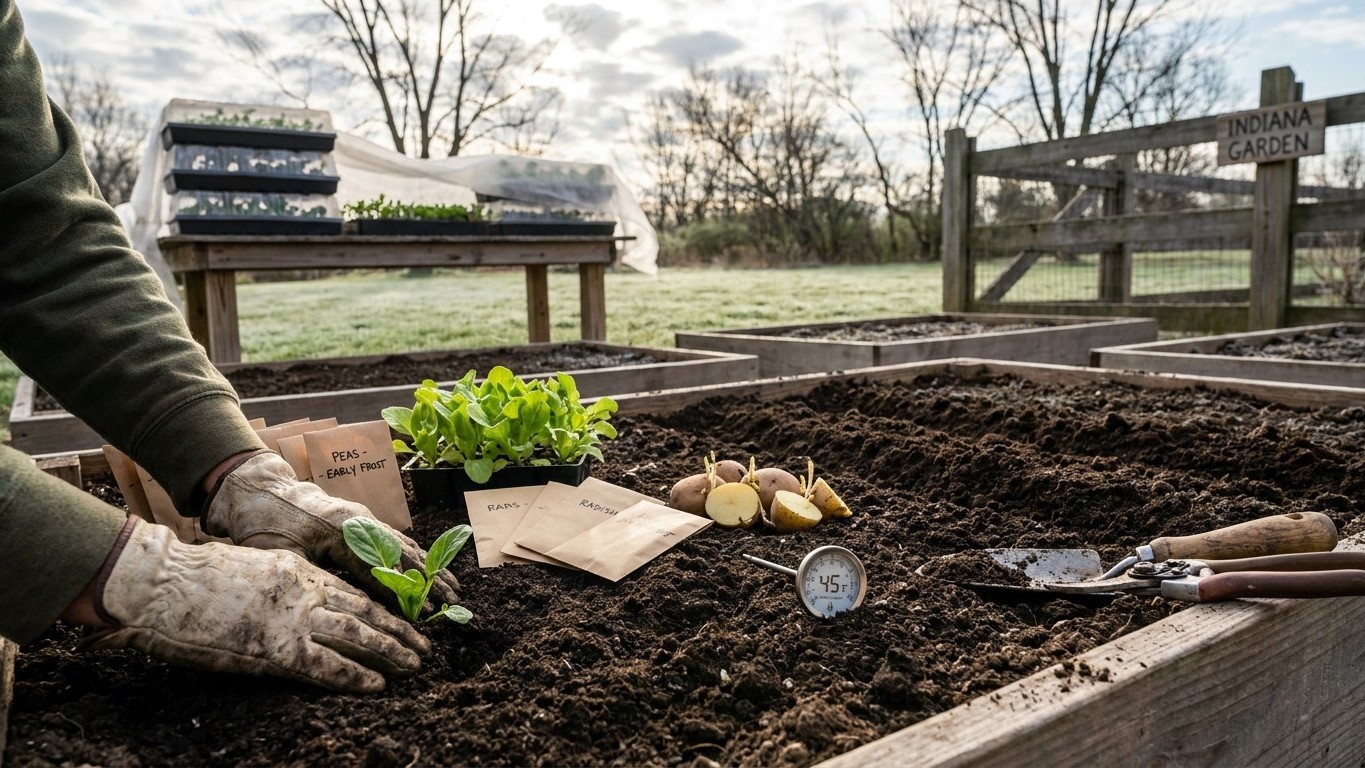

Indiana’s April splits into two gardens: what tolerates a lingering frost and what doesn’t. Peas, spinach, lettuce, onion sets, seed potatoes, kale and carrots go into the ground now. Tomatoes, peppers, beans and squash wait, because Indianapolis averages its last spring frost between April 9 and April 21, and Purdue Extension notes roughly a 10% chance of a freeze even after that. Zone matters too: Indiana spans USDA zones 5b to 7a.
What goes in the ground in April

The calendar says April, but the soil doesn’t care what the calendar says. What decides whether a seed survives this month is soil temperature and how close you are to that April 9-21 frost window measured at Indianapolis. Crops that shrug off a light freeze can go in now. Crops that can’t will rot, stall, or die back to the roots if a cold night catches them exposed.
Peas are the classic April crop here, direct-sown as soon as the soil can be worked without turning into mud. Spinach, lettuce, arugula and mustard greens follow the same rule. Radishes and carrots go in as seed, and beets too, though beets germinate slower in cold soil and reward a little patience. Onion sets and onion transplants belong in the ground this month, as do seed potatoes, chitted or not, planted deep enough that a late frost doesn’t touch the emerging shoots. Asparagus crowns and bare-root strawberries, if you’re establishing a new bed, also go in while dormant.
Garlic planted the previous fall needs nothing more than weeding and a check that mulch hasn’t smothered the emerging shoots. Bare-root fruit trees and berry canes, if they arrived by mail or from a nursery, should go into their permanent holes before buds break.
What stays out is the tender stuff: tomatoes, peppers, eggplant, cucumbers, squash, melons and green beans. Soil at 45°F feels like planting into a refrigerator to a tomato root. Setting these out because the air felt warm for a stretch is the single most common April misstep in this state, and it’s covered in more detail further down.
Timing also shifts with geography. Southern Indiana, along the Ohio River, tends to warm up and clear its frost risk earlier than the Indianapolis average; the far north, closer to Lake Michigan, runs later, sometimes by two weeks or more. That gap matters more in April than in almost any other month, because it’s the month when the decision to plant or wait is most likely to go wrong.
What to start under cover
Seed started indoors in April is aimed at the transplant window that opens once frost risk clears, typically in May for Indianapolis and its surrounding counties. Count backwards from that window rather than from the date on the seed packet. Tomatoes need roughly six to eight weeks of indoor growth before they’re ready to go outside, so an April start lines up with a May transplant. Peppers and eggplant run longer, eight to ten weeks, and are often already showing true leaves by the time tomatoes get their start. Basil, cucumbers, summer squash and melons can wait until later in April or into May, since they grow fast and resent sitting in a pot too long.
The two ways this goes wrong both cost you a harvest. Start too early, without enough light or room, and the seedlings stretch thin and leggy, tip over, and never recover their vigor even after they’re set out. Start too late, and the transplant goes into the garden small and behind schedule, chasing a shortened window before the next stretch of heat or an early fall frost, which for Indianapolis averages between October 21 and October 30, cuts the season short from the other end.
Hardening off deserves its own attention this month. Anything started indoors in February or March, and now sizeable, needs a week to ten days outside in a sheltered, part-shade spot before it goes into open ground, gradually building up sun exposure and wind tolerance. Skipping that step is a fast way to scorch or snap plants that were otherwise ready.
Cold frames and low tunnels stretch the calendar further. Lettuce, spinach and other greens sown under cover in early April often reach harvest size two to three weeks ahead of their open-ground counterparts, useful if the goal is an early crop rather than a late-season backup.
What is ready to pick
April’s harvest in Indiana leans on what survived winter rather than what was planted this spring. Overwintered kale, leeks and spinach, if they were mulched heavily or tucked under a cold frame, resume growth as soil warms and are often the first fresh green things off the property. Chives and green onions push up early and can be cut back repeatedly through the month.
Established asparagus beds, meaning ones that have had at least two or three years to build root reserves, start sending up spears as the soil warms into the 50s. The rule with asparagus is to cut while spears are still tight and firm; once the tip starts to loosen and fern out, the stalk turns woody fast. Rhubarb follows a similar timeline, with the first stalks usually thick enough to pull by mid to late April, though the leaves themselves are toxic and go straight to the compost pile, never the kitchen.
Cold-frame lettuce and radishes sown in March may be ready by the back half of the month, giving an early salad crop well ahead of the open-garden version.
Storage crops need a look too. Potatoes, onions and winter squash held over from the previous fall are at their most vulnerable now, as warming temperatures wake up any rot that was dormant. Check for soft spots, sprouting eyes on potatoes, and squash that’s gone soft at the stem end, and pull those out before they spread mold to the rest of the batch.
The jobs that matter this month
April rewards the gardener who gets ahead of the plants rather than chasing them. Soil prep tops the list: working beds only when they’re dry enough to crumble rather than clump, since tilling or digging wet Indiana clay compacts it into something closer to brick for the rest of the season. A simple squeeze test, soil that holds a ball shape and doesn’t crumble is still too wet, works fine without lab equipment.
Pruning, feeding and staking
Dormant pruning of fruit trees and berry canes needs to wrap up before buds swell much further; pruning after leaf-out stresses the plant and invites disease into fresh cuts. Established asparagus and rhubarb benefit from a top-dressing of compost or balanced fertilizer now, while they’re pushing new growth and can use the nutrients. Peas and other climbing crops should get their trellis or stakes in at planting, not three weeks later once vines are already sprawling and hard to untangle.
Weeds, pests and succession
Weed control matters more in April than it will get credit for later. Cool-season weeds germinate at the same soil temperatures that favor lettuce and spinach, and a bed weeded now stays cleaner all season than one left to catch up in May. Scout for early pests too, slugs love the same damp, cool conditions that suit lettuce, and flea beetles emerge right as brassica seedlings are at their most tender.
Succession sowing keeps the harvest coming rather than arriving all at once. Sowing a short row of lettuce or radish every two weeks through April means a steady trickle of salad greens instead of one glut followed by a gap.
What not to do in April
The most expensive mistake this month is planting warm-season crops because a few days felt like summer. Air temperature swings fast in Indiana April weather, but soil temperature lags behind by days or weeks. A tomato or pepper set out into soil still in the 40s doesn’t die outright, usually, but it stalls, and a stalled tomato transplant often ends up producing later and less than one planted two weeks after it, once the soil has actually caught up.
Uncovering tender perennials, strawberries under mulch, roses wrapped for winter, too early after a mild stretch is the second classic error. A string of 60-degree days in early April can trick a gardener into stripping protection off, right before a cold front drops temperatures back into the 20s. Purdue’s own caution about a roughly 10% chance of frost after the published last-frost window applies directly here: keep the row cover or frost cloth on hand even after uncovering, rather than putting it away.
Nitrogen timing trips people up too. Feeding fruit trees a heavy dose of nitrogen right as they’re setting blossoms pushes leafy growth at the expense of fruit set, the opposite of what most gardeners actually want in April. A lighter, balanced feeding, or waiting until after bloom, generally produces a better fruit crop.
Working wet soil rounds out the list. It feels productive to get out there and dig after a rainy week, but compacted clay soil takes years to loosen back up, and the damage done in one wet April afternoon outlasts the season it happened in.
Checking this against your own county
Indianapolis is the reference point for the frost dates and zone range on this page, but Indiana isn’t one climate. Southern counties along the Ohio River typically clear frost risk earlier in spring and hold on to warmth later in fall. Northern counties near Lake Michigan run the opposite way, often two weeks or more behind, thanks to lake effect that delays spring warming and lingering cold air off the water. Elevation shifts things further in the hillier southern counties.
Treat every date on this page as a starting point, then confirm it against Purdue Extension, which publishes county-level guidance and a state planting calendar built for Indiana’s actual range of conditions rather than a single average.
Common questions
Is it too early to plant tomatoes in Indiana in April?
For most of the state, yes. Indianapolis averages its last spring frost between April 9 and April 21, and Purdue notes about a 10% chance of frost even after that window closes. Tomatoes generally wait until soil has warmed well past that risk, usually into May.
Can I still plant garlic in April in Indiana?
Garlic is normally planted the previous fall for a summer harvest. An April planting is possible but produces smaller bulbs, since the plant misses the cold period it needs to size up properly.
What vegetables can handle a frost in April?
Peas, spinach, lettuce, kale, carrots, beets and onions all tolerate a light freeze once established. Radishes are similarly tough. These are the crops that make sense for direct sowing while frost risk is still active.
Why does Indiana’s planting timing vary so much by region?
The state’s USDA hardiness zones range from 5b to 7a, and lake effect in the north plus elevation and river-valley warmth in the south push the practical frost window weeks apart from one end of the state to the other, even though the calendar month is the same.