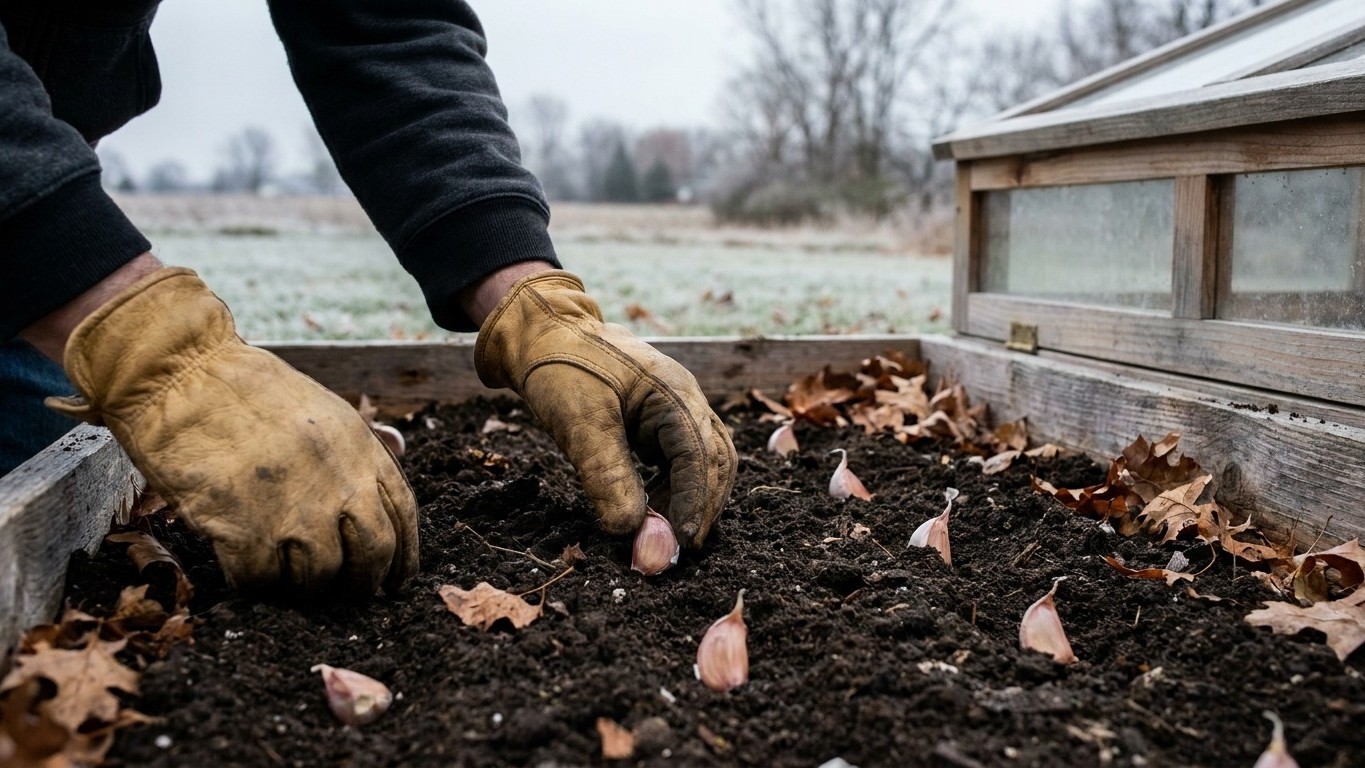

Nothing goes into open ground in most Hoosier gardens this month. Indiana’s first fall frost already landed between October 21 and October 30, and the next safe planting window doesn’t open until April 9 to April 21 at the earliest. That leaves garlic and shallots as the rare outdoor exception where soil is still workable, plus cold frames, forced rhubarb, and dormant bare-root planting for anyone determined to keep hands in the dirt.
What goes in the ground in December

The calendar says December, but the soil doesn’t care what the calendar says. What matters is soil temperature and how far the ground sits from that April 9-21 frost-free window in Indianapolis, the state’s reference point for climate data. Four months out is too far for almost anything to survive, no matter how mild a particular week feels.
In the northern third of the state, especially near Lake Michigan, ground is often frozen solid by early December and stays that way. In southern counties along the Ohio River, a mild stretch can leave soil workable well into the month, since that region sits closer to USDA zone 7a while the north hovers around 5b. That two-zone spread across one state is the reason a single planting date never fits everyone here.
Say it plainly: nothing new gets direct-sown or transplanted into open garden beds this month. But a few things still make sense if the ground hasn’t locked up:
- Garlic and shallots — ideally in by late October or November, but a workable spot in southern Indiana can still take cloves in early December
- Bare-root fruit trees and cane fruit — dormant stock can go in the ground whenever it’s unfrozen and diggable, since the plant isn’t trying to grow
- Cold frames and low tunnels — not for new sowing, but for protecting greens already established before the hard freezes hit
- Forced rhubarb and chicory — dig dormant crowns or roots, move them into a dark, cool spot indoors, and let them push tender, blanched growth with almost no light
None of this is a workaround for the season. It’s what actually survives when the ground itself has shut the door on everything else.
What to start under cover
Count backward from the last frost window rather than forward from today. Onions and leeks, the slowest standard vegetable starts, typically need 10 to 12 weeks indoors before they’re ready to go outside. Measured against an April 9-21 frost-free date, that puts their ideal start in mid-January at the earliest, not December.
That arithmetic matters because it’s the exact math that trips up impatient gardeners every winter. Start alliums now, and by the time the ground is safe to plant in April, the seedlings are rootbound, leggy, and stressed before they ever leave the tray. Start them too late, on the other hand, and they never bulk up enough to size properly before summer heat sets in. Both failures come from ignoring the countback and trusting the wall calendar instead.
December under cover is really about two things: keeping a continuous indoor harvest going, and getting equipment ready rather than seed trays. Microgreens and sprouts are the one crop that makes sense to sow indoors this month on any schedule, since they’re ready in one to two weeks regardless of outdoor conditions. Beyond that, this is the month to check grow lights still work, clean seed-starting trays, and confirm a heat mat functions before the January onion sowing actually needs it. Jumping the gun on transplants now just means replacing them in six weeks anyway.
What is ready to pick
Outdoors, the honest answer is very little. Most beds sit frozen or under snow across the state, and anything tender was harvested or lost weeks before the first fall frost passed. That doesn’t mean the kitchen goes empty.
Overwintered kale, leeks, and Brussels sprouts often hold up under a light snow cover and actually taste sweeter after a hard frost has converted some of their starches to sugar. Digging leeks and kale out from under a few inches of snow is entirely doable as long as the ground beneath isn’t frozen solid; a garden fork and patience usually beat a shovel.
Cold frames extend this further. Spinach, mache, and arugula planted before the cold set in will keep producing small, slow harvests through the winter as long as the frame keeps wind and hard freezes off the leaves. Inside, microgreens and sprouts fill the gap for anyone without a cold frame at all, ready in days rather than weeks.
The other job this month is quality control on what’s already stored. Check squash, potatoes, and onions weekly:
- Squash — press gently near the stem end; any soft spot means use it now, before it spreads
- Potatoes — pull any that have gone soft, sprouted, or turned green from light exposure
- Onions — check the neck; a softening neck means that bulb goes in this week’s meals, not next month’s
One rotting potato in a bin will take its neighbors down with it if it sits unchecked for a few weeks.
The jobs that matter this month
A quiet garden doesn’t mean an empty task list. December carries some of the highest-value work of the entire year, precisely because nothing is actively growing to distract from it.
Dormant pruning tops that list. Apple and pear trees, along with raspberry and blackberry canes, are pruned while they’re fully dormant and while fungal and bacterial diseases are far less active than in warmer months. Wounds made now heal cleanly come spring instead of inviting infection during a wet April. Pick a dry, above-freezing day rather than pruning during a hard freeze, since wood can be more brittle and prone to cracking in extreme cold.
Seed ordering belongs here too, and earlier beats later. Popular varieties, especially disease-resistant tomatoes and specialty pepper types, routinely sell out of seed houses by late winter. Ordering now guarantees the variety a gardener actually wants instead of whatever’s left on the shelf in February.
This is also the month to plan next season’s rotation on paper, while there’s no pressure to decide on the fly. Soil testing fits the same logic: with beds idle, a sample sent to a lab gives results back in time to amend properly before spring planting, rather than guessing after the fact. Turning the compost pile keeps decomposition moving even in cold weather, and a layer of leaves or straw over it holds heat in.
Round out the list with maintenance that has nowhere else to go on the calendar: cleaning and oiling pruners and shovels before they sit unused for months, repairing raised bed corners and fence posts while there’s no crop in the way, and mulching garlic and perennial beds once the ground has actually frozen, which insulates roots without inviting rodents to nest in warm, unfrozen soil.
What not to do in December
The most common mistake is trusting a mild afternoon over the calendar’s four-month gap to the next frost-free window. A 55-degree December day doesn’t mean the soil has warmed to match; ground temperature lags air temperature by weeks, and a single sunny stretch is never proof the frost risk has passed. Anything transplanted or direct-sown on the strength of a warm spell is gambling against odds that haven’t shifted at all.
A related error is uncovering cold frames or pulling back mulch too eagerly after a few warm days, only to leave plants exposed when temperatures drop again. Fluctuating exposure does more damage to dormant plants than steady cold ever does, since repeated freeze-thaw cycles heave roots and crack bark in ways a consistent freeze doesn’t.
Fertilizing is the other trap. Feeding nitrogen to dormant beds or trees now does nothing useful, since nothing is actively growing to use it. Worse, unused nitrogen either leaches away with winter rain and snowmelt or sits in the soil pushing tender new growth right before a hard freeze arrives, which then kills that growth outright. Hold nitrogen applications until closer to the actual start of spring growth, near that April frost window, not now.
Finally, don’t let stored crops go unchecked because “it’s cold enough, they’ll keep.” Cold storage slows spoilage; it doesn’t stop it. A weekly look through the potato bin and squash shelf catches problems before they spread.
Checking this against your own county
A state-wide December guide is a starting point, not an instruction sheet. Indiana’s frost dates and hardiness zones, spanning 5b to 7a, shift by a fortnight or more between the northern lake-effect counties and the Ohio River counties in the south. Elevation changes and proximity to Lake Michigan move local frost timing further still, and none of that shows up in a single statewide date.
The Indianapolis figures cited here (frost windows, zone range) are a reference, not a guarantee for any specific address. Anyone gardening seriously in Indiana should cross-check against the Purdue Extension for county-level guidance and localized planting calendars before betting a season on a statewide number.
Common questions
Can I still plant garlic in Indiana in December?
In southern counties where the ground hasn’t frozen, yes, though late October through November is the better window. Once soil is frozen or waterlogged, hold cloves until early spring instead.
Is it too late to start onion seeds indoors in December?
Slightly too early, actually. Counting back 10 to 12 weeks from the April 9-21 frost window puts the ideal onion start in mid-January, so starting in December often means leggy, rootbound seedlings by transplant time.
Do I need to cover overwintered kale and leeks during snow?
Not usually. Both tolerate snow cover well and often taste sweeter after frost. Just avoid harvesting when the ground beneath them is frozen solid, since digging can damage roots and surrounding soil structure.
Why shouldn’t I fertilize dormant plants in December?
Dormant trees, canes, and perennial beds aren’t taking up nutrients, so applied nitrogen either leaches away in winter precipitation or triggers vulnerable new growth right before a hard freeze. Wait until growth resumes near the spring frost window.