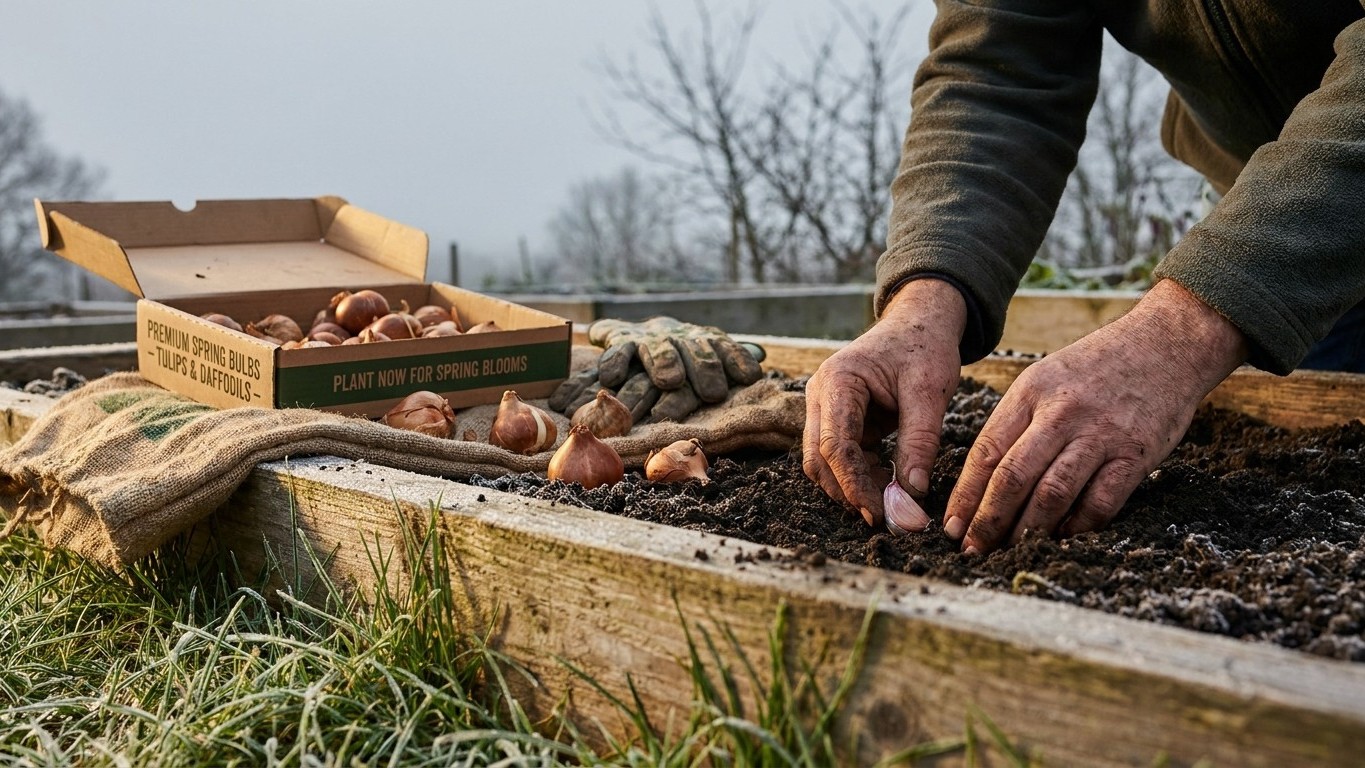

By November, most of Indiana has already had its first fall frost, so the open garden is largely closing down. Garlic and shallot cloves can still go into workable soil, spring bulbs need to get in before the ground locks up, and cold frames keep a few hardy greens going. The bigger work this month is dormant pruning, soil building, and getting tools and beds ready for the season ahead.
What goes in the ground in November

Indiana’s first fall frost lands between October 21 and October 30 in the Indianapolis area, based on NOAA’s 1991-2020 Climate Normals for station USW00093819. That means by the time November opens, most of the state has already seen at least one freeze, and mornings with frozen puddles are common. The question this month isn’t the calendar, it’s whether the soil is still workable, dry enough to dig, and not yet locked under a hard frost crust.
Garlic and shallot cloves are the exception worth planting outdoors. Both go in root-down, a few inches deep, while the ground still gives under a trowel. They root before winter shuts things down completely, then push up growth once the soil warms in spring. Spring-flowering bulbs, tulips, daffodils, crocus, belong in the same window: they need weeks of cold soil contact to bloom properly, so getting them in before the ground freezes solid matters more than getting them in early.
Almost nothing tender survives outdoors this month without help. Lettuce, spinach, and mache can keep growing under a cold frame or low tunnel, where the extra few degrees of protection make the difference between a harvest and a mush of frozen leaves. Bare-root fruit trees, berry canes, and roses can still go in while dormant, as long as the hole can be dug without a pickaxe.
| Crop or plant | Outdoors in November? | Condition |
|---|---|---|
| Garlic, shallots | Yes | Soil still workable, not frozen |
| Spring bulbs (tulips, daffodils) | Yes | Before ground freezes hard |
| Bare-root trees, canes, roses | Yes | Dormant stock, diggable ground |
| Hardy greens (spinach, mache) | Under cover only | Cold frame or low tunnel |
| Peas, lettuce, warm-season crops | No | Past the frost window for this season |
If none of that fits your plans, forcing is the other option. Potted rhubarb crowns or Belgian endive (chicory) roots brought into a dark, cool spot indoors will push tender new growth over several weeks, giving you something fresh from a garden that otherwise looks finished.
What to start under cover
Seed starting under lights makes little sense this month for anything meant to go outside in spring. Indianapolis’s average last spring frost falls between April 9 and April 21, and most transplants (peppers, eggplant, early tomatoes) need 8 to 10 weeks indoors before that window opens. Counted backward, that lands seed-starting in mid-February to early March, not November. Start those crops now and you’ll be nursing rootbound, leggy seedlings for two extra months before there’s anywhere for them to go.
What does make sense under cover this month is anything with a short cycle or a long enough runway to justify an early start. Microgreens and sprouts are ready in a matter of days on a windowsill, and they’re a genuine way to keep fresh greens coming when the outdoor garden has nothing left to offer. Windowsill herbs, parsley, chives, basil kept from a summer pot, can carry a kitchen through winter with minimal fuss.
Onions are the one crop where starting absurdly early actually pays off. Gardeners aiming for large storage bulbs sometimes start onion seed indoors in November or December, because onions need 10 to 16 weeks of growth before they’re ready to harden off, far longer than peppers or tomatoes. That’s the exception, not the rule.
The two failure modes to watch are opposite problems. Start too early, and warmth-loving transplants sit under lights for months, stretching thin and stressed before they ever see real sun. Start too late, working from a fixed date rather than counting back from the actual frost window, and short-season crops run out of growing time before summer heat or the next frost catches up with them. The fix in both cases is the same: count backward from April 9 to April 21, not from a date on the wall calendar.
What is ready to pick
Outdoors, the list is short and mostly frost-improved rather than frost-damaged. Kale, collards, and Brussels sprouts left in the ground actually taste better after a freeze or two, since cold triggers the plant to convert starches to sugars. Leeks, hardy enough to shrug off repeated freezing, can stay standing and get pulled as needed, even after a light snow. Carrots, beets, and parsnips left under a thick mulch layer can be dug right up until the ground freezes too hard to break with a shovel.
Cold frames and low tunnels extend the picking list a little further: spinach, mache, and some tougher lettuce varieties will keep producing small harvests as long as they get covered before hard freezes and uncovered on milder days for airflow.
Indoors, sprouts and microgreens are the fastest return on effort, ready within a week of sowing. That’s worth leaning on this month, since it’s the one harvest that doesn’t depend on the weather at all.
Stored crops need regular checking now, not just at harvest. Winter squash should feel firm with no soft spots or mold at the stem end. Potatoes that have started sprouting or gone soft and wrinkled should be pulled from storage before they spread rot to the rest of the bin. Onions that feel mushy near the neck are past saving and should be composted, not left to affect their neighbors.
The jobs that matter this month
Dormant pruning tops the list once trees have fully dropped their leaves. Apple, pear, and stone fruit trees, along with raspberry and blackberry canes, are easier to see and shape without foliage in the way, and cuts made while the plant is fully dormant heal cleaner than cuts made while sap is still moving. Wait until leaf drop is complete before reaching for the loppers; pruning too early, while a tree is only partly dormant, leaves open wounds more vulnerable to disease.
Seed catalogs are worth ordering from soon. Popular varieties, especially heirloom tomatoes and specialty peppers, sell out well before spring planting season, and waiting until late winter to order often means settling for whatever’s left rather than what was actually wanted.
Soil testing pays off now precisely because there’s time for amendments to work before spring. Lime added to acidic soil needs months to shift pH, and compost worked in now has all winter to break down further and integrate. Turning the compost pile itself, and insulating it with a layer of leaves or straw, keeps decomposition moving even as temperatures drop.
Tools deserve attention before they get put away for the season: cleaning off dirt and sap, sharpening blades on pruners and loppers, and a light coat of oil on metal parts prevents rust from setting in over a damp winter. Raised bed frames, fencing, and trellis posts are also easier to repair or replace now, while the ground is still soft enough to set a post, rather than after it’s frozen solid.
Mulch belongs on garlic beds, strawberry crowns, and other perennials once the soil has cooled but before it freezes hard, insulating roots without smothering growth that hasn’t gone fully dormant yet. Young fruit tree trunks benefit from a wrap or guard against rabbits and rodents, which do real damage to bark over a hungry winter.
What not to do in November
The most common mistake is treating a mild afternoon as a sign the season has more room in it than it does. A 60-degree day in the middle of the month doesn’t mean it’s safe to leave tender potted plants outside overnight, or to uncover a cold frame and forget to close it before temperatures drop after sunset. Indiana’s swings between warm afternoons and freezing nights are exactly the pattern that catches gardeners off guard.
Feeding lawns, perennials, or fruit trees with high-nitrogen fertilizer this month works against the plant rather than for it. Nitrogen pushes soft new growth right when the plant should be shutting down for winter, and that tender growth is the first thing damaged by the next hard freeze. If feeding is needed at all, a low-nitrogen or phosphorus-and-potassium-focused product supports root development instead.
Waiting too long to get garlic and spring bulbs into the ground is another version of the same problem: the ground doesn’t stay workable forever, and once it’s frozen a few inches down, there’s no forcing a clove or a bulb into place without damaging it. If soil is still diggable, that’s the signal to plant, not a specific date on a calendar.
Stored squash and potatoes left in an unheated garage or shed can freeze on a hard-cold night, turning soft and unusable within days. Storage crops need a spot that stays above freezing even when outdoor temperatures drop well below it.
Checking this against your own county
A state-wide frost window is a starting point, not an instruction for a specific yard. Indiana’s hardiness zones span 5b to 7a under the USDA system, and the Indianapolis frost dates cited here run earlier in spring and later in fall across southern counties, sometimes by a fortnight or more, while northern Indiana and areas near Lake Michigan see the reverse effect from lake moderation. Elevation shifts things further still.
For a window matched to your own county, the Purdue Extension service is the reliable next stop, along with the state’s own planting calendar resources.
Common questions
Can I still plant garlic in Indiana in November?
Yes, as long as the soil can still be worked with a trowel or shovel. Garlic cloves need to root before the ground freezes solid, but they don’t need warm soil to get started.
What vegetables can survive frost in Indiana?
Kale, collards, Brussels sprouts, and leeks tolerate repeated freezing outdoors, and many actually taste sweeter after a frost. Root crops like carrots and parsnips can stay in the ground under mulch well into the cold season.
Is it too late to plant spring bulbs in November in Indiana?
Not yet, as long as the ground hasn’t frozen hard. Tulips, daffodils, and crocus need weeks of cold soil contact before spring, so getting them in before the freeze locks in matters more than an exact date.
When should fruit trees be pruned in Indiana?
Once trees are fully dormant, after all leaves have dropped. Pruning too early, while a tree is only partly dormant, leaves cuts more exposed to disease than pruning done later in the dormant season.
Gardeners who plant by the Moon can check the November 2026 moon planting calendar, a tradition rather than a proven method.
Related guides
Elsewhere? See what to plant in November in every state and province.