
February in Indiana means frozen or waterlogged ground across most of the state, so the honest answer is that almost nothing goes into open soil this month. What you can do is plant a short list of cold-hardy exceptions outdoors, start the backbone of the spring garden under cover, and get ahead on the jobs that make March and April go smoothly.
What goes in the ground in February

The decision here isn’t the calendar, it’s soil temperature and workability. Indianapolis data puts the average last spring frost between April 9 and April 21, which means February sits roughly eight to eleven weeks ahead of that window across most of the state. Ground that far out is often still frozen at depth, saturated from snowmelt, or both, and working wet clay soil now compacts it for the whole season. So for most of Indiana, the direct-sow list this month is short and it should stay short. Padding it with lettuce or peas that will rot in cold mud does the reader no favors.
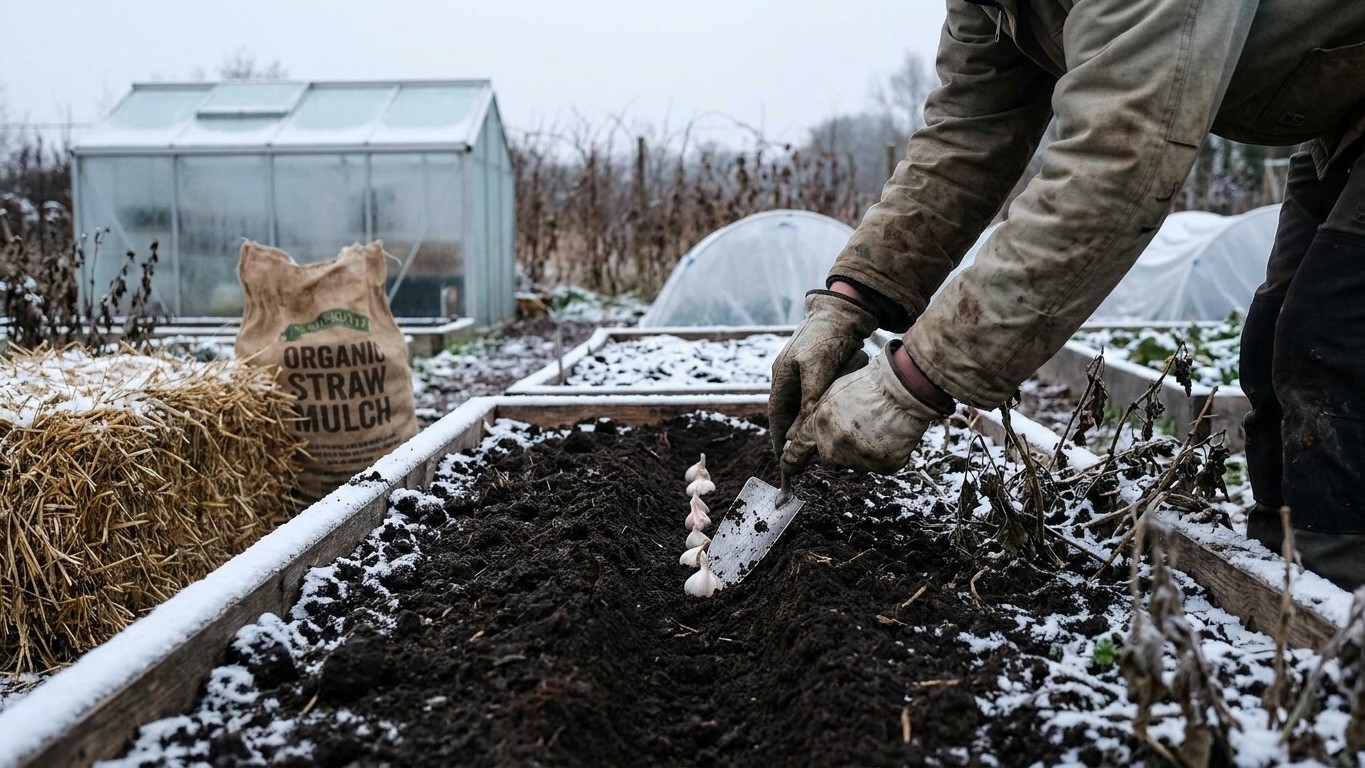
What actually has a shot: garlic and shallots, if you missed the fall planting window and the ground in southern Indiana has thawed enough to work. Push cloves 2 inches deep, cover with straw, and accept that yields will trail a proper fall planting. Bare-root fruit trees, grapevines, and berry canes can go in on a mild, dry day if the soil crumbles rather than clumps in your hand, since these are dormant and don’t care about air temperature the way seedlings do.
Cold frames and low tunnels change the math
Under glass or plastic, the rules shift. A cold frame or low tunnel can carry spinach, mache, claytonia, and other hardy greens sown in late fall through the worst of winter, and in many years you can tuck a few more seeds of the same crops into that protected soil now, since the cover buys 10 to 15 degrees over open air. That’s a real planting option this month, just not an open-ground one.
Indoors, this is also the month to force rhubarb crowns or chicory roots in a dark, cool spot for an early harvest of pale, tender stalks or Belgian-style chicons, using plants you already have rather than anything newly seeded.
What to start under cover
Count backward from the frost window instead of a fixed date, and the math works differently for every crop. Onions and leeks from seed want 10 to 12 weeks under lights before transplanting, which lands squarely in February for an April 9 to 21 target. Peppers need 8 to 10 weeks, so early to mid-February sowing gets them to transplant size right as the ground warms. Celery and celeriac run slow too, at 10 to 12 weeks, making them a February crop by the same logic.
| Crop | Weeks before last frost to sow | February start? |
|---|---|---|
| Onions, leeks (seed) | 10-12 weeks | Yes, most of the month |
| Celery, celeriac | 10-12 weeks | Yes |
| Peppers | 8-10 weeks | Yes, early to mid-month |
| Tomatoes | 6-8 weeks | Late month at the earliest |
| Cucurbits (squash, melon) | 3-4 weeks | No, too early |
The two ways this goes wrong are predictable. Start too early, working backward from the frost date incorrectly or just guessing, and you end up with rootbound, leggy tomato starts sulking on a windowsill weeks before it’s safe to plant them out. Start too late, particularly with onions or celery, and you never build the size those slow crops need before the season demands they go in the ground. If you’re unsure which side of the line you’re on, err toward the later half of the calculated window rather than the early edge, since a slightly smaller transplant recovers faster than an overgrown one.
What is ready to pick
Outdoors, the list is thin, and pretending otherwise doesn’t help anyone. What’s actually coming out of a February garden in Indiana is whatever survived under cover or under snow. Kale and leeks that overwintered in the open ground are typically still pickable, since both crops tolerate hard freezes and often taste sweeter after cold exposure. If a cold frame or low tunnel is running, spinach, mache, and claytonia can be cut a little at a time through the winter.
Indoors, sprouts and microgreens fill the gap nobody talks about enough. A jar of sprouting seeds or a tray of microgreens on a counter delivers fresh, crisp food in 5 to 10 days with zero garden access required, and it’s a reasonable stand-in for the greens the outdoor garden isn’t producing yet.
Checking the root cellar and pantry
This is also the month stored crops start to turn if they’re going to. Squash with a soft spot near the stem end, potatoes that have gone soft or sprouted heavily in storage, and onions with a squishy neck should get pulled and used or composted before they take neighboring produce down with them. A quick weekly check of the storage bins costs five minutes and saves a lot of otherwise good food.
The jobs that matter this month
Dormant pruning is the headline job, and February is close to ideal for it. Apple, pear, and stone fruit trees, along with raspberry and blackberry canes, are still fully dormant, which means you can see the branch structure clearly without leaves in the way, and cuts made now heal cleanly before spring growth starts pulling sap. Wait too long, into active bud break, and pruning stresses the plant and invites disease into fresh wounds during the wettest part of the season.
Seed ordering has its own deadline, one that has nothing to do with weather. Popular varieties, especially heirloom tomatoes and anything with a limited seed lot, sell out from suppliers well before spring. Ordering now means the seed arrives in time for the backward-counted start dates above; ordering in April means settling for whatever’s left.
- Test soil pH and nutrient levels while beds are empty, so amendments have time to work before planting
- Turn and check the compost pile, since freeze-thaw cycles slow decomposition and it may need a fresh nitrogen source
- Clean and sharpen pruning shears, loppers, and hoes before the season’s first real use
- Repair raised beds, trellises, and fencing while there’s nothing growing to work around
- Sketch out crop rotation for the coming season, moving nightshades and brassicas away from where they grew last year
None of this is filler work. A pruning cut made in February on a dormant apple tree shapes that tree’s yield for years; a rotation plan sketched now prevents a disease buildup that shows up as wilted plants in July.
What not to do in February
The classic mistake is reading a stretch of 50-degree afternoons as a green light. Air temperature and soil temperature are not the same thing, and Indiana soil in February often sits well below what a tender seedling needs even when the thermometer says spring. Setting out anything beyond the hardy exceptions covered above, based on a mild week, usually ends with transplants that stall or die when the cold returns, and it will return before the April 9 to 21 frost window closes.
A related error is uncovering cold frames or pulling mulch too early after a warm spell. Purdue’s own caution about the spring frost date applies here directly: there remains roughly a 10% chance of a 32°F freeze even after the published last-frost range passes, so anything exposed on the strength of a few warm days needs a cover ready to go back on that night.
Feeding nitrogen now is another timing error. Dormant trees, shrubs, and any hardy crops overwintering outdoors aren’t in active growth, so nitrogen applied this early either leaches away before roots can use it or pushes soft, premature growth right when a hard freeze is still likely. Hold nitrogen applications until you see actual new growth starting, not until the calendar or a warm afternoon suggests it’s time.
Checking this against your own county
Everything above is built around Indianapolis, and Indiana is bigger than one reference point. Southern counties along the Ohio River typically warm up earlier in spring and hold heat later into fall than the Indianapolis average by two weeks or more, while northern counties near Lake Michigan see lake-effect snow and a shorter, later spring. Elevation shifts things further within both regions. Treat every date and window in this article as a starting point, then check it against local conditions before committing seed or money to a planting date.
Purdue’s Cooperative Extension Service tracks county-level frost data and localized planting guidance that will sharpen these ranges for wherever you actually garden.
Common questions
Can I plant anything outdoors in Indiana in February?
Only a short list: garlic or shallots if the ground is workable, bare-root fruit trees and canes on a dry day, and hardy greens under a cold frame or low tunnel. Open, unprotected soil is generally too cold or too wet for anything else this month.
Is it too early to start tomato seeds indoors in February?
For most of the month, yes. Tomatoes need only 6 to 8 weeks before transplanting, and with the last frost typically falling between April 9 and April 21, starting much before late February risks leggy, rootbound plants by the time it’s safe to set them out.
What USDA hardiness zone is Indiana in?
Indiana spans USDA zones 5b to 7a, based on the 2023 Plant Hardiness Zone Map. That’s a wide range across one state, so a variety rated hardy in the southern Ohio River counties may struggle in the far north, and vice versa for heat tolerance.
What should I do if a warm spell hits in February?
Resist uncovering cold frames or pulling back mulch permanently. There’s still roughly a 10% chance of a freeze even after the published spring frost range ends, so keep row cover or frame lids within reach and ready to go back on the same evening.