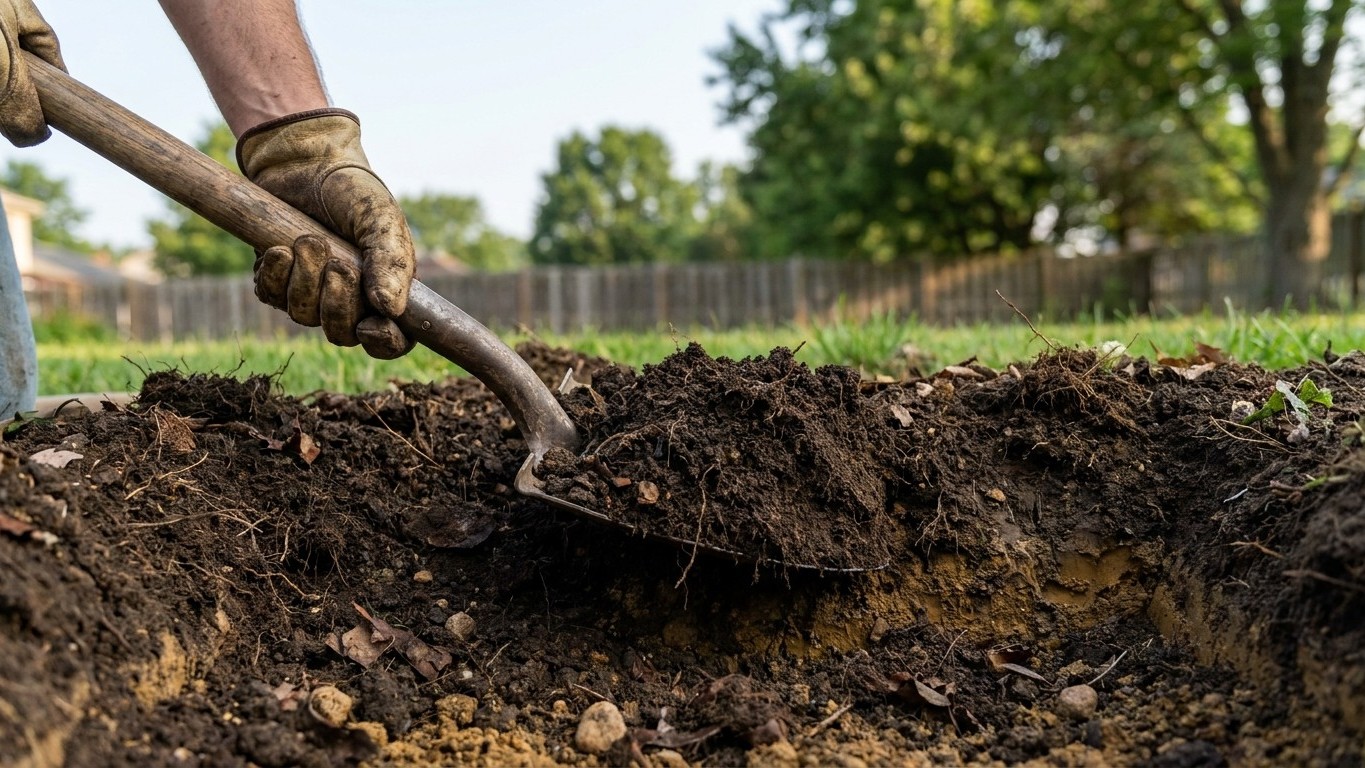

Dig a shovel into an Indiana yard and there’s a good chance you’ll hit the Miami series, a loam-to-silt soil that formed under hardwood forest and covers a large share of the state’s farmland and backyards alike. It’s not spectacular ground, but it’s workable ground, and knowing its numbers tells you exactly where to start.
What is under your garden

The Miami series is what USDA NRCS lists as representative of Indiana soil. It’s an Alfisol, a soil order that formed under deciduous forest and generally holds nutrients better than soils that developed under grassland or in wetter, more leached conditions. That forest history matters: Alfisols tend to have a clay-enriched subsoil and a topsoil that, left alone, isn’t naturally loaded with organic matter the way a prairie soil would be.
Here’s what the surface horizon actually measures, according to USDA’s Soil Data Access records for the major components of the series.
| Reading | Value |
|---|---|
| Surface pH | about 6.5 (slightly acid) |
| Sand | 30 percent |
| Clay | 20 percent |
| Silt | 49 percent |
| Organic matter | about 2.0 percent |
| Drainage class | moderately well drained |
A pH near 6.5 sits close to neutral, which is where most vegetables and lawns are happiest. The texture, 30 percent sand, 20 percent clay, and 49 percent silt, puts Miami squarely in loam-to-silt territory: not the sticky, slow-draining clay some gardeners dread, and not the sandy soil that drains too fast to hold a nutrient. Two percent organic matter is modest but workable, the kind of number that responds well to a few seasons of compost.
None of that means it’s your number. Miami is what USDA calls representative of Indiana, not a measurement of any single backyard. Hundreds of other soil series exist across the state, river bottoms behave differently than hill country, and any ground a builder has scraped, graded, or filled during construction is essentially reset to zero as far as topsoil goes. Treat the Miami figures as a starting expectation, not a verdict on your dirt.
Reading your own soil in five minutes
Two quick checks will tell you more than staring at the ground ever will. First, the ribbon test: take a moist handful of soil, squeeze it between thumb and forefinger, and push it upward into a ribbon. Clay-heavy soil forms a long, shiny ribbon over an inch or two before breaking. Sandy soil won’t ribbon at all, it just crumbles. Loam forms a short, dull ribbon that breaks quickly, which is roughly what you’d expect if your yard tracks with the Miami series.
Second, the jar test. Fill a clear jar about a third full of soil, add water to near the top, shake it hard, and let it sit overnight. Sand settles first and fastest, forming the bottom layer within minutes. Silt settles next over a few hours. Clay stays suspended longest and forms the top layer, sometimes taking a full day to clear. The thickness of each band, compared side by side, gives you a rough percentage breakdown you can eyeball against the numbers above.
Testing before you amend
Guessing at soil amendments is the fastest way to waste a growing season and a bag of money. Lime, sulfur, and fertilizer all cost cash, and applying the wrong one, or the right one in the wrong amount, can push a soil further from where you want it rather than closer. A real soil test measures your actual pH, phosphorus, potassium, and organic matter, none of which you can judge accurately by looking at dirt or by trusting a regional average.
Given that the Miami series runs a surface pH around 6.5, a gardener working typical Indiana ground might reasonably expect something in that neighborhood. That’s a fair starting guess. It’s not a substitute for a number pulled from your own bed, especially if your yard sits on fill dirt, sits low and collects runoff, or has had years of fertilizer or lime applied by a previous owner.
Taking a proper sample isn’t complicated, but skipping steps skews the result.
- Choose the area you’re testing, garden bed, lawn section, or vegetable plot, and treat each distinct area as its own sample.
- Dig 8 to 10 small cores or slices, 6 to 8 inches deep for garden beds (shallower, around 3 to 4 inches, for lawns), spaced evenly across the area.
- Mix all the cores together in a clean bucket, breaking up clumps by hand.
- Remove rocks, roots, mulch, and any surface debris from the mixed sample.
- Pull about a pint of the mixed soil, let it air dry on a tray if it’s wet, and pack it into the test lab’s sample bag or container.
- Label it clearly with the area name and date, and fill out the crop or plant type you intend to grow there, since recommendations differ for lawn versus vegetables versus shrubs.
The results will come back with a measured pH along with phosphorus, potassium, and often organic matter. That number, not the Miami series average, is what should drive any amendment you make next.
Amending it
The Miami series sits at a surface pH of about 6.5, which points toward one clear conclusion for most of the state’s typical ground: don’t add lime speculatively, and don’t add sulfur either, unless your own test says otherwise. A soil already near neutral doesn’t need a pH correction at all in most cases. The amendment story for Indiana ground is less about swinging the pH and more about building organic matter and managing texture, since the sand-silt-clay mix (30-20-49) is moderate rather than extreme in either direction.
If your test comes back below about 5.5
Some Indiana yards, particularly older lawns that have been fertilized heavily for years or ground near certain parent materials, will test more acidic than the Miami average. If your number drops below roughly 5.5, lime is the correct lever, not sulfur. Acid soil locks up phosphorus so plants can’t use it even when it’s present in the soil, and it stresses brassicas like broccoli and cabbage, which prefer closer to neutral conditions. Lime works slowly. Expect it to take a full season or more to shift pH meaningfully, since it has to react with soil moisture and microbial activity over time. This is not a fix you apply in spring and see results from by summer.
If your test comes back above about 7.3
On the alkaline side, the rule flips completely: lime should never go on ground that’s already testing high. The honest, slow route is elemental sulfur combined with steady additions of organic matter, both of which nudge pH downward over repeated seasons rather than one application. High pH also locks iron out of reach of plant roots, and that’s exactly what yellow leaves with green veins, a classic sign of iron chlorosis, are telling you. If you see that pattern on acid-loving plants like blueberries or azaleas, don’t reach for iron spray as a permanent fix, address the pH first.
Working with the clay and sand you’ve got
At 20 percent clay, Miami-type ground isn’t heavy clay, but if your own test shows a higher clay percentage, organic matter is the fix, not sand. Adding sand to clay is a classic mistake that can actually create a texture closer to concrete rather than loosening it. Never work clay soil while it’s wet, doing so compacts it into clods that take months to break down. If your soil leans sandy instead, organic matter again does the work, but expect to water more often and in smaller amounts, since sandy ground won’t hold moisture or nutrients in place the way loam does. Organic matter additions show results within a season or two. Structural fixes for heavy clay, by contrast, often take two to three years of consistent compost and cover cropping before the texture visibly changes.
Drainage and compaction
Miami series soil is classed as moderately well drained, which in practical terms means water moves through it steadily but not instantly. After a hard rain, you might see standing water in low spots for an hour or two, but a well-structured Miami-type bed shouldn’t stay soggy for a day or more. If your yard does hold water that long, something other than the native soil, compaction, poor grading, or a clay lens closer to the surface, is likely the real cause.
A simple percolation test settles the question. Dig a hole about a foot deep and a similar width, fill it completely with water, and let it drain once. Fill it again and time how long it takes to drop, say, 6 inches. A result of 1 to 3 inches per hour is typical of moderately well drained ground and workable for most garden plants. Anything slower than an inch an hour signals a drainage problem worth addressing before you plant.
Compaction from foot traffic, parked equipment, or heavy machinery during construction can turn even good Miami-type soil into a slow-draining mess, since compacted soil loses the pore space that lets water and air move through. Double digging, once the standard fix, has fallen out of favor because it’s labor-intensive and can bring up subsoil that’s worse than what you started with, while disturbing the soil structure and microbial life that took years to build.
- Do: add organic matter yearly, keep foot traffic off wet beds, and use raised beds where drainage tests poorly.
- Avoid: tilling or digging clay-heavy ground while it’s wet, and piling sand into clay hoping to loosen it.
- Plant elsewhere or raise the bed: if your percolation test runs under an inch per hour even after amendment, stop fighting the native soil and build up instead of down.
On ground that tests consistently slow and stays wet for a day or more after rain, a raised bed is often the honest answer rather than three years of amendment that may never fully solve a grading or subsoil problem underneath.
Local help
Purdue University’s Cooperative Extension Service runs Indiana’s soil testing program and can point you to the current lab options and county-level guidance for interpreting your results. Find your local office and testing details through Purdue Extension. County educators typically walk through the report with you, translating raw numbers into what to add and how much.
Common questions
Is all Indiana soil the Miami series?
No. Miami is the series USDA lists as representative of the state, but Indiana contains hundreds of mapped soil series, and river bottoms, hill country, and disturbed urban lots can differ substantially from it.
Do I need to test my soil if I already know the state average?
Yes. The state figures describe a mapped natural surface horizon, not your cultivated bed, and construction, fertilizer history, and drainage can all push your actual numbers away from the regional expectation.
How often should I retest my soil?
Every 2 to 3 years for an established garden is typical, or sooner if you’ve made a major amendment and want to confirm it worked.
What does a 2.0 percent organic matter reading mean for planting?
It’s a workable starting point but on the low side for vegetable gardening. Most gardeners aim to build toward 5 percent or higher through regular compost additions over several seasons.