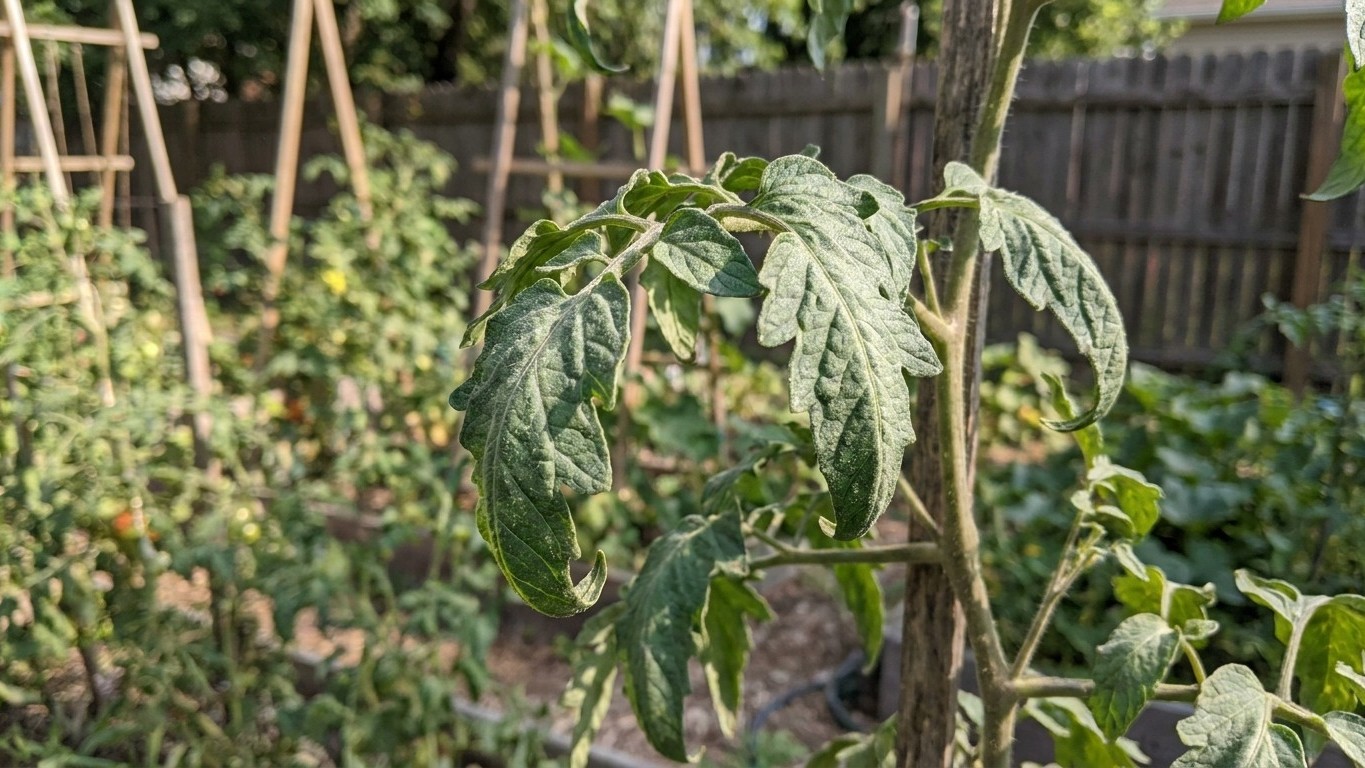

Curling tomato leaves are usually a physiological stress response, not a disease, and most plants recover without treatment. The leaves cup upward and feel leathery, starting with the oldest leaves low on the plant, in reaction to heat, drought swings, or transplant shock. Herbicide drift and virus infection cause curling too, each with different clues. Check the newest growth at the top of the plant: if it looks green and normal, the plant is not in serious trouble.
What you are looking at

The classic sign is a leaf that rolls upward from its edges, so the leaflet forms a loose tube along its length instead of lying flat. It usually starts on the oldest leaves near the base of the plant and moves upward as stress continues, though a sudden heat spike can affect the whole plant at once. The leaf tissue itself stays firm and leathery to the touch, and the color underneath is ordinary green, not pale, yellow, or blotched.
Where it starts and what it is not
Physiological curl leaves the leaf surface smooth and unmarked. If you also see brown or tan spots with concentric rings, you are looking at a fungal disease such as septoria leaf spot or early blight, not stress curl, and that calls for a different response entirely. If the growing tip looks stunted, mottled with light and dark patches, or narrow and fernlike, that points to herbicide injury or a virus, and the next section will help you tell those apart.
The plant otherwise keeps growing normally with stress curl: flowers keep opening, fruit keeps sizing, the vine keeps extending. Curled leaves on a plant that is otherwise thriving is the single best sign you’re dealing with temporary stress, not disease.
What actually causes it
Physiological leaf curl is the plant’s way of cutting water loss. When roots can’t pull up moisture as fast as the leaves are losing it, usually because of high heat, wind, or a dry spell following heavy rain, the plant rolls its leaves inward to reduce the surface exposed to sun and moving air. It is not a sign of disease or nutrient shortage, and it is not caused by overwatering, despite that being a common guess. Heavy pruning or over-fertilizing with nitrogen can make plants more prone to it, since lush new growth loses water faster than the roots underneath can replace it.
Herbicide drift and virus explained
Herbicide injury, most often from 2,4-D or dicamba drifting over from a nearby lawn or field application, works on a different mechanism. These are growth-regulator herbicides, and at low doses they disrupt cell division in new tissue rather than damaging leaves that are already mature. The result is twisted, narrow, strap-like new leaflets and a downward curl rather than the upward roll of stress. Drift damage often shows up on other broadleaf plants in the same yard at the same time, a clue stress curl never gives you.
Viral infection, particularly tomato yellow leaf curl virus, spreads through whitefly feeding rather than through the air. It produces upward curling too, but it comes bundled with stunted growth, small pale flowers, and yellowing along the leaf margins that does not clear up once the weather cools. Unlike physiological curl, a virus does not reverse itself.
| Cause | Leaf direction | New growth | Reversible |
|---|---|---|---|
| Heat or water stress | Rolls upward into a tube | Normal, green | Yes, once conditions improve |
| Herbicide drift | Twists, often downward | Narrow, strap-shaped, distorted | Sometimes, if dose was light |
| Viral infection | Rolls upward, with stunting | Small, mottled, yellowing | No |
What to do now

If you’ve confirmed physiological curl, there is nothing to fix on the plant itself. Fruit already set is not affected, and the curled leaves will flatten again once temperatures moderate or the plant catches up on water. Keep the soil evenly moist rather than swinging between soaked and bone dry, since that swing is what triggers the curl in the first place. Mulch around the base to buffer soil moisture and temperature, and hold off on heavy nitrogen feeding until the stress passes, since it pushes tender new growth that struggles even more under the same conditions.
When the damage is herbicide or viral
Herbicide drift is a different conversation. Mild exposure often lets the plant grow out of it: leaves that emerge after the drift event look normal again, and fruit already forming usually finishes fine, though it can come out misshapen if exposure was heavy. Watch the growing tip for the next couple of weeks. If new leaves keep coming in twisted, the dose was high enough that the plant likely will not recover fully, and there is no treatment that reverses it, only time.
Virus is the one case where waiting doesn’t pay off. Once tomato yellow leaf curl virus is confirmed, the plant will not recover, and it becomes a source of infection for whiteflies to carry to your other tomatoes. Removing and destroying the plant protects the rest of the row. It’s worth checking nearby plants for the same stunting and yellowing while you’re at it, since whiteflies move fast in warm weather. If flowering has also stalled, the cause may overlap with what’s covered in Tomato Plants Not Setting Fruit: Temperature, Pollination and Too Much Nitrogen, so it’s worth ruling out both at once.
What does not work
Gardeners reach for calcium first, because curling gets lumped in with the same worry that drives Blossom End Rot on Tomatoes: Why Calcium Is Rarely the Real Problem. Crushed eggshells worked into the soil, foliar calcium sprays, and adding garden lime to soil that already has plenty of calcium all miss the point here, since leaf curl from heat or water stress has nothing to do with calcium levels. Even where calcium genuinely factors into a tomato problem, the calcium is usually already present in the soil. The plant simply cannot move it to where it’s needed fast enough under stress, and none of these additions changes that transport problem.
Trimming off the curled leaves is another common reflex, and it doesn’t help either. In the physiological case those leaves aren’t dying or diseased, they’re conserving water, and removing them only cuts the plant’s total leaf area for photosynthesis without touching the underlying moisture swing.
What people try for virus and drift, and why it fails
Spraying an infected plant with insecticide to knock back whiteflies after tomato yellow leaf curl virus has already taken hold does not cure that plant. It can slow spread to its neighbors, but the infected one stays infected. Fungicides, sometimes reached for out of habit when any leaf looks off, do nothing here either, since none of these three causes is fungal. And once herbicide injury has occurred, no rinse, spray, or soil drench pulls the chemical back out of the plant’s tissue. Time and new growth are the only paths back, if the dose was light enough to allow it.
Preventing it next time
Consistent soil moisture matters more than anything else on this list. A thick layer of mulch, straw, shredded leaves, or grass clippings keeps the root zone from swinging between soaked and parched, and that swing is the trigger behind most physiological curling. Watering deeply on a regular schedule, rather than a quick daily splash, does more to prevent curling than any other single change. Deep watering encourages roots to grow far enough down to ride out short dry spells without the plant needing to roll its leaves to compensate.
Cutting drift and virus risk
Site selection heads off herbicide drift before it starts. Keep tomato beds away from lawns treated with broadleaf weed killers, and give neighbors a heads-up if your plants sit close to a shared property line. Drift travels further on windy days than most people expect, and a plant several rows back can still show symptoms.
Whitefly control is the main lever against viral curling, since that’s how tomato yellow leaf curl virus moves plant to plant. Reflective mulch, yellow sticky traps, and clearing out volunteer tomatoes and weeds that host whiteflies over winter all cut the population before it reaches your rows. If curling shows up alongside yellowing that follows a distinct pattern rather than spreading evenly across the leaf, compare it against Yellow Leaves on Tomato Plants: What the Pattern Tells You to sort out whether virus or a nutrient issue is more likely. Getting the basics of siting, spacing, and watering right from the start, the fundamentals covered in How to Grow Tomatoes, prevents most of the stress curling gardeners deal with in the first place.
Common questions
Will curled tomato leaves flatten back out?
Yes, if the cause is heat or water stress, the leaves usually flatten again once the weather cools or the plant catches up on watering. Herbicide-damaged and virus-affected leaves generally do not flatten out, since the distortion happens inside the tissue rather than as a temporary response to conditions.
Is curling the same thing as leaf roll virus?
Not necessarily. “Leaf roll” gets used loosely to describe physiological curling from heat and water stress, which is far more common and has nothing to do with any virus. True viral leaf curl comes with stunting, yellowing, and small distorted flowers alongside the curl, not curling on its own.
Can I still eat tomatoes from a plant with curled leaves?
Yes, if the curling is physiological stress, since it doesn’t affect the fruit at all. If the plant has herbicide damage, fruit that finished sizing before the exposure is generally fine to eat, though badly deformed fruit is worth discarding on appearance alone. Fruit from a virus-infected plant is typically small and lower quality but not unsafe.
Why is only one plant in my row curling and not the others?
That pattern points toward something localized rather than a garden-wide issue like heat. A single affected plant near the edge of a bed suggests herbicide drift from one direction, root disturbance from nearby digging, or a whitefly that happened to land there first if a virus is involved. Check the plants immediately downwind or closest to a shared fence line before assuming the whole planting is at risk.