
December in Kansas answers most planting questions with a flat no. The state sits weeks past its first fall frost, soil temperatures are dropping toward the freeze line, and open-ground sowing is finished until spring returns. What’s left is real work all the same: dormant planting of garlic and bare-root stock where the ground still gives, cold frames holding hardy greens, and the season’s most useful indoor tasks, from pruning to seed ordering to soil testing through K-State Research and Extension.
What goes in the ground in December

Kansas crosses its first fall frost somewhere between October 23 and November 2, based on 1991-2020 climate data from the airport weather station used for statewide reference. By December, most of the state is four to six weeks past that mark, and soil temperatures at planting depth have usually dropped into the 30s and low 40s, sometimes lower in the north and at higher elevation. That is too cold for germination of almost anything. Direct sowing and transplanting into open ground are, for practical purposes, closed for the month across the state.
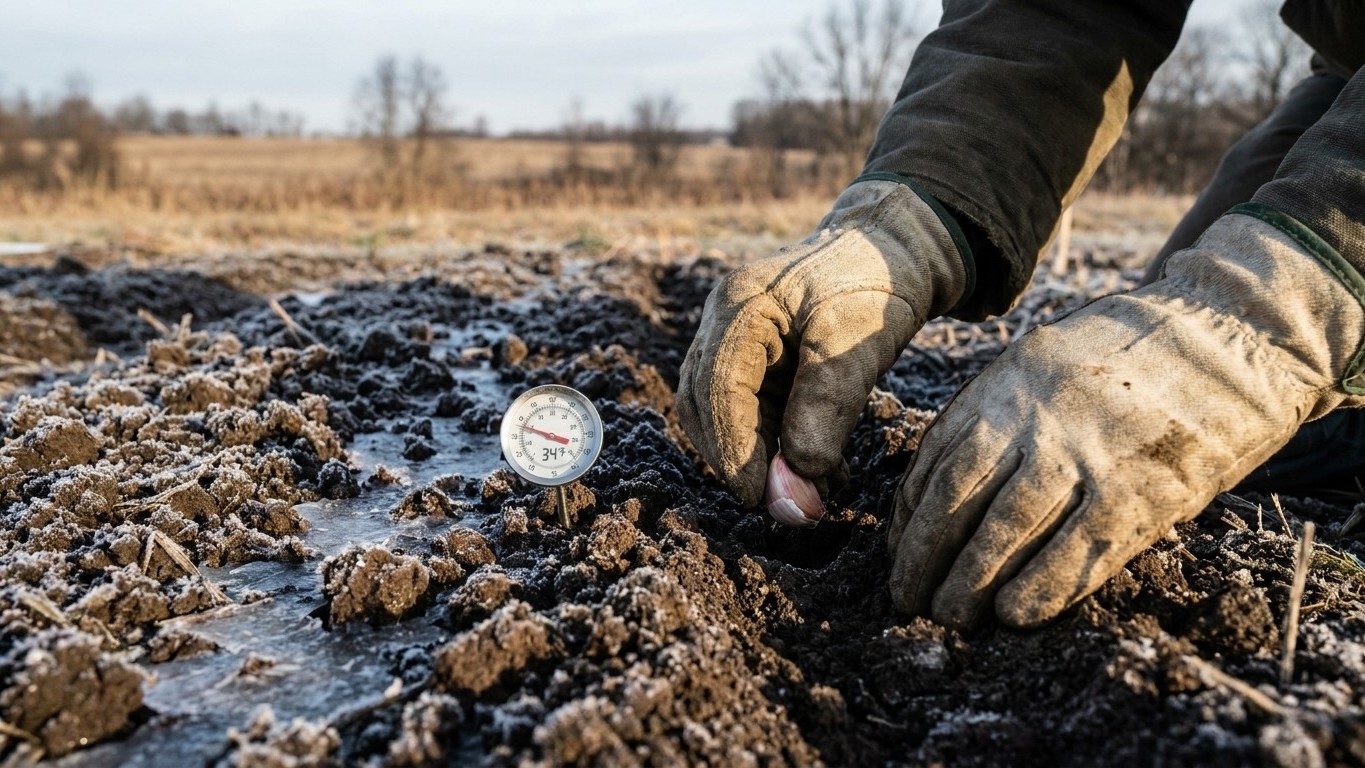
The one gamble worth naming is garlic. Gardeners who missed the usual October-November window sometimes still get cloves into the ground in early December if the soil hasn’t frozen solid, especially in the southern tier of the state where the USDA hardiness zone runs closer to 7a. It’s a late planting, not an ideal one: root development before hard freeze will be thin, and the harvest may lag behind a properly timed crop. Shallots follow the same logic and carry the same risk.
Bare-root and dormant planting is a better bet. Fruit trees, roses, and cane fruits like raspberries and blackberries can go into prepared holes while they’re fully dormant, provided the ground can still be dug. Frozen or waterlogged clay is a hard stop; if a shovel won’t go in cleanly, wait. Cold frames and low tunnels are the other legitimate December ground activity, but they’re not for planting new crops so much as protecting what’s already established: spinach, mache, and hardy lettuce sown weeks earlier can keep producing under cover long after the open beds have shut down.
Indoors, this is also the month to force rhubarb crowns or chicory roots in a dark, cool space for an early harvest of tender stalks or blanched chicons. It isn’t glamorous, but it’s genuine production at a time when nothing else in the yard is offering much.
What to start under cover
Working backward from a last spring frost of April 4 to April 18 is the only honest way to schedule indoor starts, because the calendar date means nothing without that arithmetic. Onions and leeks, which need roughly ten to twelve weeks of indoor growth before transplant, land their seeding window in mid-to-late January for most of the state. Peppers, at eight to ten weeks, follow a few weeks after that. Counted this way, December sits ahead of nearly every standard seed-starting date in Kansas, which makes it a poor month for tomatoes, peppers, or onions started under lights.
What December is genuinely good for is cold stratification. Many native perennials and some hardy flower seeds, milkweed, coneflower, and a range of prairie natives among them, need a period of cold, moist dormancy before they’ll germinate. Sealing seed in damp sand or a paper towel inside a bag in the refrigerator, or using the outdoor winter-sowing method with covered containers left exposed to freeze-thaw cycles, uses this month’s cold to do work that can’t be rushed later. It’s slow, low-effort, and exactly suited to a month with little else to plant.
The two failure modes to watch for run in opposite directions. Start long-season transplants like onions or peppers too early and they turn rootbound and leggy on a windowsill weeks before it’s safe to plant them out, wasting vigor that won’t come back. Start stratification-dependent seed too late, skipping the cold period the seed actually needs, and germination rates drop even after the seed goes outside in spring. Matching the method to the calendar backward from April, rather than forward from the day the seed catalog arrives, avoids both mistakes.
What is ready to pick
Outdoors, the honest answer is close to nothing. Any crop still standing in an open Kansas bed in December has likely already been damaged by the frosts that arrived in late October or early November. That said, a few things persist. Kale and collards, both genuinely frost-hardy, can still be picked after a snow if the plants weren’t killed outright, and cold actually sweetens their flavor by converting starches to sugar. Leeks left in the ground under a thick mulch layer can be dug as needed, since their tolerance for freezing soil is better than almost any other allium.
Cold frames change the picture. Spinach, mache, and hardy lettuce varieties sown in fall keep growing slowly under glass or plastic even when outside temperatures sit well below freezing, and they can be harvested a few leaves at a time through the whole month. Indoors, sprouts and microgreens fill the gap for households wanting something fresh and fast; both are ready in days rather than weeks and need no outdoor conditions at all.
The other December harvest is really an inspection. Stored squash, potatoes, and onions should get checked now for the ones starting to turn: a soft spot on squash, a sprout pushing out of a potato, or a papery onion that’s gone soft at the neck are all signs to pull that item and use it immediately, before rot spreads to the rest of the bin. One bad squash left in a box of good ones is a fast way to lose the whole batch.
The jobs that matter this month
Dormant pruning is the biggest task on the December list, and the timing genuinely matters. Fruit trees, grapevines, and cane fruits are pruned while fully dormant and while the plant’s structure is easy to see without leaves in the way; cutting now, before sap starts moving in late winter, reduces stress on the plant and lowers the risk of disease entering fresh wounds during a period of active growth. Wait too long and the pruning window closes as buds begin to swell.
Seed ordering belongs on this month’s list too, and not as an afterthought. Popular onion, tomato, and pepper varieties routinely sell out of seed companies’ stock during the winter ordering season, and gardeners who wait until the indoor-starting window in January or February often find their first-choice varieties already gone. Ordering now, while shelves are still full, is simple insurance against a scramble later.
Soil testing fits naturally into a month with no outdoor sowing competing for attention. A sample sent to K-State Research and Extension now returns results in time to plan amendments before spring beds need prepping, rather than guessing at fertility after the fact. Compost piles still benefit from turning even in cold weather, since an active pile generates its own heat and keeps breaking down slower but steadily through winter. Tools deserve the same attention: cleaning soil and rust off blades and sharpening edges now means everything is ready the moment spring digging starts, instead of losing the first good planting day to maintenance.
Round out the month by checking raised bed frames and fencing for winter damage, mulching the base of young trees and perennials against hard freezes, and mapping next season’s crop rotation on paper while the beds themselves are empty and easy to think about clearly.
What not to do in December
A mild stretch of 55 or 60 degree days is common in Kansas in December, and it fools people. Uncovering cold frames or pulling mulch off perennials because it feels like winter’s over is the month’s most repeated mistake; a hard freeze almost always follows a warm spell, and plants that had their protection stripped too soon take the full hit. Leave the covers on until the pattern of consistently colder days is well established, not just after one warm afternoon.
Feeding nitrogen to lawns, shrubs, or dormant perennials this month is another common error. Dormant plants aren’t taking up nutrients the way they do during active growth, so fertilizer applied now either washes away with winter precipitation or, worse, triggers a flush of tender new growth that has no chance of hardening off before the next freeze kills it. Save nitrogen for the growing season, when roots can actually use it.
Trying to work soil that’s frozen or waterlogged is a third trap. Digging, tilling, or even walking heavily on clay-based Kansas soils while they’re saturated compacts them for a full season, undoing structure that took years to build. If a shovel doesn’t slide in cleanly, the ground is telling the gardener to wait, not to push through.
Last, don’t assume stored crops are fine because the box looks fine from the outside. Skipping the monthly check on squash, onions, and potatoes is how one soft spot turns into a ruined bin by the time anyone opens it again.
Checking this against your own county
Every figure here comes from one reference weather station, and Kansas is too large and too varied for a single date to apply evenly. Elevation, local wind patterns, and simply being north versus south of the state can shift frost windows by two weeks or more, and rural or low-lying gardens often run colder than the airport data suggests. Treat everything above as a starting point, then confirm it against local conditions through K-State Research and Extension, which maintains county-level guidance and a Kansas-specific planting calendar built for exactly this kind of adjustment.
Common questions
Can I still plant garlic in Kansas in December?
It’s possible if the ground hasn’t frozen, but it’s a late planting. Cloves get less time to root before dormancy, which usually means a smaller harvest than garlic planted in October or November.
Is it too early to start onion or pepper seeds indoors?
Yes, for most of Kansas. Counting back from the April 4 to April 18 last-frost window, onions and leeks need seeding roughly ten to twelve weeks ahead, which lands in mid-to-late January, and peppers a few weeks after that.
What can I actually harvest from a Kansas garden in December?
Very little outdoors beyond overwintered kale, collards, or leeks that survived the fall frosts. Cold frames extend spinach, mache, and lettuce, and indoor sprouts or microgreens fill the rest of the gap.
Why does pruning fruit trees now matter more than in fall?
Full dormancy means the tree’s branch structure is visible and the plant is under less stress from cuts. Pruning before sap movement resumes in late winter also lowers the risk of disease entering fresh wounds.