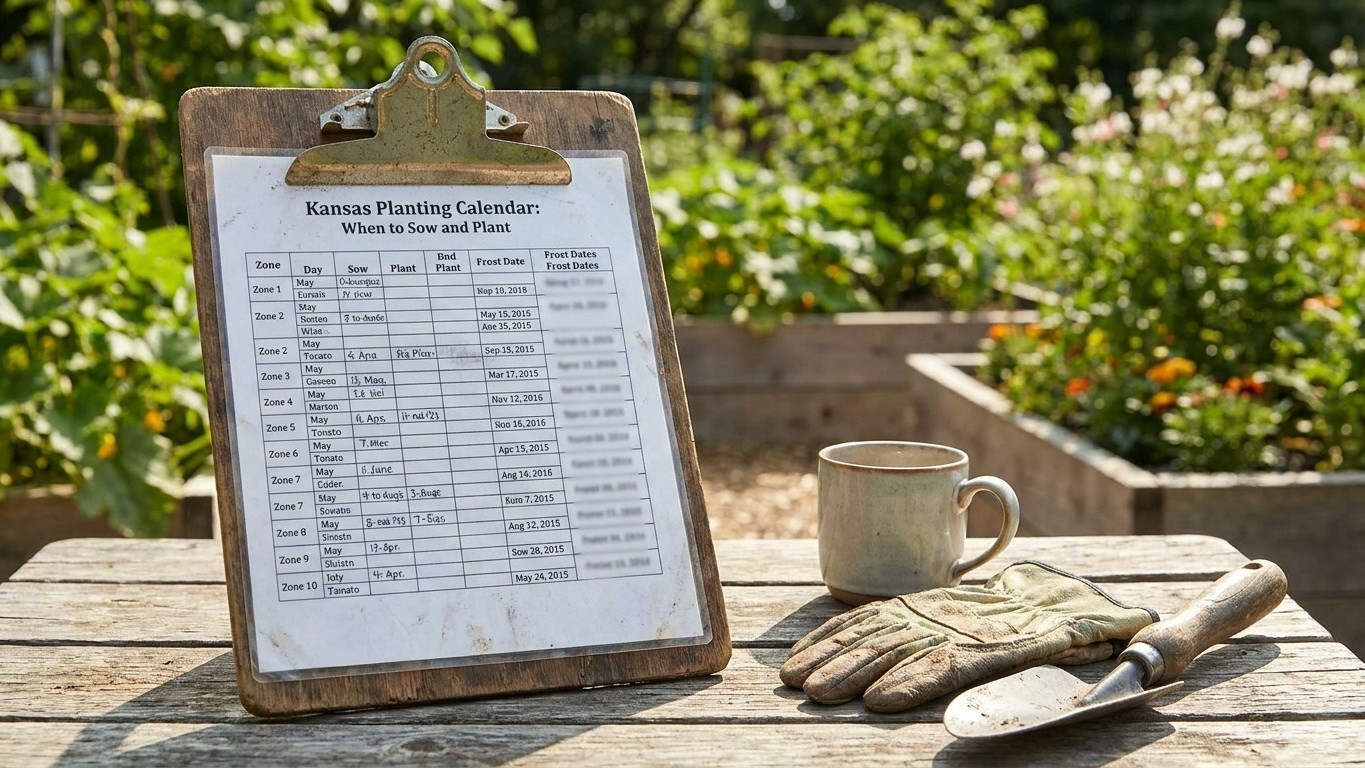

Wichita’s April 4 to April 18 window for the last spring freeze is the number every Kansas planting calendar leans on—and it’s a probability band, not a guarantee, built from 30 to 70 percent odds of a 32°F freeze at one airport station. Move to a low frost pocket or up in elevation toward western Kansas, and that window slides a week or two later in spring, earlier in fall. That shift, more than any calendar date, decides when seed actually belongs in your ground.
The frost window in Kansas

Everything on a Kansas planting calendar traces back to two dates. At Wichita, NOAA’s National Centers for Environmental Information puts the last spring freeze, using the 1991-2020 climate normals and the 30 to 70 percent probability band for a 32°F freeze, at April 4 to April 18. The first fall freeze at the same station falls between October 23 and November 2. Those two ranges bracket the frost-free season for the reference city that most Kansas planting guides use as a baseline.
That window is not the same everywhere in the state. Wichita sits in south-central Kansas at a fairly low elevation, and the NOAA figures above come from the airport weather station there. Gardens in the surrounding suburbs and countryside typically see the last spring frost run later, and the first fall frost arrive earlier, often by one to two weeks, with the gap widening further at higher elevation toward western Kansas. A garden sitting in a low frost pocket, or up on higher ground, can lose two to three weeks of usable season compared to what the Wichita numbers suggest.
Do the arithmetic and Wichita’s frost-free stretch runs somewhere in the neighborhood of six to seven months, depending on which end of each range a given year lands on. That is enough margin for two full plantings of many crops, cool season in spring and again in fall, with the frost-free middle reserved for tomatoes, peppers, and other heat lovers—see What to Plant in Kansas in January for planning the season before it starts, What to Plant in Kansas in March for the earliest cool season starts, What to Plant in Kansas in July for what fits into that peak summer window, while What to Plant in Kansas in April covers the cool season crops that open the season, What to Plant in Kansas in May carries that momentum into the transition toward summer planting, What to Plant in Kansas in September picks that second cool season planting back up as fall approaches, and What to Plant in Kansas in November picks back up once that first fall freeze closes out the frost-free stretch, What to Plant in Kansas in June bridges that gap as spring gives way to early summer, and What to Plant in Kansas in October closes out that second cool season planting as the first fall freeze approaches heat, What to Plant in Kansas in August picks up as that summer heat begins tapering toward the fall planting push, What to Plant in Kansas in December rounds out the calendar once the garden has gone dormant, and What to Plant in Kansas in February covers the indoor starts and early prep that set up the whole season before that frost window even opens. The reason to work with the range instead of picking one date out of it is simple. A gardener who plants toward the earliest possible last-frost date and gets the latest one instead has lost nothing. A gardener who plants toward the latest date and gets an early frost can lose an entire tray of seedlings overnight.
Year to year variability is also part of the picture. Some years the freeze breaks at the early edge of the range, other years it holds on past the late edge, and there is no way to know in advance which kind of year you are in. Treat both ranges as live possibilities every spring and fall rather than narrowing them down to a guess.
Cool-season crops
Peas, spinach, lettuce, brassicas, and root crops go into the ground while frost is still a real possibility, because all of them tolerate at least a light freeze once they are established. The trigger for these crops is not a calendar month, it is the last spring frost date itself. Most go in four to six weeks ahead of it, which in Wichita’s case means working backward from the April 4 to April 18 window into early to mid-March for the earliest sowings.
Which crops tolerate the cold, and why
Peas are the most frost-hardy of the group and can go into the ground as soon as the soil can be worked, well ahead of the frost date, since germinating pea seed shrugs off soil temperatures that would rot warm-season seed outright. Spinach and lettuce follow similar logic. Both germinate in cold soil, and the seedlings tolerate a hard frost once they have a few true leaves, so gardeners sow them a few weeks before the last frost rather than waiting for it to clear.
Broccoli, cabbage, and kale go out as transplants a few weeks before the last frost date as well, though they hold up better as transplants than as direct-sown seed, since the seedling stage is the most frost-tender part of their life cycle. Root crops split the difference. Carrots, beets, and radishes are direct-sown, and radishes in particular grow fast enough to deliver a full crop between when the soil first opens up and when the frost window closes.
- Peas: direct sow as soon as soil is workable, well before the last frost
- Spinach and lettuce: direct sow a few weeks before the last frost
- Broccoli, cabbage, kale: set out transplants a few weeks before the last frost
- Carrots, beets, radishes: direct sow through the cool weeks leading up to the frost date
The common thread is that none of these crops need warm soil to get going, and most actually perform worse once daytime highs climb into genuine summer heat. That is why a Kansas planting calendar treats cool-season crops as spring, and often fall-repeat, crops rather than something to succession-sow all summer long.
Warm-season crops

Tomatoes, peppers, squash, beans, and corn all germinate and grow poorly in cold soil, so the last spring frost date is only the first hurdle, not the finish line. Soil temperature is the real gatekeeper. Warm-season seed can rot before it sprouts if the soil is still cold even after the air has stopped freezing, which is why Kansas gardeners typically wait a further stretch of warm weather past the frost window rather than planting on the frost date itself.
Starting tomatoes indoors
Tomato transplants are usually started five to six weeks before they go into the ground. Since Wichita’s last spring frost falls between April 4 and April 18 per NOAA’s 1991-2020 normals, and outdoor set-out for tomatoes typically runs from mid-April to early May to give the soil extra time to warm, counting back five to six weeks lands seed-starting indoors in early to mid-March. That is a range calculated from two other ranges, so treat it as a planning window rather than a single date, and shift it later if your own soil is slow to warm in a given year.
Days-to-maturity figures on a seed packet are counted from transplant, not from seed, and they shift by a week or two either way depending on the season’s heat. Cross that catalogue number against the frost window to see how much margin a variety leaves before the first fall frost. Sakura and Sun Gold mature fast enough to leave well over 115 days of margin, while a long-season paste tomato leaves closer to 96.
Peppers need even more sustained heat than tomatoes and are usually the last transplants to go into the ground, generally after the soil has had a further week or two to warm past the tomato-planting window. Squash, beans, and corn are typically direct-sown once frost danger has passed, since all three germinate quickly in warm soil and gain nothing from an early, cold-soil start. Corn in particular tends to just sit and rot in the ground if it goes in before the soil has warmed enough for quick germination.
The table below cross-checks days-to-maturity for tomato varieties in our catalogue against Wichita’s frost window, showing roughly how much season is left after the first fruit ripens. All of them assume the same mid-April to early May transplant window built from that frost range.
| Variety | Days to maturity | Type | Key resistance | First ripe | Margin before fall frost |
|---|---|---|---|---|---|
| Sakura | 55 | Indeterminate | Nematodes, Tomato Mosaic Virus, Fusarium Wilt 1&2 | Late June | 119 days |
| Edox | 55 | Indeterminate | Nematodes, Tomato Mosaic Virus, Fusarium Wilt 1&2 | Late June | 119 days |
| Valentine | 55 | Indeterminate | Early Blight (Intermediate) | Late June | 119 days |
| Glacier | 55 | Determinate | None listed | Late June | 119 days |
| Sun Gold | 57 | Indeterminate | Tobacco Mosaic Virus, Fusarium Wilt 1 | Late June | 117 days |
| Supersweet 100 | 60 | Indeterminate | Verticillium Wilt, Fusarium Wilt 1 | Early July | 114 days |
| Juliet | 60 | Indeterminate | Late Blight, Early Blight | Early July | 114 days |
| Amalfi | 68 | Determinate | Nematodes, Late Blight, Early Blight | Early July | 106 days |
| Cherokee Purple | 72 | Indeterminate | None listed | Mid July | 102 days |
| Big Beef Plus | 72 | Indeterminate | Nematodes, Gray Leaf Spot, Tomato Mosaic Virus | Mid July | 102 days |
| Tiren | 75 | Indeterminate | Verticillium Wilt, Tomato Mosaic Virus, Fusarium Wilt 1 | Mid July | 99 days |
| Granadero | 75 | Indeterminate | Nematodes, Verticillium Wilt, Tomato Mosaic Virus | Mid July | 99 days |
| Celebrity Plus | 78 | Determinate | Nematodes, Gray Leaf Spot, Tomato Mosaic Virus | Mid July | 96 days |
| San Marzano II | 78 | Indeterminate | None listed | Mid July | 96 days |
A gardener transplanting into cooler soil, or gardening further from Wichita, should push the whole schedule later by the same one to two weeks noted for the frost dates themselves. The margins above still hold, they just start from a later point on the calendar.
The fall planting window
Fall planting works backward from the first frost instead of forward from the last one. Wichita’s first fall freeze, per NOAA’s 1991-2020 normals, falls between October 23 and November 2, and a fall crop needs to reach usable size before then, with extra time built in because cooler autumn days slow growth compared with the same days-to-maturity figure printed for a summer planting.
Counting backward with a buffer
The standard approach is to take a crop’s days-to-maturity, add roughly two extra weeks to account for shortening daylight and cooling soil, and count back from the earliest date in the frost range rather than the latest, since a fall crop that finishes early costs far less than one caught by frost. A crop rated at 60 days effectively needs closer to ten weeks of calendar time once that slowdown is factored in.
Lettuce, spinach, and other quick greens are natural fits for a second planting, since they are the same cool-tolerant crops used in spring and mature fast enough to fit into the window after summer crops are cleared. Brassicas such as kale and broccoli can go in for a fall crop the same way, and many gardeners find the fall crop of these outperforms the spring one because it matures into cooling weather instead of building heat.
Root crops planted for fall, particularly carrots, are worth leaving in the ground through the first light frosts rather than pulling them the moment they reach size. The cold triggers the roots to convert stored starch into sugar, and the flavor improves noticeably. Kale and Brussels sprouts do the same thing above ground, turning sweeter after a frost instead of being damaged by it. None of this applies to tomatoes and other warm-season crops, which need to be harvested or pulled before the first frost of the range arrives, since a hard freeze ends their season outright.
Gardeners further north work with a much tighter fall margin. In Michigan, for example, the frost-free season closes earlier in the year than it does in Kansas, which is covered in the Michigan Planting Calendar; Kansas’s later first-frost range gives a few more weeks of slack for a fall planting to finish out properly.
Reading a planting calendar properly
A state-wide planting calendar, including this one, is built from a single weather station, and Wichita’s numbers do not describe every county in Kansas. Elevation, local terrain, and how built-up an area is all shift the frost window, sometimes by more than the one to two weeks NOAA’s own station-based caution suggests. A garden in a low valley that collects cold air can freeze weeks after a garden on a nearby ridge has cleared its last frost, and a garden inside a city benefits from the urban heat island effect that keeps nighttime lows a few degrees higher than the surrounding countryside.
A calendar built for a very different climate makes the same point from the other direction. Saskatchewan’s growing season is far shorter than Kansas’s, and a schedule built for it, laid out in the Saskatchewan Planting Calendar, compresses the same cool-season-then-warm-season-then-fall logic into a much narrower window. The underlying method, working from frost dates rather than calendar months, holds everywhere. Only the dates themselves change.
What to track instead of trusting the date alone
- A soil thermometer at planting depth, checked over several mornings, tells you more than any date on a chart
- Your own frost log from past years, kept even informally, narrows the range faster than a station average
- Local microclimate cues: a slope that drains cold air, a south-facing wall, a low spot that collects frost first
- A late cold snap after a warm stretch, which catches gardeners who plant to the earliest date in a frost range
Treat the ranges in this calendar as the outer edges of what is reasonable, then narrow them using what actually happens in your own yard over a season or two of watching.
Local help
For frost dates specific to your own county, along with soil testing and planting guidance tailored to your part of the state, contact Kansas State Research and Extension through the extension service rather than relying on the Wichita-based ranges above. Extension agents can also help time fall plantings using local frost records instead of state-wide averages. For more region-specific advice, our Kansas guides cover crops and timing in more depth.
Common questions
Can I plant tomatoes before Wichita’s last frost date?
You can, but you’re gambling on soil that is probably still too cold for the roots to establish well, even if the air itself does not freeze. Most Kansas gardeners get a stronger plant, and often an earlier real harvest, by waiting until soil has had a week or two of warmth past the frost window rather than racing the calendar.
My town isn’t Wichita. How do I adjust these dates?
Start with the ranges given here, then shift your last frost later and your first frost earlier by roughly one to two weeks if you’re in a rural or higher-elevation part of the state, since that is the pattern NOAA’s station-based normals typically miss. Kansas State Research and Extension can usually supply county-level frost data if you want a tighter estimate.
Is it too late to plant anything if I missed early spring?
Not for the whole season. Fast crops like radishes, lettuce, and bush beans still fit into a Kansas summer even after the classic cool-season window has closed, and the fall planting window described above gives a second full opportunity for the same cool-season crops later in the year.
Should I cover tomatoes if a late frost is forecast after I’ve already transplanted?
Yes. A frost that arrives after transplants are already in the ground can still kill them even though the calendar says the danger has passed, since the frost ranges given here describe probability, not certainty. Row cover, buckets, or water-filled cloches placed over plants the evening before a forecast frost usually gets them through a single cold night.
What USDA hardiness zone is Kansas in?
Hardiness zone maps describe average winter minimum temperatures, which matter for perennials and fruit trees, not for timing annual vegetables like the crops in this calendar. Check the USDA hardiness zone map alongside your county extension office for the number that applies to your specific location, since it varies across the state.
Some gardeners layer an older custom on top of frost dates: planting by the moon, which we explain as almanac tradition, not fact.
Related guides
- Nebraska Planting Calendar: When to Sow and Plant, Frost Dates Included
- Missouri Planting Calendar: When to Sow and Plant, Frost Dates Included
- Michigan Planting Calendar: When to Sow and Plant, Frost Dates Included