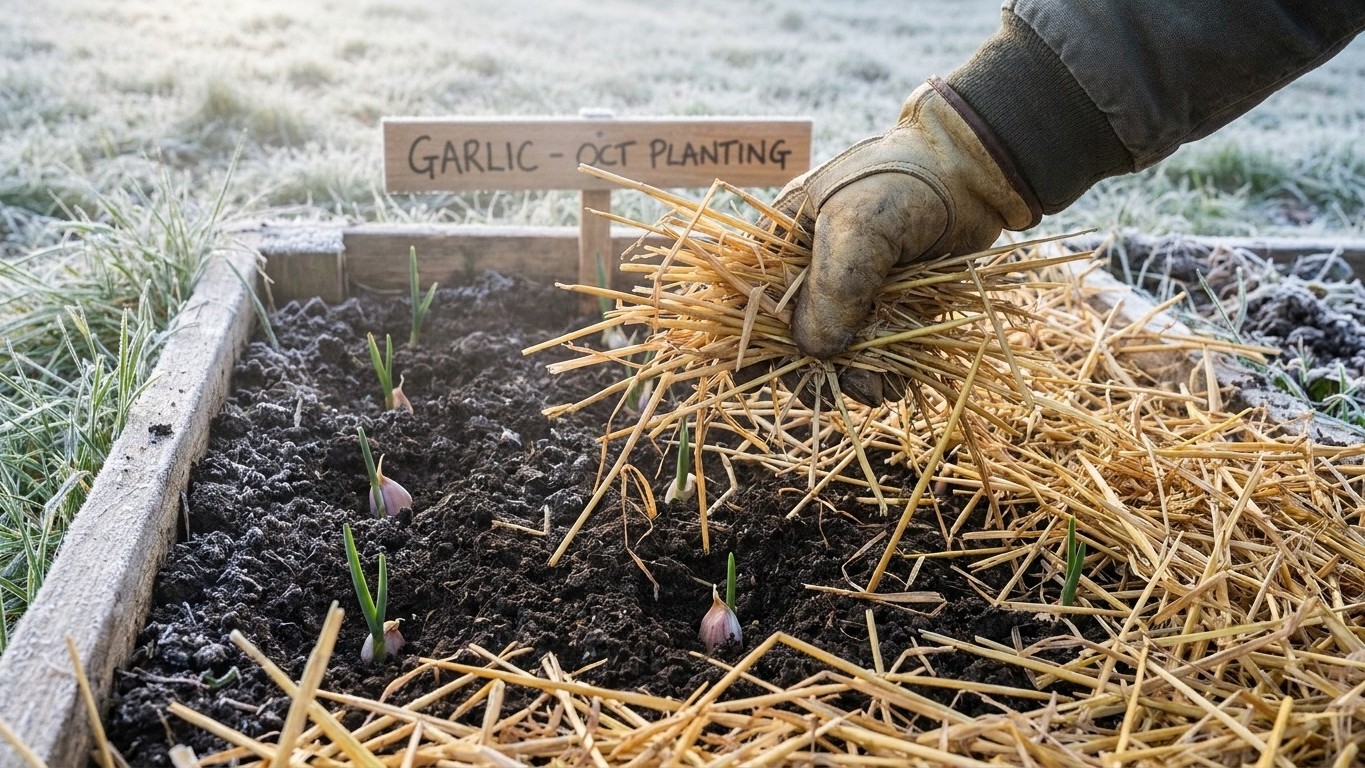

By December, Maine’s growing season is closed for direct outdoor planting almost everywhere in the state. The frost window ran from October 9 to October 21, so the soil has been cooling for weeks and is frozen or snow-covered across most counties. What’s left this month is narrow but real: mulching fall garlic where it’s already in, tending cold frames, forcing a few crops indoors, and the pruning and planning work that sets up next season.
What goes in the ground in December

The decision here isn’t the calendar, it’s soil temperature. Maine’s first fall frost lands between October 9 and October 21 depending on location (NOAA NCEI 1991-2020 Climate Normals for the Portland reference station), and by the time December arrives, ground temperatures across nearly the entire state have dropped well below the range where roots can establish. That’s true whether the air feels unseasonably mild or bitterly cold on a given afternoon. Air temperature lies. Soil temperature doesn’t.
So the honest answer is that nothing new goes into open ground in Maine this month, for almost anyone. Garlic and shallots are the one narrow exception, and only where the ground hasn’t frozen solid yet, mostly in a mild coastal pocket in a light-winter stretch. If you missed the fall garlic window, that door is now closed until spring, not this month.
What’s actually productive right now:
- Mulching fall-planted garlic and shallots with straw or shredded leaves, 4 to 6 inches deep, to buffer freeze-thaw cycles
- Cold frames and low tunnels holding hardy greens that were already established before the ground closed
- Forcing witloof chicory roots or rhubarb crowns indoors in a dark, cool space for winter harvests
- Checking mulch on any perennial beds, berry canes, or newly planted trees for wind-thrown gaps
None of this is new planting in the usual sense. It’s protecting what’s already committed to the ground and pulling a harvest out of storage roots instead of soil. That distinction matters more in Maine’s zone 3b to 6a range (USDA Plant Hardiness Zone Map, 1991-2020 normals) than in almost any other New England state, because the gap between the mild coast and the cold interior is wide enough to change what’s even worth attempting.
What to start under cover
The math for indoor starting runs backward from the last spring frost, which falls between April 22 and May 1 at the Portland reference point (NOAA NCEI, 1991-2020 Climate Normals) and later still inland and to the north. Most transplants count back 6 to 10 weeks from that window, which lands their sowing dates in late winter, not now. Onions and leeks, the slowest common vegetable starts, count back closer to 10 to 12 weeks, which still points to sometime after the new year, not December itself.
That means December under cover is mostly a preparation month rather than a sowing month. Starting too early is the real trap here: seedlings sown now for crops that won’t transplant until May will be leggy, rootbound, and stressed long before the ground is ready to receive them. The opposite failure, starting too late, doesn’t apply yet because the window hasn’t opened.
What legitimately belongs on a December list is narrower: sprouting seeds and microgreens on a windowsill or under lights, which run on a days-to-harvest cycle rather than a frost calendar, and cold-stratifying seeds for perennials or hardy flowers that need weeks of chilling before they’ll germinate at all. Some growers also use this stretch to pot up and force spring bulbs indoors for bloom, which is a different project entirely from vegetable starting but keeps growing lights and trays in use.
If you’re tempted to get ahead by starting peppers or tomatoes now, resist it. Count back from April 22 to May 1, land on the actual sowing date for your crop, and mark it. December’s job is getting the lights, trays, and seed inventory ready, not filling them yet.
What is ready to pick
Outdoors, the list is short. Anything still standing in the garden this month is there because it was planned for cold tolerance months ago, not because it grew fast enough to catch up. Kale, especially varieties bred for hardiness, and leeks that were hilled up in fall can often be dug out from under snow cover, sometimes sweeter after hard frost has converted some of their starches to sugar.
Cold frames and low tunnels are doing more work than open beds right now. Spinach, mâche, and hardy lettuce varieties planted in late summer can hold through December inside that extra layer of protection, growing slowly if at all but staying edible far longer than they would exposed.
Indoors, sprouts and microgreens are the closest thing to a fast, reliable harvest this month, ready in days rather than weeks. Beyond that, the household is largely living off what’s already in storage. This is the point to go through the root cellar or basement shelves and check winter squash for soft spots near the stem, potatoes for sprouting or shriveling, and onions for soft necks or sprouting. Pull anything questionable now rather than letting one rotting squash take down the crate around it.
The jobs that matter this month
A quiet garden doesn’t mean a quiet to-do list. December in Maine is when several jobs either get done on schedule or slip into a rush next spring, and a few of them have real deadlines attached.
Pruning and structural work
Dormant pruning on fruit trees and berry canes is a December-through-late-winter job, done while the plant is fully asleep and the branch structure is easy to see without leaves in the way. Skip it now and you’re pruning into active growth later, which stresses the plant and invites disease into fresh cuts at the worst possible time.
Ordering and planning
Seed catalogs move fast on popular varieties, and ordering now beats discovering in March that the onion or tomato variety you counted on is sold out. This is also the natural window to sketch next season’s crop rotation, since the beds are empty and the plan doesn’t have to compete with actual planting decisions.
Soil, compost, and tools
Soil testing can be done on frozen or near-frozen ground in some cases, but even where sampling has to wait, this is the time to request test kits and plan amendments so they’re ready to apply the moment soil is workable. Turning compost keeps microbial activity going even in cold weather. Cleaning and sharpening pruners, hoes, and shovels now means they’re ready to grab in spring instead of rusted shut.
Storage and structures
Beds, fencing, and cold frame frames that took wind or ice damage are easier to repair now, while nothing is growing and access is unrestricted, than in the scramble of spring planting. And storage crops need a recheck every few weeks all winter, not just once at the start.
What not to do in December
The most common mistake this month is trusting a mild afternoon over the actual season. A stretch of unseasonably warm days can make it tempting to pull mulch off garlic beds or vent a cold frame wide open, but Maine’s winter weather swings hard, and exposed crowns or greens can take real damage when the cold snaps back days later. Leave winter protection in place through the season rather than reacting to a single warm spell.
Feeding nitrogen to anything dormant is another one to skip. Dormant trees, shrubs, and overwintering crops aren’t using nitrogen for growth right now, and applying it can push a burst of tender new growth if a warm stretch follows, growth that then gets killed by the next hard freeze, weakening the plant going into the rest of winter.
Pruning during an extreme cold snap causes its own problems: wood becomes brittle and prone to tearing rather than cutting cleanly, and open wounds are slower to seal over in deep cold. Pick a milder day within the dormant window instead of forcing the job on the coldest afternoon available.
Finally, don’t let stored crops sit unchecked because “it’s too cold to bother.” Rot spreads in storage regardless of the temperature outside, and a single soft potato or squash left in a crate can take out everything around it within a few weeks.
Checking this against your own county
Every date and zone here is a statewide starting point, not a guarantee for your specific yard. Maine’s hardiness range runs from 3b to 6a (USDA Plant Hardiness Zone Map, 1991-2020 normals), and coastal Portland sits at the mild end of that range while inland valleys, higher elevations, and the northern counties run colder, with spring arriving later and fall frost arriving earlier than the coastal reference dates.
| Region | General pattern | What it means for December |
|---|---|---|
| Coastal south (Portland reference) | Mildest zone band, latest fall frost, earliest spring frost | Ground may stay workable slightly longer into the cold season |
| Interior and northern Maine | Colder zone band, earlier fall frost, later spring frost | Ground typically frozen solid well before December begins |
For a planting calendar built around your own county, check the University of Maine Cooperative Extension, which tracks local conditions the statewide averages can’t capture.
Common questions
Can I still plant garlic in Maine in December?
Only where the ground hasn’t frozen yet, which is a narrow and unreliable window even on the mild coast. If your garlic is already in, focus on mulching it rather than planting more.
Is it too late to start seeds indoors for spring?
No, but December is early for most crops. Count back from the April 22 to May 1 frost window for your crop’s lead time before sowing; most vegetable starts land in January or February, not December.
What can I actually harvest in Maine right now?
Overwintered kale and leeks under snow or mulch, greens held in cold frames, and sprouts or microgreens grown indoors. Everything else is coming from storage.
Should I prune fruit trees in December?
Yes, dormant pruning is appropriate through the winter months, but avoid doing it during an extreme cold snap, since wood is more likely to tear than cut cleanly at very low temperatures.