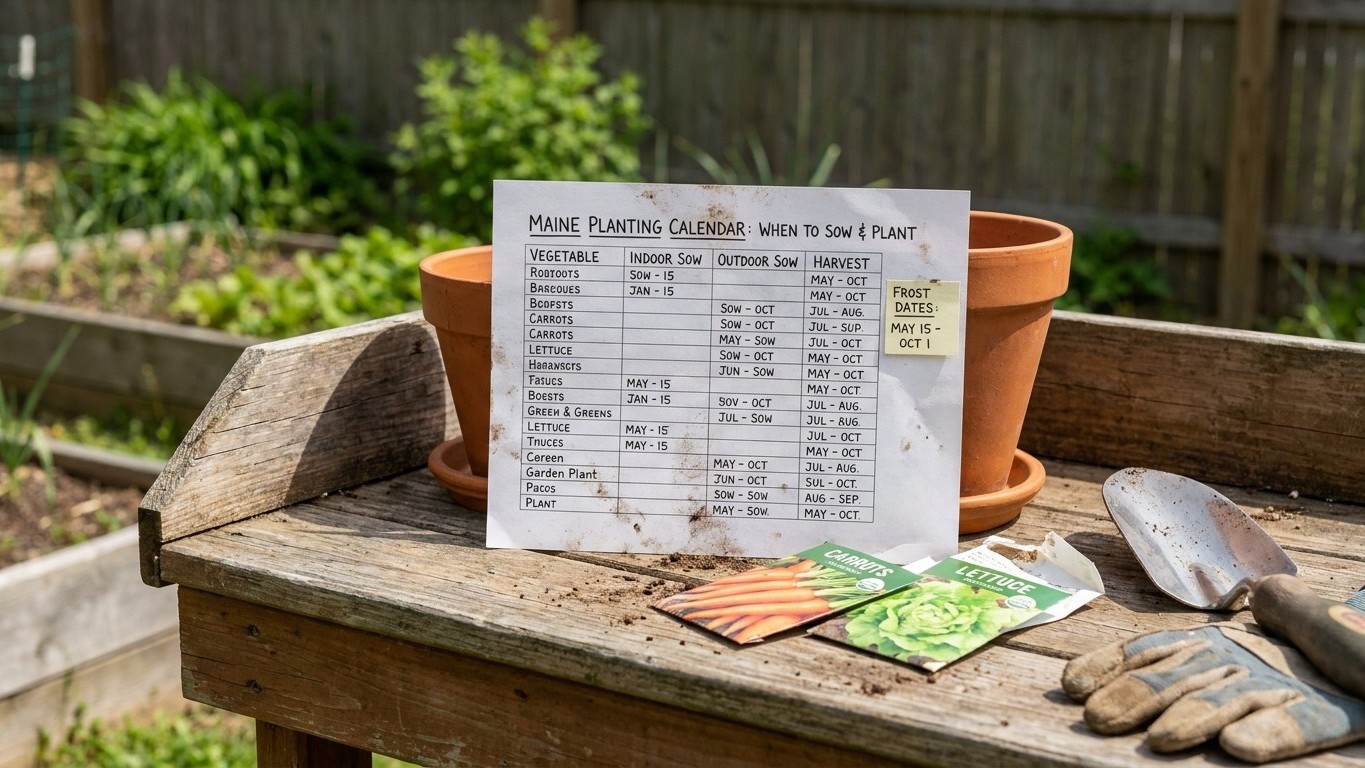

Maine’s growing season hinges on one thing: your town’s frost window, not Portland’s. Portland gardeners get April 22 to May 1 for the last spring frost and October 9 to 21 for the first fall frost — but inland and up north, both dates shift against you by weeks, sometimes a full month. That gap between your local frost record and Portland’s is what actually decides when you plant this year. So before anything goes in the ground, pull your own town’s frost data and measure the difference yourself.
The frost window in Maine

Portland’s last spring frost falls between April 22 and May 1, and its first fall frost arrives between October 9 and October 21. Both figures come from NOAA’s NCEI 1991-2020 Climate Normals, calculated from the 30 to 70 percent probability band for a 32°F freeze at the Portland Jetport weather station. That band is deliberately wide: it’s the range in which a frost is neither a near-certainty nor a rare event, which is why it reads as a window rather than a single date. If you’re planning your earliest sowings, see What to Plant in Maine in February for what can go in before that window even opens, while What to Plant in Maine in March covers the sowings that follow as the window draws nearer.
What the window means for the season length
Stretch those two windows out and Portland’s frost-free season runs from roughly 170 to 173 days, depending on where the actual frost falls within each range in a given year. Call it a bit over five and a half months at the coast. That’s enough time for a full run of warm-season crops with room to spare, provided you don’t plant into cold soil just because a date on a calendar has passed. As the window starts to open but frost risk still lingers, What to Plant in Maine in April covers the transitional sowings that bridge late winter and true spring. Once the soil has warmed and the frost risk has truly passed, What to Plant in Maine in May covers the crops that go in right as that window opens. Once the season is in full swing, What to Plant in Maine in June covers the warm-season crops that take advantage of that longer stretch, and What to Plant in Maine in July covers the crops that keep that momentum going at the height of summer. Once that long stretch reaches its midpoint, What to Plant in Maine in August covers the succession sowings and fall-crop timing that keep the season going, and as the frost window edges closer, What to Plant in Maine in September covers the last succession sowings before that window narrows, while as that same window starts to close again, What to Plant in Maine in October covers what still has time to go in before the first fall frost arrives.
Coastal Portland is the mild end of Maine, and the caution matters more here than almost anywhere else in New England. Inland and northern Maine run substantially later in spring and earlier in fall, which shortens the frost-free season by real weeks, not days. Towns in Aroostook County or up in the western mountains routinely see frost linger into late May and return before the end of September, a season that can be a full month shorter than Portland’s. If you garden away from the coast, treat every date in this article as a starting point to push later in spring and earlier in fall, not as your actual schedule. Before the season even starts, What to Plant in Maine in January covers the indoor prep and early planning that get you ready for those shifted dates. As that earlier fall frost approaches, What to Plant in Maine in November lays out what still fits once the season winds down. Massachusetts, just to the south, works through the same frost-window logic on a milder timeline. The Massachusetts Planting Calendar shows how much difference a few hundred miles of latitude and a longer coastline make to the same set of crops.
Cool-season crops
Cool-season crops go into the ground on the far side of the last frost date, not after it. Peas, spinach, lettuce, brassicas, and root crops all tolerate cold soil and a light freeze far better than heat, and holding them until after Portland’s last frost window closes in early May wastes weeks of usable growing time.
What goes in early, and why it survives
Peas and spinach can go into the ground as soon as the soil can be worked, well before the last spring frost, because both germinate in cold soil and shrug off a light freeze once they’re up. Lettuce is nearly as tough: transplants started indoors a few weeks ahead can go outside under a light row cover while frost is still a real possibility, and direct-sown lettuce seed handles cold soil about as well as spinach does.
Brassicas, meaning broccoli, cabbage, kale, and their relatives, are usually started indoors and moved out as hardened-off transplants before the last frost date, since a young transplant that’s been gradually exposed to outdoor conditions tolerates a freeze far better than one moved straight from a warm windowsill. Root crops like carrots, beets, radishes, and turnips are direct-sown, and radishes in particular are fast enough to get a full crop in before the soil warms up for tomatoes.
- Peas and spinach: direct-sow as soon as the ground can be worked, ahead of the last frost window
- Lettuce: direct-sow early, or set out hardened-off transplants before the last frost
- Brassicas (broccoli, cabbage, kale): start indoors, transplant out before last frost once hardened off
- Carrots, beets, radishes, turnips: direct-sow in cold soil, well ahead of warm-season planting
The frame that matters here is Portland’s own last-frost window of April 22 to May 1, from NOAA’s 1991-2020 normals. Gardeners on the coast can start these crops in early April with row cover as insurance. Inland and northern gardeners, working with a later frost window, should shift the entire schedule back by however many extra weeks their own local frost history runs behind Portland’s, which is a question your county’s extension office can usually answer with actual local data.
Warm-season crops

Tomatoes, peppers, squash, beans, and corn don’t care what the calendar says about frost. What they care about is soil temperature, and cold, wet soil will rot seed or stunt a transplant even on a day with zero frost risk. That’s why warm-season planting is described as a wait after the last frost window, not a countdown to it: Portland’s last frost falls between April 22 and May 1 per NOAA’s normals, and warm-season transplants generally go out from early May to mid May, once both the air and the soil have had time to actually warm up rather than the instant the frost risk clears.
Tomato varieties by days to maturity
Every tomato’s days-to-maturity figure on the seed packet is counted from transplant, not from seed, and it shifts by a week or two depending on the season’s own weather. Set transplants out early May to mid May in the Portland area, and you can work forward from there using the catalog number for whatever cultivar you’re growing. Short-season types like Sakura (55 days) clear their first ripe fruit by early July, leaving roughly 92 days of margin before Portland’s earliest fall frost on October 9. Longer types like San Marzano II (78 days) don’t ripen until early August, which still leaves about 69 days of margin in Portland, but far less if you’re gardening somewhere with a shorter local season.
| Variety | Days to maturity | Habit | Set out | First ripe | Margin before fall frost |
|---|---|---|---|---|---|
| Sakura | 55 | Indeterminate | Early to mid May | Early July | 92 days |
| Edox | 55 | Indeterminate | Early to mid May | Early July | 92 days |
| Valentine | 55 | Indeterminate | Early to mid May | Early July | 92 days |
| Glacier | 55 | Determinate | Early to mid May | Early July | 92 days |
| Sun Gold | 57 | Indeterminate | Early to mid May | Mid July | 90 days |
| Juliet | 60 | Indeterminate | Early to mid May | Mid July | 87 days |
| Supersweet 100 | 60 | Indeterminate | Early to mid May | Mid July | 87 days |
| Amalfi | 68 | Determinate | Early to mid May | Late July | 79 days |
| Cherokee Purple | 72 | Indeterminate | Early to mid May | Late July | 75 days |
| Big Beef Plus | 72 | Indeterminate | Early to mid May | Late July | 75 days |
| Tiren | 75 | Indeterminate | Early to mid May | Late July | 72 days |
| Granadero | 75 | Indeterminate | Early to mid May | Late July | 72 days |
| San Marzano II | 78 | Indeterminate | Early to mid May | Early August | 69 days |
| Celebrity Plus | 78 | Determinate | Early to mid May | Early August | 69 days |
Working indoors, count back six to eight weeks from that early May to mid May transplant date and you land on a starting window of roughly early March to early April. Peppers need a longer head start, closer to eight to ten weeks before transplant, which pushes their indoor sowing earlier into that same March window. Squash, beans, and corn skip the indoor stage entirely for most gardeners and go directly into the ground once the soil has warmed well past the frost date, since their seed rots quickly in cold, wet soil rather than simply sitting dormant.
The fall planting window
Fall planting works the same arithmetic as spring, run in reverse: start from Portland’s first fall frost, which NOAA’s 1991-2020 normals put between October 9 and October 21, and count backward using the days-to-maturity figure for whatever you’re sowing. The conservative move is to count from the earlier end of that window, October 9, so an early frost doesn’t catch a crop that isn’t ready.
Building in a buffer for slowing growth
The count-back isn’t a straight subtraction. Add one to two weeks of buffer on top of the printed days-to-maturity number, because the same crop planted in the shortening, cooling days of late summer grows slower than it did under the long daylight of June. A crop that took 45 days from a May sowing can easily take 55 to 60 from an August one. Skip the buffer and you’ll find plants that are still small when frost arrives, rather than a mature harvest sitting ready.
Some crops actually improve with a touch of cold rather than just tolerating it. Kale sweetens noticeably after a light frost converts some of its starches to sugars, and the same is true of carrots and parsnips left in the ground into fall. Spinach handles a hard frost with barely any damage and can often be harvested well past the first fall frost date if it’s been given cover. None of that is a reason to delay planting, though. Getting these crops in early enough to reach a useful size before the cold arrives still matters more than the frost tolerance they show once they’re grown.
Reading a planting calendar properly
A state-wide planting calendar, this one included, describes an average year at one weather station. It is a starting point for a plan, not an instruction to follow blindly, and the gap between the two matters most in a state with Maine’s range of terrain and coastline.
Where the calendar breaks down
Elevation changes frost timing fast: a garden a few hundred feet higher than the valley floor nearby can run a week or two behind it in spring and ahead of it in fall, cold air being denser and settling into low ground overnight. Proximity to a large lake or the ocean has the opposite effect, moderating temperature swings and softening both the last spring frost and the first fall one. A garden in a paved, built-up area holds heat longer than open countryside a few miles away, which is why the same frost date rarely applies evenly across a single county, let alone a whole state. And a late cold snap can arrive well inside a probability band that says frost is unlikely, which is exactly what that 30 to 70 percent range in NOAA’s normals is built to warn you about: it is not a guarantee, only a likelihood.
The scale problem gets clearer by comparison. A planting calendar written for a state with a much longer frost-free season, such as the Mississippi Planting Calendar, is close to useless if applied to a Maine garden, since the underlying frost windows are months apart. The same logic applies at a smaller scale within Maine itself: a calendar tuned to Portland’s coastal climate needs real adjustment before it fits a garden in the mountains or up near the Canadian border.
What actually works is watching your own garden over a season or two: note the date of the last frost you actually get, not the date the calendar predicts, and keep a simple log. After a couple of years that log is a better guide than any regional average, because it reflects your own microclimate rather than a weather station miles away.
Local help
For county-level frost dates and actual soil testing, the state’s own resource is UMaine Extension, the USDA land-grant extension service for Maine. Its offices run soil test programs county by county and keep more localized planting guidance than any state-wide average can offer. Start at UMaine Extension and look for your county office directly, and browse more Maine guides for crop-specific planting pages that go deeper than a single calendar.
Common questions
Can I trust the last frost date for my whole county, not just Portland?
Not exactly. NOAA’s frost normals are measured at specific weather stations, and Portland’s is on the mild, coastal end of Maine. A county that includes both coastline and inland hills can easily have a two- or three-week spread in actual frost timing across its own borders, so treat the Portland figure as a reference point and check with UMaine Extension for anything closer to your own town.
What if frost hits after I’ve already planted tomatoes?
Cover the plants overnight with a sheet, row cover, or overturned bucket if a late frost is forecast after transplanting, since even a light freeze can kill young tomato tissue outright. This is exactly why waiting until soil has genuinely warmed, rather than planting the moment the calendar’s frost window closes, matters more than hitting an early date.
Do I really need to start seeds indoors, or can I just direct-sow everything?
Long-season warm crops like most tomato varieties need the indoor head start to ripen at all in Maine’s frost-free window, since direct-sowing them outdoors would push ripening past the first fall frost for all but the very shortest-season cultivars. Squash, beans, and corn, by contrast, generally do better direct-sown once the soil has warmed, since they grow fast and resent root disturbance from transplanting.
How much later does frost run in northern Maine compared to Portland?
The FACTS available here don’t give a specific figure for inland or northern Maine, only the direction of the difference: NOAA’s normals note that those areas run substantially later in spring and earlier in fall than the coast. For an actual number in your area, your county’s UMaine Extension office is the right source rather than a statewide estimate.
Is it worth planting a second round of cool-season crops in late summer?
Yes, for crops with a short enough days-to-maturity figure to finish before the first fall frost once you’ve added the extra buffer for slower fall growth. Lettuce, spinach, radishes, and many quick brassica greens all work well as a second planting, and several of them, kale especially, taste better after a light frost than they did all summer.
Related guides
- New Hampshire Planting Calendar: When to Sow and Plant, Frost Dates Included
- Massachusetts Planting Calendar: When to Sow and Plant, Frost Dates Included