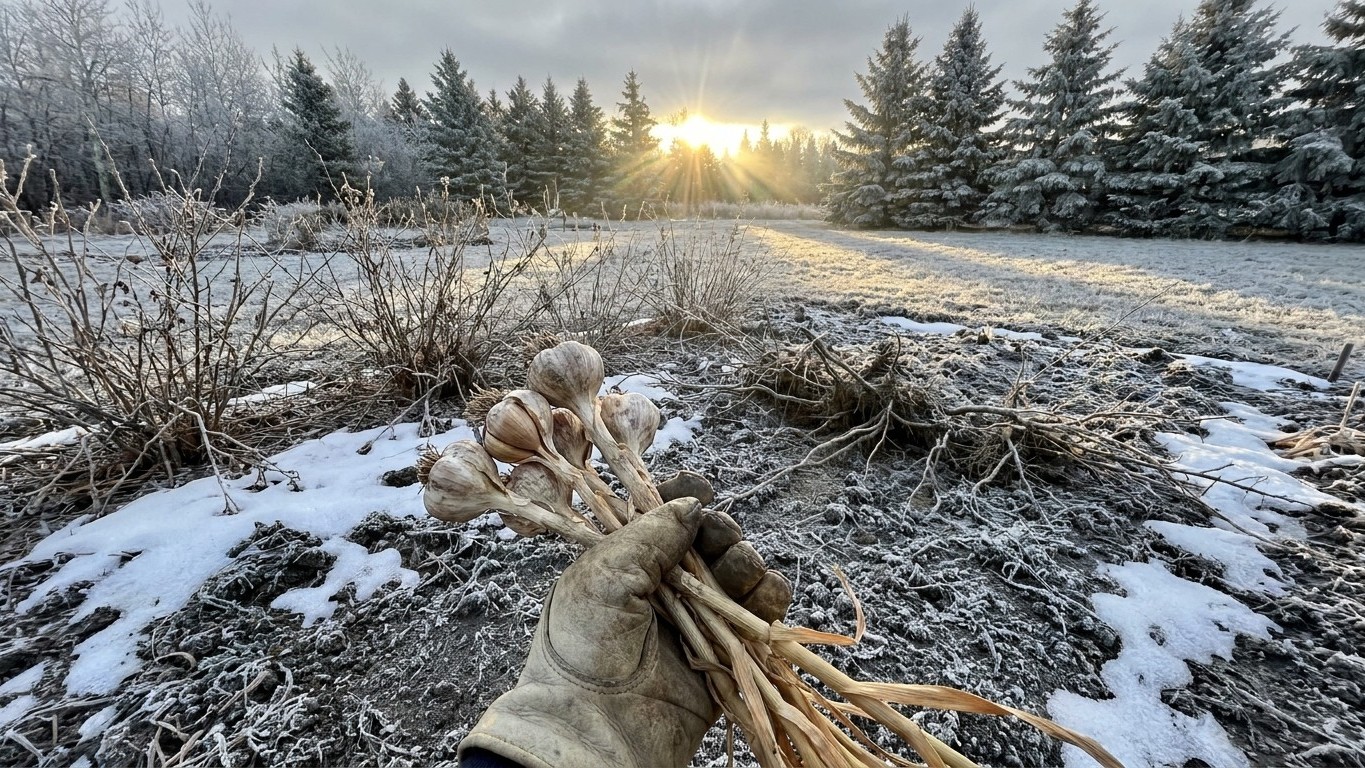

By November, most of Manitoba’s growing season has already closed. The ground is freezing or frozen across the province, snow cover is common, and the short answer for open-ground planting is: nothing. What’s left is a narrower set of jobs, protecting what’s already in the ground, forcing a few crops indoors, and getting ahead on the work that spring won’t leave time for.
What goes in the ground in November

The mechanism that decides this isn’t the calendar, it’s soil temperature and freeze-up. Manitoba’s average first fall frost, recorded at the Winnipeg Richardson International Airport station, lands around September 22. That’s a mean date from Environment and Climate Change Canada’s 1981-2010 climate normals, not a hard line, in half the years on record, frost arrives later than that. By the time November opens, though, most of the province is weeks past that average and moving toward a hard freeze, if it hasn’t already arrived. Soil that’s frozen an inch down won’t take a transplant or germinate a seed, no matter how mild the air feels on a given afternoon.
So the honest answer for most of Manitoba in November is that the open garden bed is closed for the season. What still has a narrow window:
- Garlic and shallots, but only in the first days of the month and only where the ground hasn’t locked up yet, this is really an October job that sometimes spills into early November in a mild year.
- Bare-root and dormant woody plants, again only if the soil is still workable, heeled in and mulched heavily the same day.
- Cold frames and low tunnels holding over hardy greens that were already established before freeze-up, not new sowings.
- Forcing rhubarb or chicory indoors, using dormant roots dug before the ground froze.
Manitoba sits in Canadian hardiness zone 3b, based on Natural Resources Canada’s mapping for Winnipeg using 1991-2020 normals. That’s the Canadian seven-variable system, not a USDA zone, and the two scales don’t convert directly, a single Canadian zone can span several USDA zones. What it tells a Manitoba gardener in practical terms: winters are long and severe enough that almost nothing planted in November has time to establish before the freeze truly sets in.
| Option | Still possible in November? | Condition |
|---|---|---|
| Garlic/shallot cloves | Early month only | Ground must still be diggable |
| New seed sowing outdoors | No | Soil too cold to germinate |
| Bare-root shrubs/trees | Early month only | Same-day heavy mulch required |
| Forced rhubarb/chicory indoors | Yes | Roots must be pre-dug and dormant |
What to start under cover
The right way to count is backward from the last spring frost, not forward from today. Manitoba’s average last spring frost, again from the Winnipeg Richardson station’s 1981-2010 normals, falls around May 23, and like the fall date, that’s a midpoint, not a guarantee. In half the years, frost shows up after that.
Run the arithmetic from there. Slow crops like onions or leeks from seed typically want 10 to 12 weeks indoors before transplant, which lands the start date in late February or early March for a May 23 target. Peppers and celery, at 8 to 10 weeks, land a few weeks later still. November falls nowhere near that window, starting those crops now would leave them leggy, rootbound, and struggling in a pot for three months before the soil is even close to ready.
What actually fits November is different: outdoor winter sowing of cold-hardy perennials and native flower seeds in sealed containers, left outside to stratify naturally through the freeze-thaw cycle, germinating on their own once spring warms up. Forced bulbs for indoor bloom (paperwhites, amaryllis) are another genuine November start, since they’re not tied to the outdoor frost calendar at all. The failure to avoid here isn’t starting too late, it’s starting vegetable transplants far too early and burning through their usable growth indoors before the ground can take them.
What is ready to pick
Outdoors, there’s little to nothing left standing by November in most of Manitoba. Anything not harvested before the ground froze is likely lost to it now. The exceptions are narrow but worth checking: kale and leeks that were mulched heavily before freeze-up can sometimes still be dug from under snow in the early part of the month, and a maintained cold frame may still be holding spinach or mâche that survived the first hard frosts.
Indoors is where the actual harvest happens this month. Sprouts and microgreens on a windowsill or under a grow light are ready in one to two weeks from sowing and don’t depend on outdoor conditions at all. Anything forced from dormant roots, chicory for witloof, rhubarb crowns brought in for early stalks, comes on over several weeks under cover.
The other job that counts as “harvest” this month is inspection. Go through the root cellar, garage, or basement stash of squash, potatoes, and onions and pull anything showing a soft spot, a wet patch, or a sweet fermenting smell, one rotting squash left in a bin will take its neighbors down with it. Potatoes with green shoulders or sprouting eyes should be used first, since they’re the ones with the shortest remaining shelf life.
The jobs that matter this month
This is the section that carries the page in a month with almost no planting, and there’s a real list behind it.
In the garden
Mulch matters most right now, before the ground locks up solid. A heavy layer over garlic beds, perennial crowns, and the base of young fruit trees insulates roots through a winter that routinely drops well below zero across the province. Drain and disconnect hoses and irrigation lines before the first hard freeze cracks a fitting. Tidy raspberry canes that fruited, cutting spent floricanes to the ground, but hold off on major fruit tree pruning cuts, which heal poorly in extreme cold and are usually better left until late winter.
Indoors and on paper
Seed catalogs move fast, and the popular varieties of tomatoes, peppers, and specialty greens sell out well before spring planting season arrives. Ordering now, while the list is still complete, is cheaper insurance than scrambling in March. This is also the moment to sketch next season’s rotation, since the beds are empty and the layout is easy to picture without a stand of plants in the way. If the soil isn’t frozen yet, pull a sample for testing, an amendment applied now has all winter to work into the soil. Turn the compost pile one last time before it freezes solid, clean and sharpen tools before they sit idle, and walk the fence line and raised bed frames for repairs while the ground is still soft enough to reset a post.
What not to do in November
The most common mistake is trusting a warm afternoon over the soil thermometer. A mild spell doesn’t mean the ground has thawed or that it’s safe to uncover tender plants, and pulling mulch back too early only to have a hard freeze return undoes weeks of protection in a single night.
Nitrogen fertilizer is another trap. Feeding it now pushes soft new growth on perennials and shrubs right when that growth has zero chance of hardening off before the cold arrives, and that tender tissue is what winterkill takes first. If soil needs amending, phosphorus and potassium sources or plain compost are the safer late-season choice.
Leaving root crops in frozen ground too long is a slower version of the same mistake, once the soil locks up, digging carrots or potatoes cleanly becomes close to impossible, and what’s left behind often rots in place by spring. And putting off garlic planting past the point where the ground is still workable means losing an entire season of it, since there’s no real fallback planting window once the freeze sets in for good.
Checking this against your own county
A province-wide month is a starting point, not a fixed instruction. Manitoba’s frost dates and freeze-up timing shift by weeks depending on elevation, proximity to Lake Winnipeg and the other large lakes, and simply how far north or south a garden sits relative to Winnipeg. A garden near the Manitoba Escarpment or in the Interlake region can freeze solid well ahead of one in the Red River Valley, and the reverse holds true for spring thaw. For local planting calendars and current guidance, Manitoba Agriculture is the reference point worth checking against whatever a province-wide date suggests.
Common questions
Can I still plant garlic in Manitoba in November?
Only in the first days of the month, and only if the ground is still workable. Most years, garlic planting needs to be finished in October before freeze-up sets in.
Is it too late to start seeds indoors in November for spring planting?
It’s actually too early for most vegetable transplants. Counting back from the May 23 average last frost, onions and leeks don’t need starting until late February or early March, and starting sooner just produces leggy, rootbound plants.
What can I still harvest from a Manitoba garden in November?
Very little outdoors beyond mulched kale or leeks dug early in the month, if they’re accessible. Sprouts, microgreens, and forced rhubarb or chicory indoors are the more reliable November harvest.
Should I prune fruit trees in November?
Light cleanup of dead or diseased wood is fine, but major structural pruning cuts heal poorly in extreme cold and are better saved for late winter, closer to when the trees break dormancy.
Gardeners who plant by the Moon can check the November 2026 moon planting calendar, a tradition rather than a proven method.
Related guides
Elsewhere? See what to plant in November in every state and province.