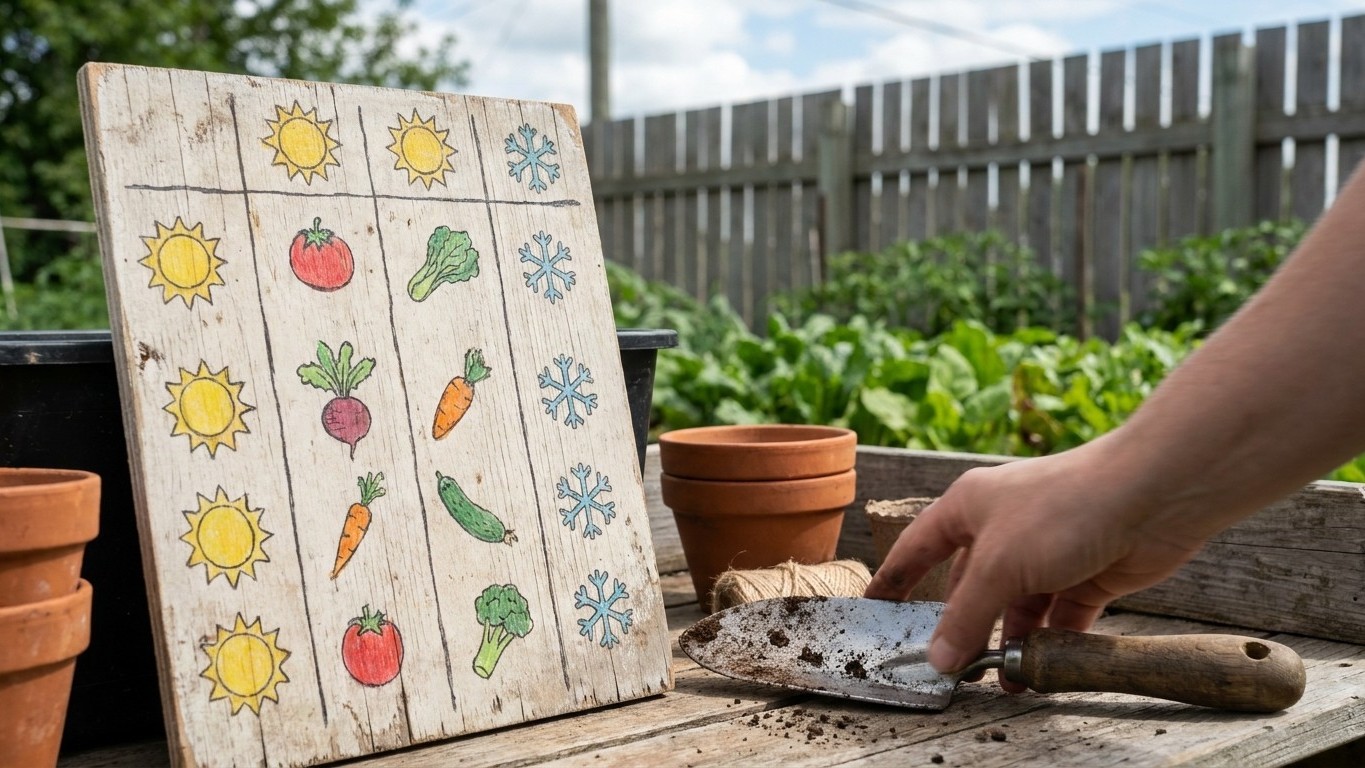

May 23 marks the average last spring frost at Winnipeg’s Richardson airport, with the first fall frost typically landing September 22 — a frost-free stretch of roughly four months. But “average” hides a lot of scatter: in half the years on record, that last spring freeze came later than May 23, sometimes weeks later. The Red River Valley’s flat, low ground nudges these dates milder than much of the province, yet even here the number is a midpoint to plan around, not a green light.
The frost window in Manitoba

Environment and Climate Change Canada’s 1981-2010 climate normals, recorded at the Winnipeg Richardson International Airport station, put the average last spring frost at May 23 and the average first fall frost at September 22. Subtract one date from the other and the station’s typical frost-free season runs to about 122 days.
That word “average” is worth sitting with. A mean date marks the middle of a spread of actual frost dates, not a cutoff. In roughly half of the years behind this normal, the last spring frost at Winnipeg landed after May 23, sometimes considerably after it. Treat May 23 as the center of a window you plan around, not the day you’re cleared to plant tender seedlings. The same caution applies at the other end of the season: September 22 is a midpoint, and a first frost that arrives two or three weeks later than average is well within the historical record.
Winnipeg sits low in the Red River Valley, which is among the warmest, flattest stretches of the province and one reason its frost dates run earlier in fall and later in… reversed… actually later in spring departure and earlier in fall onset than much of the rest of Manitoba. Districts to the west on higher ground, and settlements further north, see their frost-free window open later in spring and close earlier in fall, which shortens the growing season measurably compared to the Winnipeg figures above. If you garden outside the Red River Valley, shift everything in this article later in spring and earlier in fall, and don’t assume the 122-day season applies to your yard. Once the soil starts to warm, What to Plant in Manitoba in April lays out which crops can go in first, and by midsummer What to Plant in Manitoba in August covers the succession crops to get in before that fall frost arrives, and once that first fall frost has passed, What to Plant in Manitoba in October covers which crops and cover work still make sense before winter sets in.
For a broader look at how growing conditions shift across the province, the Manitoba guides hub collects region-specific notes that go beyond the single Winnipeg station used here. For month-by-month planting guidance, see What to Plant in Manitoba in June, which details which crops go in the ground once the frost risk has passed.ba/garden/planting-calendar/february/”>What to Plant in Manitoba in February, which covers the early-season tasks you can start well before the last frost date.ba/garden/planting-calendar/may/”>What to Plant in Manitoba in May, which details which crops to start once the frost risk has passed.ba/garden/planting-calendar/july/”>What to Plant in Manitoba in July, which covers what to get in the ground once the frost risk has passed.ba/garden/planting-calendar/april/”>What to Plant in Manitoba in April, and thenitoba/garden/planting-calendar/october/”>What to Plant in Manitoba in October guide, part of a full year-round planting calendarba/garden/planting-calendar/june/”>What to Plant in Manitoba in June or, for the tail end of the season, What to Plant in Manitoba in September.
Cool-season crops
Peas, spinach, lettuce, brassica transplants and most root crops don’t wait for the frost-free window to open. They germinate in cold soil, tolerate a light frost on exposed leaves, and in several cases actually perform worse if you wait for warm soil to sow them. Gardeners plant these well before the May 23 average last frost, as soon as the ground has thawed enough to work with a spade or hoe.
Peas are usually first into the ground. Their seed germinates in soil that would stall a bean or a squash outright, and a light frost on emerging seedlings rarely does lasting damage. Spinach and lettuce follow similar logic: both bolt to seed quickly once the weather turns warm, so an early, cool start is not a compromise, it’s the better strategy for a longer harvest window before the plants turn bitter.
What tolerates frost and what doesn’t
- Peas: direct-seeded in cold soil, tolerates hard frost on foliage
- Spinach: direct-seeded, tolerates hard frost, bolts quickly once it’s warm
- Lettuce: direct-seeded or transplanted, tolerates light frost, also bolts in heat
- Brassica transplants (cabbage, broccoli, kale): tolerate light frost once hardened off outdoors
- Carrots, beets, radishes: direct-seeded, roots develop fine in cold soil, tops tolerate light frost
Brassica transplants need a head start indoors before they go out into that still-cold ground, and they need hardening off first: a few days outside in a sheltered spot to toughen the leaf tissue before it meets open-air frost. Root crops skip the indoor step entirely. Carrots, beets and radishes go straight into the soil as seed, and cold soil actually slows germination just enough to give you an even stand rather than a rushed, patchy one.
Warm-season crops

Tomatoes, peppers, squash, beans and corn are a different problem from the cool-season crops above. These plants don’t just dislike frost, their roots stall in cold soil even when the air temperature looks fine, which is why soil temperature, not the calendar date of the last frost, is the real gate for warm-season planting. A tomato transplant set into ground that’s still cold from winter will sit and sulk for weeks, frost or no frost.
Why “early June” shows up for every tomato variety
Every tomato cultivar in our catalogue for this territory carries the same guidance: set out in early June. That figure isn’t the May 23 average last frost itself, it’s that date plus a margin. Since the mean frost date is only a 50-50 proposition, gardeners routinely add one to two weeks before setting out anything tender, both to clear the frost risk and to let the soil actually warm up to a temperature tomato roots can use. Early June is where that buffer lands.
Starting seed indoors follows the same backward arithmetic. Standard tomato practice is to sow indoors six to eight weeks before the transplant date. Count back from an early-June transplant and that puts indoor sowing in early to mid-April, not a single fixed day. Peppers generally want an even earlier indoor start than tomatoes and even warmer soil at transplant, so treat them as running behind the tomato schedule rather than alongside it.
Squash, beans and corn skip the indoor stage. They’re direct-seeded once the soil has warmed, which in practice tracks close to the same early-June window used for tomato transplants, since it’s the same soil-temperature threshold driving both decisions.
| Variety | Days to maturity | Type | First ripe (calculated) | Margin before Sept 22 frost |
|---|---|---|---|---|
| Sakura | 55 | Indeterminate | Late July | 53 days |
| Edox | 55 | Indeterminate | Late July | 53 days |
| Valentine | 55 | Indeterminate | Late July | 53 days |
| Glacier | 55 | Determinate | Late July | 53 days |
| Sun Gold | 57 | Indeterminate | Early August | 51 days |
| Supersweet 100 | 60 | Indeterminate | Early August | 48 days |
| Juliet | 60 | Indeterminate | Early August | 48 days |
| Amalfi | 68 | Determinate | Mid August | 40 days |
| Cherokee Purple | 72 | Indeterminate | Mid August | 36 days |
| Big Beef Plus | 72 | Indeterminate | Mid August | 36 days |
| Tiren | 75 | Indeterminate | Mid August | 33 days |
| Granadero | 75 | Indeterminate | Mid August | 33 days |
| San Marzano II | 78 | Indeterminate | Late August | 30 days |
| Celebrity Plus | 78 | Determinate | Late August | 30 days |
The days-to-maturity figures printed on a seed packet are counted from transplant, not from seed, and they shift by a week or two depending on how warm the season actually runs. Even so, the margin column matters: a 78-day paste tomato like San Marzano II or Celebrity Plus is cutting it closer against the September 22 average first frost than a 55-day cherry type like Sakura, and a cool, late summer eats into that margin fast.
The fall planting window
Fall planting works the same arithmetic as spring, run in reverse. Start from the September 22 average first fall frost and count backward: the days to maturity for the crop, plus extra time because growth slows as daylight shortens through late summer, even before any frost actually arrives.
Take a 60-day crop as an example. Sixty days of growth plus roughly one to two weeks of margin for that slower fall growth adds up to nine or ten weeks counted back from September 22, which lands the sowing date somewhere in mid-to-late July. A faster 30-day crop like radishes or baby lettuce has much more room and can go in through most of the summer for a fall harvest, since it clears its maturity window well ahead of frost even with the fall slowdown factored in.
Some crops actually improve after a light frost rather than being damaged by it. Kale, Brussels sprouts, parsnips and carrots left in the ground through a light frost convert starches to sugars in response to the cold, which is why gardeners in short-season regions often leave root crops in place under a layer of mulch rather than pulling them at the first sign of cool weather. Spinach behaves the same way, turning sweeter and less bitter after a frost than it was in warm weather.
The practical risk with fall planting isn’t the frost itself, it’s running out of daylight. A crop sown too late may technically still have “days to maturity” left on the clock, but with shorter days and a lower sun angle, growth slows so much that it never actually finishes before hard freezes end the season for good. Err early rather than late when counting backward from September 22.
Reading a planting calendar properly
A provincial planting calendar, this one included, is built from one weather station’s history. The Winnipeg Richardson International Airport figures used throughout this article describe conditions in the Red River Valley, and a province this size is not one climate. Elevation changes the picture on its own: higher ground to the west cools faster at night and holds frost risk later into spring than the valley floor does.
Local effects a state-wide date can’t capture
Lake Winnipeg and the smaller lakes across the province moderate temperatures nearby, both delaying the first fall frost near the shoreline and, in some configurations, holding cold air in low-lying areas away from the water. Cities generate their own heat, so a garden in a paved, built-up part of town often runs a few degrees warmer at night than open farmland a short drive away, shifting both frost dates. None of this shows up in a single station’s normals.
A late cold snap after weeks of warm weather is the scenario that catches gardeners out most often. The calendar says it’s safe, the soil has warmed, transplants go in, and then a clear, calm night drops temperatures well below what the “average” date implied was likely. This is exactly why the May 23 figure needs the caveat attached to it throughout this article: it is a midpoint, not a guarantee, and it says nothing about any single year.
The fix is to watch your own garden rather than the provincial number alone. Track the last frost date in your own yard for a few years, keep a soil thermometer on hand for warm-season planting, and pay attention to how your own microclimate runs warmer or colder than the airport station a short drive from where you actually garden. Other regions handle this same problem in their own way: a New Brunswick gardener near the Bay of Fundy watches a completely different set of local factors, and a Colorado gardener has to account for elevation swings that can shift frost dates by weeks over a short distance, as covered in the New Brunswick planting calendar and the Colorado planting calendar.
Local help
For dates and conditions specific to your own county, contact Manitoba Agriculture, the province’s extension service, at gov.mb.ca/agriculture. County-level frost records, soil testing services and crop-specific advice suited to your particular district go well beyond what a single Winnipeg station can tell you, and a soil test is worth the small cost before you plan a garden on rented or newly purchased ground.
Common questions
Is May 23 actually safe to plant tomatoes outside in Manitoba?
No. May 23 is Environment and Climate Change Canada’s average last frost date for the Winnipeg station, which means frost arrives later than that in roughly half of all years. Most gardeners wait until early June for warm-season transplants specifically to build in that margin.
What plant hardiness zone is Manitoba in? This article doesn’t state a specific Canadian plant hardiness zone number, since the reliable figures we have for Manitoba are the Winnipeg frost dates from Environment and Climate Change Canada, not a zone map. Check with Manitoba Agriculture or a local nursery for the zone rating used in your specific district.
Can I still plant a fall garden if I only just finished harvesting spring crops?
Possibly, depending on how much time is left before the September 22 average first fall frost. Count the days to maturity of whatever you want to sow, add extra time for slower fall growth, and compare that total to how many weeks remain. Fast crops like radishes and baby greens usually still fit even after a late spring harvest.
Do I need to cover my plants if frost threatens after I’ve already planted warm-season crops?
Yes, if a frost warning comes after you’ve set out tomatoes, peppers or other tender transplants. A bedsheet, row cover or overturned bucket over each plant overnight is usually enough to get them through a light, short frost event.
Why do seed packets give a days-to-maturity number that doesn’t match what I actually got?
Catalogue days-to-maturity figures are measured from transplant under fairly ideal conditions, and they shift by a week or two depending on how warm or cool the actual season runs. A cool, cloudy stretch in July or August will push real harvest dates later than the number printed on the packet.
Related guides
- Saskatchewan Planting Calendar: When to Sow and Plant, Frost Dates Included
- Ontario Planting Calendar: When to Sow and Plant, Frost Dates Included
- New Brunswick Planting Calendar: When to Sow and Plant, Frost Dates Included