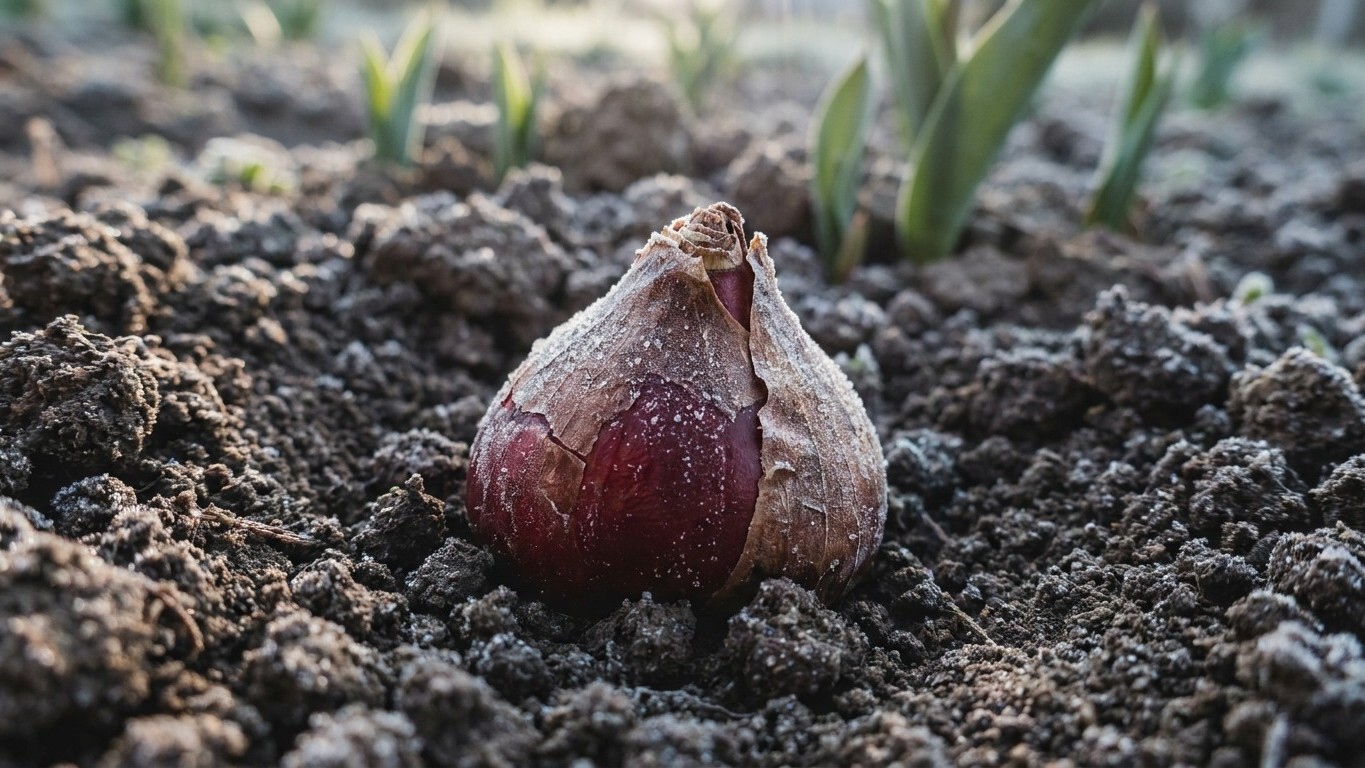

Garlic in Manitoba gets eaten in two waves by different things. Voles, wireworms and bulb nematodes work below ground from the day the cloves go in. Onion maggots, thrips and mites show up once spring warms the leaves. Because garlic is planted in autumn and lifted the following summer, one bed sits through both waves. The first fall frost marks where the first wave ends and the second begins.
The short answer for Manitoba
The fall half of the pest calendar closes, on average, around September 22. That is the mean first fall frost at the Winnipeg Richardson International station, from Environment and Climate Change Canada’s 1981-2010 Canadian Climate Normals. It is a midpoint, not a safe date: in one year out of two, the first frost arrives later.
Why anchor on frost at all? Because most of the leaf-eating and sap-sucking insects die back or go dormant when the first real frost hits, and the soil pests drop deeper as the ground cools. What replaces them is a quieter, more destructive set of animals: mice and voles looking for a warm, insulated place to spend the winter. A bed of fresh garlic under a blanket of mulch and snow is exactly that.
The whole year, in the order the crop experiences it:
- Autumn after planting, through winter: voles and mice tunnel under mulch and snow and eat cloves.
- Spring thaw to early summer: wireworms and cutworms feed on shoots and roots, and onion maggot flies lay eggs near the plants.
- Early to midsummer: thrips and leaf curl mites feed on foliage, with grasshoppers a threat in dry years.
- Every month, invisibly: bulb and stem nematodes, carried in the seed clove itself.
The frost date moves a lot across the province, and so does the spring thaw. Manitoba Agriculture does not publish a single province-wide pest schedule that this page can cite, so treat the order above as reliable and the dates as yours to work out locally.
Working it out for your own garden
Winnipeg is one point on a very large map. A garden near Lake Winnipeg, on the escarpment edge or well north of the Red River Valley will not see September 22. Elevation, a big lake and distance from the city can each shift the date by two weeks in either direction. The arithmetic is simple enough to do on the back of a seed catalog.
Step one: pin down your frost window
Start with September 22. Subtract two weeks and you get September 8; add two and you get October 6. Your garden’s mean frost sits somewhere in that span, and your own record of the last few autumns tells you where. Remember that the figure is a mean. A year with frost on September 8 and a year with frost on October 6 can both be perfectly normal, so plan around the early end of your window rather than the middle.
Planting garlic is the other half of this calculation. The cloves need time to root before the ground locks up, but not so much time that they send up top growth that winter will burn. The full counting-back method is in When to Plant Garlic in Manitoba: Counting Back From the First Frost. Planting date also decides pest exposure. Cloves in the ground weeks before freeze-up are available to rodents for longer, and cloves planted at the last minute are weakly rooted and slower to outgrow wireworm damage in spring.
Step two: let the thaw set the spring clock
Spring pests follow soil and air temperature, not the calendar, so a fixed date will mislead you. Mark the day the snow leaves your bed, then walk it every few days. Look for cut or chewed shoots (cutworms), tunnels in the base of the plant (wireworms), small flies hovering near the row, and yellowing tips with pale streaks (thrips). A warm early spring pulls the whole sequence forward, and a late one compresses it.
Last, count back through the beds themselves. Onions, leeks, shallots and garlic share nematodes and maggots, so a bed that carried any of them recently is a poor place to plant. Four seasons without alliums is the rotation most growers aim for. Bulb and stem nematodes can persist in soil, and cloves saved from an infested bulb simply carry the problem into the new bed. Prefer clean seed stock, and consider the varieties in Garlic Varieties That Suit Manitoba Winters as a starting point for what to buy.
What changes across Manitoba
The province runs from the flat, heavy-clay Red River Valley to boreal country. Pests and timing shift with them, and the cause matters more than the label.
| Part of Manitoba | What drives the difference | Pest pattern to expect |
|---|---|---|
| Red River Valley (Winnipeg, Morden, Portage la Prairie) | Low, flat ground; the area the Winnipeg frost figure describes | Fall frost near the September 22 midpoint; heavy soil that holds wet and favours maggots and rot |
| Lake Winnipeg and Lake Manitoba shores, Interlake | Big water cools spring and holds fall warmth, shifting dates by up to two weeks | Later spring pest emergence, slightly later fall frost; rodents common in cottage and field edges |
| Westman and the southwest (Brandon area) | Higher, drier prairie, more exposed | Grasshoppers in dry years; ground squirrels and gophers around open ground |
| Parkland and the Riding Mountain uplands | Elevation brings earlier fall frost and a later thaw | Frost weeks ahead of Winnipeg’s midpoint; voles and mice from bordering bush and forest |
| Northern Manitoba (The Pas, Thompson) | Latitude shortens the season | Frost well before Winnipeg’s date; fewer insect generations, but winter rodent pressure remains |
Treat the table as a map of causes, not a forecast. Upland and northern districts run weeks behind the Winnipeg figure, so the safe assumption there is an earlier freeze-up and a later thaw. The lake effect is the one that surprises people. A garden a short drive from a big lake can sit in a different frost window than one a few miles inland, which is why your own notes beat any published average.
One more pattern is consistent across all of these: deep, early snow insulates rodents as well as garlic. In years with steady snow cover, vole damage is harder to see until spring, when you find a row of missing plants.
The mistakes this climate punishes
Garlic mistakes in a mild-winter state are different from the ones Manitoba punishes. A Maryland gardener who plants a hardneck can lose the crop to a winter too gentle to trigger it (see When to Plant Garlic in Maryland: Counting Back From the First Frost and Garlic Varieties That Suit Maryland Winters). In Manitoba the trouble runs the other way: the winter is long and hard, and the errors are ones of exposure and timing.
Planting too late to root. If the frost falls early and the cloves have not rooted, they sit unanchored and are easier for freeze-thaw to heave out of the soil. Weak plants also take wireworm and maggot damage harder in spring. Using September 22 as a safe date rather than a midpoint is the usual cause, since half of all years freeze later and half earlier.
Planting too shallow. Shallow cloves lose the insulation the soil provides and sit closer to the surface where voles forage. Plant deeper than you would in a milder state, and bring in mulch once the ground begins to freeze.
Mulching too early. Straw laid down in warm October weather makes a ready-made nest. Wait until the surface of the soil is cold, then cover.
Replanting where alliums grew. Nematodes and maggots carry over, and Manitoba’s cold does not reliably kill the nematodes in the soil. Rotate, and start from clean seed garlic.
Breaking new sod. A bed dug out of lawn or pasture is prime wireworm ground. Cultivate it a season ahead or choose a bed that has been in vegetables.
Choosing a variety by catalog photo. Cold-hardy hardnecks tend to be the dependable choice in prairie winters, and the varietal differences are worth reading before you buy.
Checking this against your county
For local numbers, go to Manitoba Agriculture. Its regional agricultural offices and crop-pest resources can tell you which insects are active in your municipality this season, and what to watch for in the Interlake, Westman or the north. Pair that with your own frost log and you will have a pest calendar that fits your garden rather than Winnipeg’s airport. For the rest of the crop, start at Growing Garlic in Manitoba.
Common questions
What is the most common garlic pest in Manitoba?
No province-wide ranking is published here. In practice, rodents in winter and soil insects such as wireworms and onion maggots in spring cause the most visible losses. Bulb and stem nematodes do the most lasting damage, because they come in on infected seed.
Does the first frost end the pest problem?
It ends much of the insect activity above ground. It does not protect the cloves from voles and mice, which become the main threat from freeze-up through the thaw. The September 22 Winnipeg mean is a midpoint, so in half of all years insects stay active later.
Can I spot nematodes before planting?
Not reliably. Infested cloves can look normal. Buy seed garlic from a supplier you trust, rotate away from alliums, and discard any bulb that looks soft or shriveled or that grew twisted and swollen in your last crop.
When should I scout for pests?
Start the day the snow leaves the bed, and check every few days through early summer. Spring pests follow soil and air warmth, not a calendar date, so your thaw date is the real starting gun.