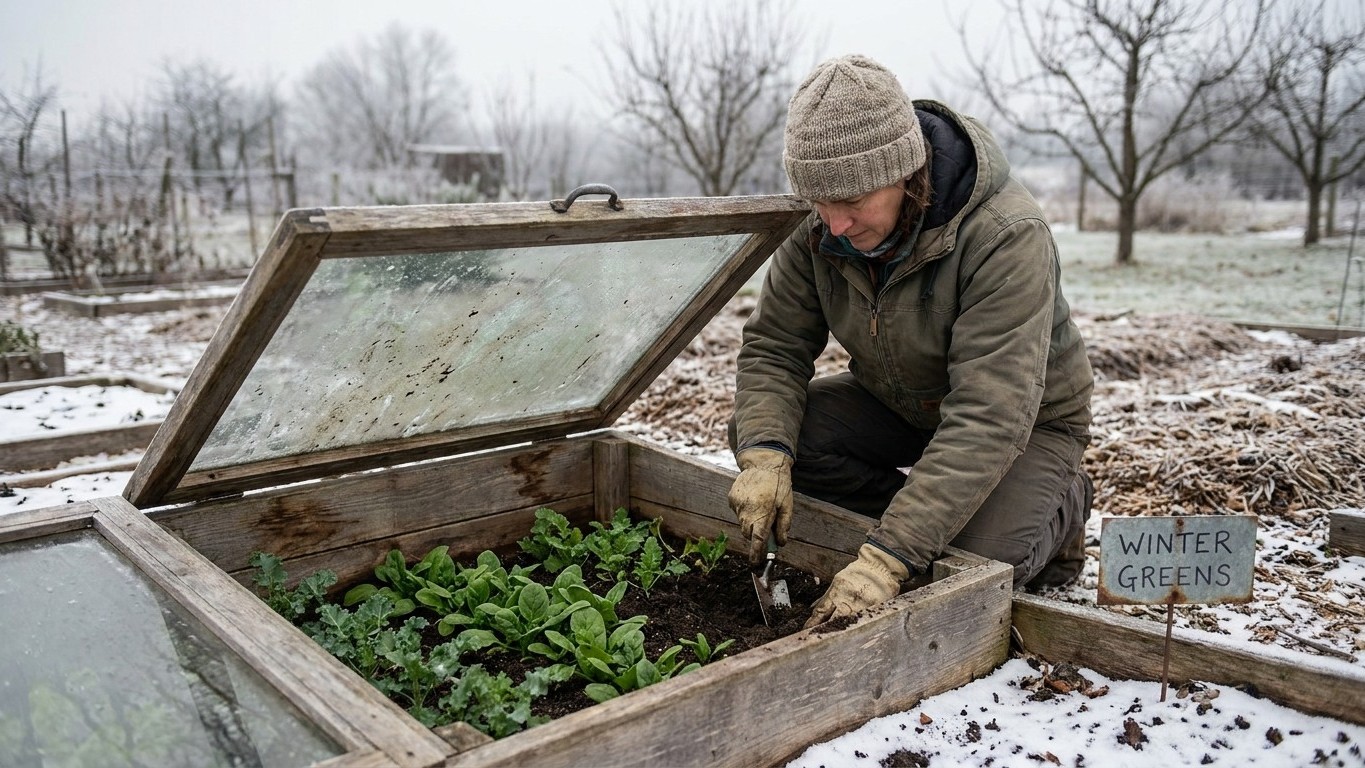

February in Maryland sits weeks, sometimes months, ahead of the last frost, so almost nothing new goes into open soil this month. What does work: garlic and shallots into workable ground, bare-root fruit stock while it’s still dormant, and cold frames holding hardy greens through the cold. The real February work happens indoors and on paper, not in open beds.
What goes in the ground in February

The decision here isn’t the calendar, it’s soil temperature and how far away the frost window sits. Maryland’s last spring frost runs April 3 to April 16 statewide, which puts February anywhere from six to eleven weeks ahead of it depending on where you garden. That gap matters more than it sounds. Soil warms slowly, well behind the air, so a run of 55-degree afternoons in February tells you nothing about whether a seed will germinate in the ground. For most vegetables, the honest answer is that nothing new goes into open soil this month.
What does go in: garlic and shallots, if the ground is workable and wasn’t already planted in fall. Both tolerate hard cold and root through winter without trouble, so a mild stretch with thawed, diggable soil is still a legitimate window. Bare-root fruit trees, brambles, and roses can also go in now while they’re dormant and before buds start to swell, since planting them awake and leafing already puts them under stress they didn’t need.
Cold frames and low tunnels do the heavy lifting for anything green this month. Spinach, mache, and kale sown under cover in fall can still be pushed along under plastic or glass, and a cold frame lets you sneak in a fresh sowing of spinach or arugula weeks before open-ground planting would make sense. Indoors, this is also the month to force rhubarb crowns or chicory roots in a dark, cool space for an early harvest that has nothing to do with outdoor soil temperature at all.
On zone: Maryland spans USDA Hardiness Zone 5b to 8a, a range built on one measurement, the average annual extreme minimum temperature. That’s a big spread for one state. Baltimore, sitting roughly in the middle of the state’s population and climate, is a reasonable reference point for zone 7b to 8a plantings; western counties and the mountains run colder, the Eastern Shore runs milder.
What to start under cover
Seed starting in February works backward from the last frost window, not forward from a date on the wall. With frost clearing statewide between April 3 and April 16, count back from whichever end of that range applies to your county.
Onions and leeks started from seed need ten to twelve weeks before transplanting, which puts a January-to-early-February start right on schedule for an April move outdoors. Peppers and eggplant want eight to ten weeks indoors before they go out, so early-to-mid February is the sowing window for most of the state. Cabbage, broccoli, and other brassicas need six to eight weeks, making mid-to-late February the right time to start trays for a late-spring transplant. Tomatoes fall in that same six-to-eight-week range, so a late-February sowing lines up with an early-to-mid-April move to the garden, right as frost risk clears.
Two mistakes show up every year at this stage. Starting too early leaves you with leggy, rootbound seedlings sitting in cell trays for weeks past their prime, stretching toward weak light and stalling once they finally hit the ground. Starting too late does the opposite damage: transplants go out small and immature, lose weeks of growing time, and often run into summer heat before they’ve had a real season. Neither mistake is fixable once the seedlings are stressed, so the count-back math matters more than instinct.
What is ready to pick
Outdoors, there’s little to harvest in February, and that’s worth saying plainly rather than padding the list. What’s still coming out of the ground are the crops built for it: overwintered kale, collards, and leeds that have sat under snow or frost cover since fall, sweetening as the cold pushes sugars into the leaves. Brussels sprouts left on the stalk often taste better after weeks of hard cold than they did in November.
Cold frames extend the list a little further, holding spinach, mache, and hardy lettuce in pickable condition through most of the winter as long as they’re vented on sunny days so the crops don’t cook under glass. Indoors, sprouts and microgreens fill the gap for households wanting something fresh cut weekly, ready in days rather than weeks and needing nothing more than a tray, water, and a windowsill.
February is also when stored crops start to show their age. Check winter squash for soft spots near the stem, a sure sign of rot spreading inward even when the rest of the skin looks fine. Potatoes that have started sprouting eyes or gone soft and wrinkled should be pulled and used first, before the rot spreads to the rest of the bin. Onions with a papery, dry neck are fine, but any that feel soft or have started sending up a green shoot are close to spoiling and won’t hold much longer.
The jobs that matter this month
February carries plenty of real deadlines even without new planting. Dormant pruning of fruit trees, brambles, and grapevines belongs here, done while the plant is still fully asleep and before buds swell and break. Prune too late and you’re cutting into growth the plant has already invested energy in; prune now and the cuts heal clean before spring pushes new wood.
Seed ordering has its own deadline that has nothing to do with weather. Popular varieties, especially disease-resistant tomatoes and early-maturing sweet corn, sell out from seed companies well before spring, so placing an order now is the difference between growing what you planned and settling for whatever’s left on the shelf in April.
This is also the planning month: sketching next season’s bed rotation so tomatoes and peppers don’t land in the same soil where they grew, or their relatives grew, the year before. Soil testing fits here too, since results from a lab take a few weeks to come back, and amendments like lime need time to adjust pH before spring planting. Maryland’s extension service offers soil testing guidance and lab recommendations through extension.umd.edu.
Beyond the beds, February is for turning the compost pile so it keeps breaking down through the last of the cold, cleaning and sharpening tools that will see heavy use in a few weeks, and repairing raised beds, trellises, and fencing before the ground softens and planting crowds out the time to fix them.
What not to do in February
The classic February mistake is trusting the air instead of the soil. A run of warm, sunny days can push the temperature into the 60s while the ground underneath stays cold and wet, and seeds or transplants that go in on that warm-day impulse either rot in cold soil or sit stalled for weeks waiting for real warmth. Wait for the soil itself, not the forecast, before anything new goes outside.
A related error: uncovering cold frames, row covers, or winter mulch too early after a mild stretch. A few warm days convince gardeners the worst is over, covers come off, and then a cold snap inside the normal range for the season kills back growth that would have been fine left protected. Maryland’s frost window runs into April, so covers earn their keep well past any February warm spell.
Feeding nitrogen too early is a quieter mistake but a costly one. Plants that are still dormant or barely stirring can’t use the nutrients, so the fertilizer sits in the soil, leaches with the next heavy rain, and does nothing but waste money and, in some cases, run off into waterways. Hold nitrogen applications until growth is visibly active, not just until the calendar says it should be.
Checking this against your own county
A statewide month is a starting point, not an instruction. Maryland’s elevation and geography stretch the frost window by weeks in either direction: the mountains of Garrett and Allegany counties run colder and later, while the Eastern Shore and areas near the Chesapeake Bay warm earlier and hold that warmth longer into fall. A planting date that works in Salisbury can be two or three weeks premature in Oakland.
Before acting on any date in this piece, check it against your own county through the University of Maryland Extension at extension.umd.edu, which maintains local planting guidance and county-level contacts for gardeners across the state.
Common questions
Can I plant vegetables outside in Maryland in February?
Only a narrow list: garlic and shallots if the ground is workable, and hardy greens under a cold frame or low tunnel. Everything else waits until the state’s frost window clears in April.
When is the last frost date in Maryland?
NOAA’s 1991-2020 climate normals put it between April 3 and April 16, depending on location, with mountainous western counties typically running later than that range.
What can I start indoors in February for a Maryland garden?
Onions and leeks early in the month, followed by peppers and eggplant, then cabbage and broccoli-family crops, timed backward from the local last-frost date rather than a fixed day.
What USDA hardiness zone is Maryland?
The state spans zones 5b to 8a on the USDA Plant Hardiness Zone Map, with colder zones in the western mountains and milder zones near the Chesapeake and Eastern Shore.