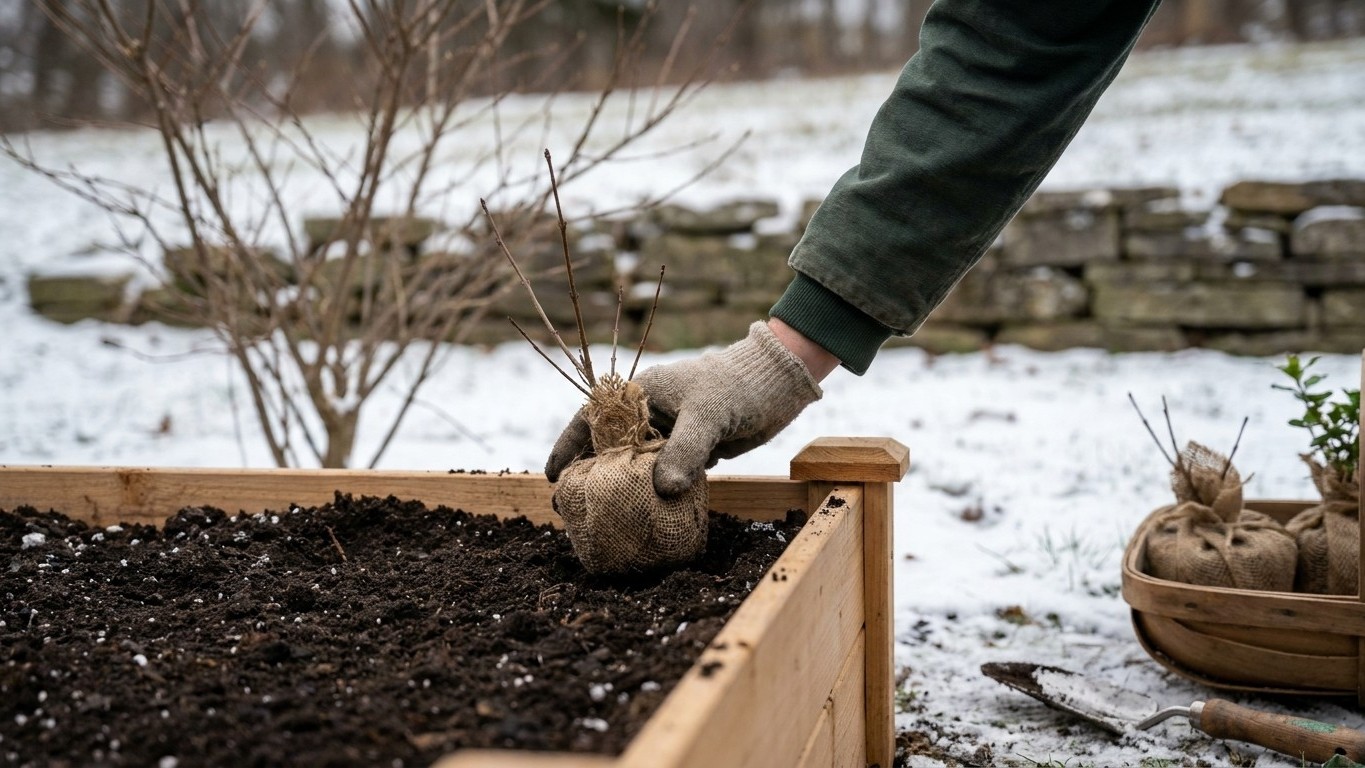

Across most of Nevada, December closes the ground: soil at elevation has been frozen or too cold to work for weeks, and nothing new goes into open dirt in Reno, Carson City, or the rural high desert. The exception is the low desert around Las Vegas, where a mild stretch early in the month can still allow garlic, shallots, and a few hardy greens before the season’s first hard frost arrives. Everywhere else, December is a pruning, planning, and protecting month.
What goes in the ground in December

The decision here isn’t the calendar, it’s soil temperature and where you sit on Nevada’s enormous elevation range. The state spans USDA Plant Hardiness Zones 4a to 10a, and that gap between the coldest mountain valleys and the low desert around Las Vegas is the whole story of what December can offer a Nevada gardener.
In the mountain and high-desert regions, ground has usually been frozen solid or close to it for weeks by this point, and the honest answer is that nothing new goes into open soil there this month. If you garden in Reno, Carson City, Elko, or any valley with real winter, treat December as a closed month outdoors and skip to the jobs section below.
The low desert is a different story, but only briefly. NOAA climate normals for the Las Vegas airport station put the first fall freeze (32°F) between December 8 and December 23, based on 1991-2020 averages. That’s a Las Vegas-specific, urban-heat-island-influenced figure, not a statewide window, and it should not be read as a Nevada planting guide. But it does mean that gardeners in the warmer pockets of the low desert may still have workable, unfrozen soil in the first week or two of the month before that freeze risk climbs.
Where that’s true, a short list still applies: garlic and shallot cloves can go into prepared beds while the ground is soft, cold frames and low tunnels can shelter a late sowing of spinach or mache, and bare-root roses or dormant fruit trees can be planted or heeled in. Forcing rhubarb crowns or chicory roots indoors in a dark, cool spot is a reliable December project anywhere in the state, since it doesn’t depend on outdoor soil at all. Nothing on this list is a warm-season crop, and nothing here should be read as safe once that Las Vegas-area frost window has passed or, elsewhere in Nevada, at any point this month.
What to start under cover
Seed-starting decisions in December work backward from your local last spring frost, not from a date on a bag of seed. That arithmetic matters more in Nevada than almost anywhere, because the last-frost range varies by months, not weeks, across the state.
For the low desert reference station near Las Vegas, NOAA’s 1991-2020 normals put the last spring freeze between January 7 and February 1. Again, that figure is specific to that station and its desert heat-island effect, so treat it as an illustration of how early low-desert spring can arrive rather than a number to apply anywhere else in the state. Counting backward from a frost window that early, long-lead crops like onions, leeks, and artichokes started from seed indoors in December can be ready to transplant once the soil warms, since those crops need eight to twelve weeks of growth before they go outside.
For gardeners at elevation, where last frost typically runs into late spring, December seed-starting for anything but the slowest-growing crops is premature. Starting too early creates the first classic failure: seedlings that outgrow their pots under weak winter light, turn leggy reaching for the sun, and sit rootbound for months before the ground is anywhere near ready. The second failure runs the other direction, waiting so long that a fast desert spring turns to summer heat before transplants have a chance to establish. Onions and leeks are the safest December sowing almost anywhere in Nevada precisely because their long growing time absorbs some of that uncertainty. Everything else, tomatoes, peppers, squash, should wait until the calendar math from your own county’s frost data actually supports it.
What is ready to pick
Little to nothing comes out of an open Nevada garden in December, and that’s true from the mountains to the low desert. Anyone expecting a harvest list this month is looking in the wrong place.
What still feeds a household is what was tucked in earlier and protected. Kale, leeks, and root vegetables like carrots and beets can overwinter under a heavy mulch layer or row cover in the milder low-desert gardens, and a hard freeze actually sweetens many of them rather than ruining them. Cold-frame greens, spinach, arugula, and mache, can keep producing light pickings through the month if the frame is vented on sunny days and closed tight at night. Indoors, sprouts and microgreens are the one genuinely reliable December harvest statewide, ready in one to two weeks with nothing more than a jar or a shallow tray on a windowsill.
The other December job at the harvest end is checking what’s already in storage. Squash, potatoes, and onions put up in fall should get a hands-on inspection now: soft spots on squash, green sprouts pushing from potato eyes, or a soft neck on an onion all mean that piece needs to be used or composted before it takes neighbors down with it. Going through the storage bin once this month, rather than waiting until something smells wrong, is the difference between losing one squash and losing the whole shelf.
The jobs that matter this month
December carries real deadlines even though nothing is growing fast, and skipping them costs the next season rather than this one.
Pruning, ordering, and protecting
Dormant pruning of fruit trees, grapevines, and cane berries is best done now, while the plant is fully asleep and the structure of its branches is easy to see without leaves in the way. Cuts made in dormancy heal cleanly and don’t trigger the tender new growth that a late-winter or early-spring cut can push out at the worst possible time. Seed catalogs are also circulating now, and ordering early matters in a state with such wide climate variation, since the specific short-season or heat-tolerant varieties that work in a given Nevada county tend to sell out before spring.
Soil, tools, and structures
Where the ground in the low desert is still workable, this is a good window for a soil test and for working in compost or amendments that need time to break down before spring planting. Turning an existing compost pile keeps it active through the cold rather than letting it stall completely. Tool maintenance, cleaning soil off blades, sharpening pruners and hoes, oiling wood handles, is easy to postpone and easy to regret postponing once spring work actually starts. Raised beds, fencing, and cold frames should get any repairs now, while there’s no crop in the way and no rush. And in mountain and high-desert gardens, checking mulch depth around perennials and young trees is worth the walk outside, since wind and freeze-thaw cycles can expose roots that were covered just weeks earlier.
What not to do in December
The most common Nevada mistake this month is trusting a warm afternoon. A 65-degree day in the low desert can feel like spring, but the soil underneath hasn’t caught up, and the region’s own frost data shows freezing temperatures are still very much in play through the month. Planting tomatoes, peppers, or squash outdoors because the air felt mild is a bet against the ground temperature, and the ground usually wins.
The second mistake is uncovering row covers or cold frames too early after a mild stretch. Nevada’s day-to-night temperature swing is extreme almost everywhere in the state, and one comfortable afternoon says nothing about the following night’s low. Pulling protection off too soon exposes tender growth to a freeze that a few more days of caution would have avoided entirely.
The third mistake is feeding nitrogen at the wrong moment. Dormant and semi-dormant plants aren’t building new tissue, so a nitrogen application now does little for the plant and instead sits in the soil or washes away with winter moisture. Worse, on the rare plant that does respond, it pushes soft new growth that a subsequent freeze will damage. Save the feeding for when active spring growth actually starts, and use December instead for the soil-building work, compost and amendments, that pays off on that timeline.
Checking this against your own county
A statewide December guide is a starting point, not an instruction sheet, and nowhere is that truer than in Nevada. Elevation alone can shift a frost window by months between a Reno-area valley and the low desert near Las Vegas, and local factors like slope, wind exposure, and nearby water further move the timing within the same county. The frost figures cited here come from a single reference station and were never meant to describe the whole state.
Before acting on any of this, check it against the University of Nevada, Reno Extension at extension.unr.edu, which publishes county-level guidance and a planting calendar built for Nevada’s specific growing regions rather than a single averaged date.
Common questions
Can I still plant garlic in Nevada in December?
In the low desert around Las Vegas, garlic can still go in early in the month while soil remains workable and before the first hard freeze arrives. In the mountain and high-desert regions, the ground is typically already too cold or frozen, and garlic planting there should have happened in fall.
Why does this page say nothing goes outside in most of Nevada this month?
Nevada’s hardiness zones run from 4a to 10a, and most of that range sits under frozen or near-frozen soil by December. Only the warmer low-desert pockets, near the milder end of that zone range, have any window at all, and even there it closes quickly.
Is December a good time to prune fruit trees in Nevada?
Yes, dormant pruning is one of the month’s most useful jobs statewide, since the tree’s structure is visible without leaves and cuts made during dormancy heal without triggering vulnerable new growth.
Should I start seeds indoors in December if I live at higher elevation?
Generally no, except for very slow-growing crops like onions and leeks. Higher-elevation Nevada gardens typically have a much later last frost than the low desert, so December-started seedlings for fast crops will outgrow their containers long before it’s safe to transplant them outside.