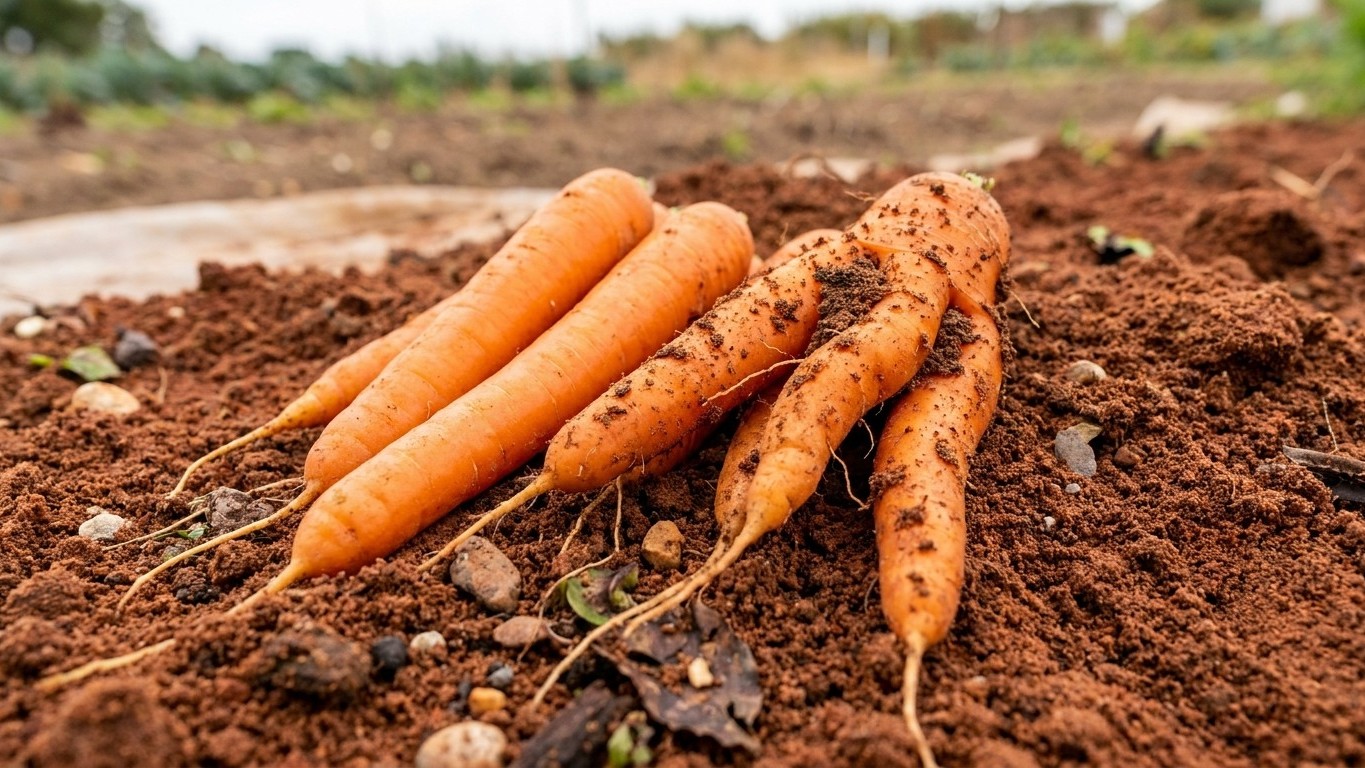

No species-by-species pest inventory for carrots grown in Nevada is part of the sourced facts behind this page. What is documented, and what actually decides whether a Nevada carrot crop comes out straight or forked, is the ground it grows in and the clock that runs from seed to root. The state soil, the storage rules once you pull the crop, and the plain difference between insect damage and everything else that mimics it, that’s the honest, sourced answer here.
Which pests attack carrot in Nevada
Start with what the record actually holds: no state-specific list of insects that feed on carrot roots or foliage in Nevada appears among the sourced facts for this page. That gap matters more than it sounds. A lot of garden advice quietly borrows a “top carrot pests” list written for a wetter, cooler state and presents it as if it applied everywhere. Nevada’s high-desert growing conditions are different enough from, say, the Southeast, that a borrowed list does a reader no favors. Rather than name bugs no one has confirmed for this state, the more useful ground truth here is the dirt itself.
Nevada’s official state soil, the Orovada series, is an Aridisol, the kind of dry-climate ground that forms under low rainfall and tends to run alkaline and hold salts. USDA soil survey data puts the surface horizon at about 66 percent sand, 8 percent clay and 26 percent silt, with organic matter around 1.4 percent and a surface pH near 7.5, and it drains well. None of that is a pest. But it decides how a carrot root grows, and root shape is the first thing many gardeners mistake for insect damage.
Utah State University Extension, writing on how to grow carrots, is blunt about what heavy or rocky soil does to the crop: it makes the root fork. Carrots want deep, sandy, well-drained ground rich in organic matter, close to the texture the Orovada series leans toward on paper. A garden built on compacted clay or studded with rock does the opposite, and a forked, twisted, stunted root gets blamed on a worm or grub more often than it gets blamed on the dirt underneath it.
The state soil is also just a representative profile, not a description of every backyard in it. Nevada spans desert basin floors, mountain valleys and river bottoms, plus any lot a builder has scraped or filled, and a bed in one part of the state can look nothing like the sand-heavy Orovada profile. Treat the state numbers as what desert ground tends to do, and treat a soil test on the actual bed as the only number worth acting on.
When each one shows up, and what it does first
Carrots are sown directly into the ground, never transplanted, so every day-count on this crop starts at seeding, not at the day a seedling goes into a bed. That single fact resets how a Nevada gardener should read any calendar written for carrots.
Clemson Cooperative Extension puts harvest at roughly 65 to 75 days after planting. Utah State University Extension puts full maturity closer to 70 to 100 days from seeding. Both describe the same crop, counted the same way, and the gap between the two windows is wide enough that a grower checking a bed on day 65 and one checking on day 100 are doing two different jobs.
What shows up first, in a Nevada bed, is not a chewed leaf or a wilting top. Nothing in the sourced record documents a foliage- or root-feeding insect for this state, so the first sign most growers actually see is the shape of the root, and they only see it the day they pull it. A forked or twisted carrot doesn’t announce itself early. The root splits underground, unseen, from the moment the taproot meets a rock or a dense clay lens, and the fork is only confirmed at harvest, whenever that harvest falls inside the 65-to-100-day window.
A second clock starts the moment the root comes out of the ground, and it runs faster than the growing one. Clemson’s guidance is specific: carrots keep at 33°F with high humidity, and bunched carrots, meaning the tops are still attached, hold up for about 10 to 14 days. That’s a few degrees above freezing, not a cellar temperature, and a shelf running at 45 or 50°F won’t come close. The tops are the catch: leaves keep pulling moisture from the root long after harvest, which is why a bunch with greens attached fades inside two weeks while a trimmed root, stored just as cold, lasts for months.
Telling the damage apart from everything else
A forked root, a stunted root, a soft root after storage: none of these need a bug to explain them, and mistaking one for insect feeding sends a gardener chasing the wrong fix. The distinction usually comes down to whether there’s an actual wound, and whether the timing lines up with the soil or with the storage bin rather than the growing season.
| Symptom | Likely cause | What tells it apart |
|---|---|---|
| Forked or branched root | Heavy, rocky, or compacted soil (Utah State University Extension) | No entry wound or tunnel; the taproot splits into two or more legs, usually where it hit an obstruction |
| Short, stunted root | Shallow soil or a hardpan layer stopping downward growth | Probing the row shows a hard layer or rock right where the root stops widening |
| Chewed or tunneled surface | Possible insect feeding, not confirmed in the sourced record for this state | A distinct entry hole or tunnel, unlike the smooth internal split of forking |
| Wilted or yellowing tops before harvest | Drought stress or uneven watering | Check soil moisture at root depth, not just the surface, before assuming a pest |
| Soft or sprouting roots after storage | Storage above 33°F | Check the actual temperature of the storage spot; sprouting is a heat problem, not a feeding problem |
None of this replaces an actual look at the plant. The one habit that separates a correct call from a guess is checking the soil temperature or texture before assuming a bug did it. When a wound with a clear entry point does show up, that’s the point to stop guessing and send a sample, not a description, to a local expert.
What actually works here, and what is a waste of time
Fixing forked roots starts underground, not with a spray. Utah State University Extension recommends working plenty of compost into heavy soil and double digging the bed before seeding, so the taproot has loose, deep ground to push through instead of clay or rock. A raised bed filled with a sandy, well-drained mix does the same job for a yard sitting on ground far denser than the state’s sandy Orovada profile.
Cutting the tops off at harvest, before the roots ever reach a fridge or root cellar, is the single move that determines whether a crop lasts two weeks or several months. Leaves left attached keep drawing moisture from the root, and no storage temperature fixes that once it’s underway. Getting the storage spot to 33°F with high humidity, per Clemson’s guidance, does the rest.
What’s a waste of time here is buying a treatment for a pest nobody has confirmed. Without a species-level pest list for Nevada in the sourced record, spraying or dusting on a hunch means treating a problem that may not exist while ignoring the soil or storage issue that actually caused the damage. A soil test and a close look at the root, rather than a shelf full of insect control, is the cheaper and more accurate first move on this crop.
Where to check this for your own county
Nevada’s land-grant extension service, University of Nevada, Reno Extension, and its county offices are the right place to get an actual identification, not a state-wide guess. What’s documented at the state level, or in this case what isn’t documented, doesn’t describe any one garden. A county office can look at an actual damaged root or a soil sample and say something specific that a page like this one can’t.
Pest presence, like soil, changes across a state this size, and it can change from one side of a county to the other. A basin-floor garden and a valley garden thirty miles apart can have entirely different pressure, even where the mapped state soil looks the same on paper. The only figure worth trusting for a specific yard is the one that comes from testing that yard, whether that’s a soil sample or a damaged root carried into a county extension office.
The next step is simple: contact the local University of Nevada, Reno Extension county office, bring a soil sample if forking or stunting is the issue, and bring the actual root, or an insect if one is visible, if the damage looks like a wound rather than a shape problem.
Common questions
Is there a confirmed list of carrot pests for Nevada?
Not in the sourced record behind this page. No species-level pest inventory for carrots in Nevada is documented here, which is why the safer move is a soil test and a local extension check rather than treating for a pest that hasn’t been confirmed.
Why did my carrot come out forked instead of straight?
Utah State University Extension attributes forking to heavy or rocky soil that blocks the taproot’s downward growth. Compost, double digging, or a raised bed with sandy, well-drained soil address the cause directly.
How long will harvested carrots actually keep?
Clemson Cooperative Extension states that bunched carrots, with the tops still attached, keep about 10 to 14 days. Cutting the tops off before storage and keeping the roots at 33°F with high humidity extends that considerably.
How do I tell if something is eating my carrots versus a soil problem?
Look for an actual wound: a distinct entry hole or tunnel points to feeding, while a smooth internal split with no wound points to forking from soil. When there’s a real wound, bring the root to a county extension office for identification rather than guessing.