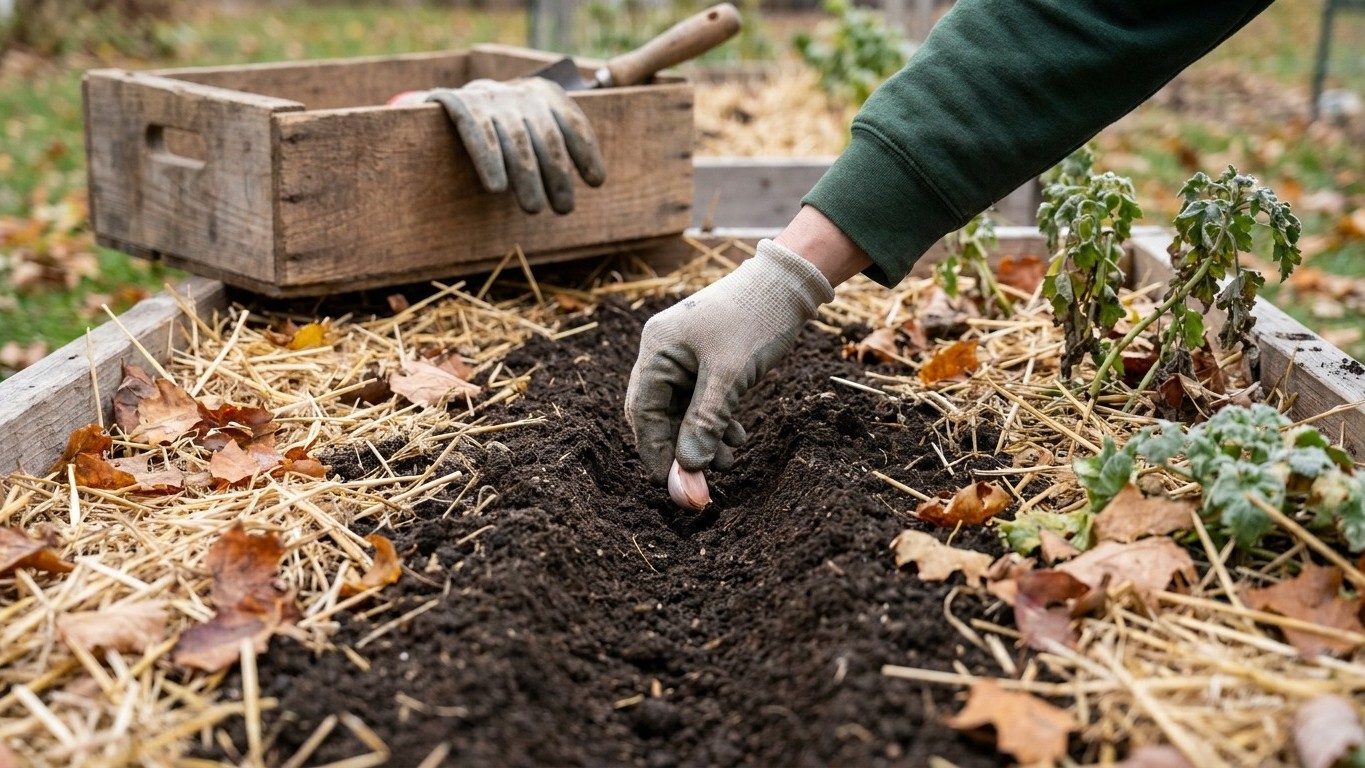

By November in New Brunswick, the growing season outdoors is essentially closed. The average first fall frost lands around October 2, so a full month of hard frosts and freezing nights has already passed by the time November opens. The only outdoor planting that still makes sense is garlic, and even that window is closing fast as the ground stiffens.
What goes in the ground in November

The soil, not the calendar, makes this call. Once ground temperature drops toward freezing, roots stop growing and any new transplant simply sits and rots. In New Brunswick’s Canadian hardiness zone 5a, that point typically arrives well before November is over, and in many years the ground is already locked with frost by mid-month.
So the honest answer for most of the province is this: nothing new goes into open, unprotected garden beds for a spring harvest. But that’s not the same as saying there’s nothing to plant.
Garlic and shallots are the exception. If the soil is still workable, meaning you can push a trowel in without hitting a frozen crust, both can still go in. They need roughly six weeks of cool soil to root before deep freeze sets in, and they’ll sit dormant under mulch or snow until spring. If the ground has already firmed up, skip it this season rather than forcing cloves into hard dirt where they won’t establish.
Cold frames and low tunnels stretch the window a little further. A cold frame over a bed that already has cold-hardy greens can keep them alive and slowly growing on sunny days even as the open garden shuts down. Bare-root fruit trees, shrubs, and canes can also go in while the ground remains diggable, since they’re dormant and don’t need active root growth right away, only firm contact with soil before winter locks it in.
Indoors, this is a good month to force rhubarb crowns or chicory roots in a dark, cool space for a harvest of tender stalks or blanched chicons in the dead of winter. It’s a small trick, but it’s one of the few ways to get anything resembling fresh growth out of a New Brunswick garden this late in the year.
What to start under cover
Almost nothing gets started for outdoor transplant this month, and the arithmetic explains why. New Brunswick’s average last spring frost falls around May 23. Long-season transplants like onions and leeks are typically started 10 to 12 weeks ahead of that date, which lands in late February or early March, not November. Start them now and by transplant time you’ll have rootbound, leggy seedlings that never recover their vigor once they hit the garden.
What does make sense under cover this month is anything grown for its own sake indoors, not for later transplant. Microgreens and sprouts are the obvious choice: they finish in one to three weeks on a windowsill or under a simple grow light, so there’s no backward-counting needed and no risk of starting too early. Cold-hardy greens like spinach, mizuna, or claytonia can also be sown directly into a cold frame or unheated greenhouse bed. They germinate slowly in the cooling soil but will sit through winter and resume growth as daylight lengthens.
The two failure modes worth naming plainly: starting long-season vegetables too early, which produces weak, overgrown seedlings with nowhere to go for months, and waiting too long to get cold-hardy greens into a frame, which means they never size up enough to survive the coldest stretch. If you’re setting up a cold frame for winter greens, this month is close to the last practical window to get seed into it.
What is ready to pick
Outdoors, there’s little left to harvest in most of the province by this point. The realistic picture is overwintered crops holding on rather than anything actively producing.
Kale and leeks are the two standouts. Both tolerate hard freezes and, once buried under snow, are often sweeter than they were in fall, since cold triggers them to convert starches to sugars. Dig leeks with a fork rather than pulling, since frozen soil grips them hard, and check that kale leaves haven’t turned mushy before eating them.
Cold frames can still be yielding small pickings of spinach or mustard greens on milder days, and this is also where sprouts and microgreens earn their keep: they’re the one dependable source of fresh green food from an indoor setup regardless of what’s happening outside.
The other job this month is going through storage. Squash, potatoes, and onions put up in fall need a check now for soft spots, sprouting, or the sweet smell that signals early rot. Pull anything questionable before it spreads to the rest of the bin. Winter squash with a soft stem end or a bruise that’s darkening should be used first, not saved for later.
The jobs that matter this month
This is the month where the garden’s future gets decided even though nothing visible is happening in the beds. Dormant pruning of fruit trees, and of cane fruit like raspberries, is best done now while wood is bare and disease pressure is low. Cutting live wood in summer stresses the plant and invites infection; cutting dormant wood now costs the plant nothing and shapes next year’s growth.
Seed catalogs are already circulating by this point, and ordering now matters more than it seems. Popular varieties, especially disease-resistant tomatoes and early-maturing corn suited to a short season, sell out well before spring planting begins. Waiting until late winter to order often means settling for whatever’s left.
Soil testing and amending pay off precisely because nothing is growing to disturb. Lime takes months to shift pH, so applying it now means it’s actually working by spring rather than sitting inert in frozen ground. Turning compost, even just once more before it freezes solid, keeps decomposition going a little longer and gives you a head start come thaw.
Tool maintenance is the kind of job that never feels urgent until a dull blade or rusted hinge fails at the worst moment. Clean, sharpen, and oil pruners and spades now, while there’s time and no pressure. The same goes for repairing raised bed frames, fencing, or trellis posts that took a beating over the growing season. Fix them while the ground is still workable enough to reset a post, because trying to do it in frozen January soil is close to impossible.
Finally, walk through stored crops one more time. A single rotting onion in a bin can spread moisture and mold to its neighbors within weeks, and catching it now is far cheaper than losing half the bin later.
What not to do in November
The most common mistake is misreading a mild, sunny afternoon as a sign the season has more life left in it than it does. Air temperature can feel deceptively warm on a clear November day while the soil a few inches down is already near freezing. Planting anything tender based on how the air feels, rather than how the ground actually is, wastes both the plant and the effort.
Uncovering cold frames or row covers too eagerly after a warm spell is another trap. A few mild days can tempt you to pull covers off greens to give them light and air, but New Brunswick’s fall weather swings hard, and an uncovered bed can lose its whole crop to a sudden overnight freeze that a cover would have blocked entirely.
Feeding nitrogen this late is also counterproductive. Nitrogen pushes soft, leafy growth, and soft growth is exactly what frost damages first. Any fertilizing that still needs doing on perennials or fruit plantings should already be finished; from here it’s better to let plants harden off naturally for winter rather than encouraging new growth that the cold will simply kill.
Leaving root vegetables in the ground too long “just in case” is the last common error. Carrots and beets can take a light frost, but once the ground freezes hard around them, digging them out undamaged becomes difficult or impossible. If they’re not already mulched heavily for a true overwinter harvest, it’s safer to lift them now than to lose them to a freeze you can’t dig through.
Checking this against your own county
A province-wide picture of November is a starting point, not a fixed instruction. The frost figures here come from the Moncton station, and New Brunswick’s coastline, river valleys, and upland interior don’t share one climate. Elevation alone can push frost and freeze-up weeks earlier in higher or northern districts compared with the milder Fundy shore or the south. A garden in the north of the province may already be under snow while one further south is still workable.
Before relying on any of these windows for your own plot, check them against your local conditions and the federal agriculture resources at agriculture.canada.ca, which can point you toward more localized planting guidance.
Common questions
Is it too late to plant garlic in New Brunswick in November?
It depends on whether the soil is still diggable. If a trowel goes in without hitting a frozen crust, garlic and shallots can still be planted. Once the ground has firmed up with frost, wait for spring rather than forcing cloves into hard soil.
Can I still harvest anything from my garden this month?
Mostly overwintering crops like kale and leeks, which actually improve in flavor after a hard freeze. Beyond that, cold frames may still offer a few hardy greens, and indoor sprouts or microgreens are a reliable fresh option regardless of the weather outside.
Why shouldn’t I fertilize with nitrogen this late in the season?
Nitrogen encourages soft new growth, and that soft growth is the first tissue frost damages. Late-season nitrogen leaves plants more vulnerable heading into freezing weather rather than helping them.
What’s the single most useful job to do in the garden this month?
Dormant pruning of fruit trees and cane fruit tends to offer the best return for the effort, since it’s easy to do correctly while the plant is leafless and dormant, and it directly shapes next season’s growth and fruiting.
Gardeners who plant by the Moon can check the November 2026 moon planting calendar, a tradition rather than a proven method.
Related guides
Elsewhere? See what to plant in November in every state and province.