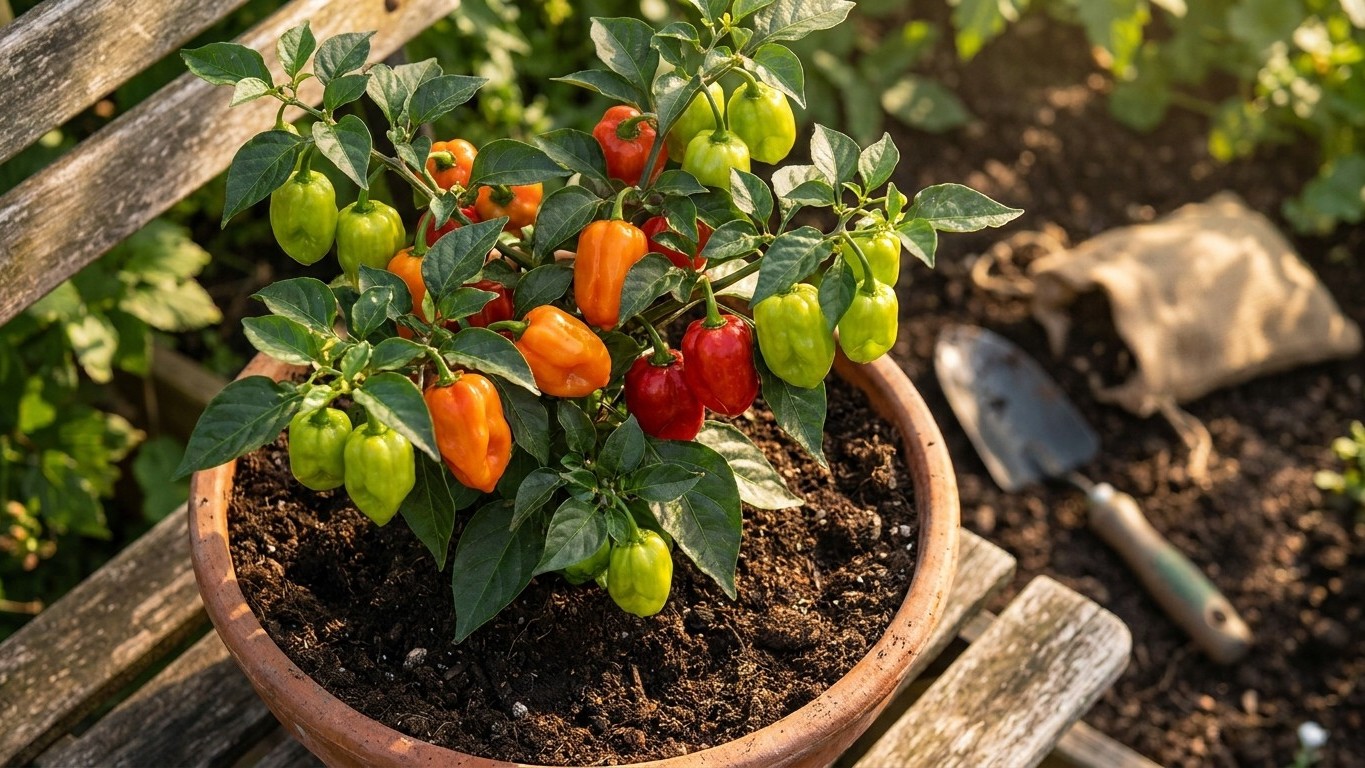

What eats a pepper crop in New Brunswick is less often a bug than a thermometer reading. Fruit set fails at both ends: on nights below 55 F (about 13 °C) and on days above 32 °C. The cool end is the one to watch here. Insect pests are not tracked on this page, so what follows is the calendar and the climate failures that cost the most fruit.
The short answer
The hot end barely applies
Moncton A, the reference station for the province on this site, reaches 32 °C (the exact equivalent of 90 F) on 1.0 days a year, on average. One day. Environment and Climate Change Canada also publishes a 30 °C count, the more familiar threshold here, and it comes to 4.6 days a year at the same station. Those are means across a long run of seasons, so some summers bring none and a hot one brings several.
For peppers, that means the heat-driven blossom drop described by Utah State University Extension (days above 90 F) is a short-lived problem in a typical season, not the main one. It would be a mistake to read the low count as a sign that heat-loving crops fail here. A count of scorching days is not a measure of the growing season. What decides whether a pepper ripens is the length of the frost-free period and the summer means, and those are questions for the planting calendar, covered in the next section.
One caution on the figure: an airport station sits outside the city, and a province is not one climate. Coastal, river-valley and upland gardens will all read differently from Moncton A.
The cool end is where gardeners lose fruit
The same Utah State University Extension guidance says pepper fruit set also fails when nights drop below 55 F, about 13 °C. This site carries the count of hot days for each territory but does not carry summer night minima, so there is no number here to hand you. Nor is there any honest way to infer one from latitude, from the coast, or from how cold the winter gets. The reader has to watch their own nights.
The practical version is cheap. A min-max thermometer set at plant height, in the bed itself, and checked each morning from the day the first flower buds show. A string of mornings under 13 °C while plants are flowering is the signal to cover them at dusk, or to expect a gap in the harvest a few weeks later. Low spots and the edges of open fields cool faster than a bed beside a south-facing wall, so two gardens in the same town can disagree.
Frost still sets the start
The mean last spring frost at the Moncton station is May 23. That is a midpoint, not a safe date: in one year out of two the last frost falls later than that. Northern and upland districts of the province run weeks behind it. The normals behind this date also cover an older period than the 1991 to 2020 figures used for American states on this site, so compare across borders with care.
If you are still choosing what to grow, start with Growing Peppers in New Brunswick for the full picture, then Pepper Varieties That Ripen in a New Brunswick Season to match the plant to your weeks. For flowers that open and then fall, Why Peppers Fail to Set Fruit in New Brunswick goes deeper than this page.
When to start seed here
The rule is a subtraction. Peppers need 8 to 10 weeks indoors before they go outside, and they go outside after frost, once the soil reaches 60 F (about 16 °C). Work backward from that day.
- Find your transplant date. Take your last frost, then wait for the soil to reach 16 °C at transplant depth. A soil thermometer settles it. The soil is often the later of the two conditions, so it sets the date.
- Treat the frost date as a midpoint. The mean at the Moncton station is May 23, and half of years frost later. Counting back from May 23 gives the earliest sensible window: 8 weeks before is March 28, and 10 weeks before is March 14. Most gardeners will want to plan from a later transplant date.
- Do the subtraction with a real date. Say your soil reaches 16 °C on June 5. Eight weeks (56 days) earlier is April 10, and ten weeks (70 days) earlier is March 27. Sow between those two dates. Swap in your own date and the arithmetic holds anywhere.
- Add the harvest wait. Clemson Cooperative Extension puts harvest at about 70 to 85 days after transplanting. That is a South Carolina figure, so read it as a guide, not a promise. From a June 5 transplant it runs from August 14 to August 29, which shows how much season is left before fall frost.
- Adjust for your own nights. If nights are still under 13 °C when the seedlings are ready, hold them indoors a little longer or cover them outside, rather than planting on the calendar alone.
Redoing it for your county
Only two inputs change from one county to the next: the date the soil warms and the date of the last frost. Your local figure may run weeks later than the Moncton one, especially inland or at elevation. Everything else, the 8 to 10 weeks indoors and the count backward, stays the same. If you do not have a published frost date for your district, this site does not hold one either, so use your own record from past springs and lean late.
What goes wrong here
- Blossom drop in a hot spell. It is rare at a station that averages 1.0 days a year at or above 32 °C, but a hot summer can bring several, and the flowers then fail to set. Remedy: shade cloth in the afternoon on the hottest days, steady watering, and patience. New flowers open again once the heat breaks.
- Blossom drop on a cool night. This is the likelier version here. Flowers fall or stay unset after nights under 55 F (about 13 °C). Remedy: watch your own minimum, since this site does not carry summer night lows, and drape row cover or an old sheet over plants at dusk when a cool night is forecast. Take it off in the morning so the bed can warm.
- Sunscald where the sun is strong. Pale, papery patches appear on the shoulder of the fruit facing the sun, usually where leaves have been lost to disease, pests or heavy pruning. Remedy: keep the foliage. Do not strip leaves off plants, stake them so the canopy stays over the fruit, and use light shade cloth in exposed southern beds.
- Blossom-end rot. A sunken, leathery dark patch on the bottom of the fruit. It follows uneven moisture more often than a shortage of calcium in the soil. Remedy: water deeply and on a schedule, mulch to hold moisture steady, and avoid heavy nitrogen feeding. Pick off the affected fruit so the plant puts energy into the next ones.
- Transplant shock from cold soil. Seedlings set out before the soil reaches 60 F (about 16 °C) stall and can take weeks to recover. Remedy: wait for the soil thermometer, harden plants off for several days, and keep a cover ready for a late frost.
Telling them apart
Timing is the clue. Flowers that fall are a weather problem from the past week or two. Damage on the fruit itself points elsewhere: a patch on the shoulder is sun, a patch on the bottom is water. Checking your minimum thermometer log against the date the flowers fell usually solves the first one.
Common questions
Is New Brunswick too cool for peppers?
No. Moncton A averages 4.6 days a year above 30 °C and 1.0 days at or above 32 °C, but that is a count of hot days and not a verdict on the season. The frost-free window and your own nights matter more. A short-season variety started 8 to 10 weeks ahead gives you the best odds.
What should I use to watch night temperatures?
A min-max thermometer placed at plant height in the bed. This site does not publish summer night minima, so your own readings are the only reliable guide. Look for nights below 13 °C (55 F) once plants start to flower.
Is May 23 safe for setting plants out?
Not by itself. It is the mean last frost at the Moncton station, which means half of years see frost later. Wait for the soil to reach 16 °C (60 F) as well, and cover plants if frost is forecast. Upland and northern districts run weeks behind.
Can I keep harvested peppers in the fridge?
The fridge is too cold. Clemson Extension gives the best storage at 45 to 50 F (7 to 10 °C) and 80 to 90 percent relative humidity, for two to three weeks at most under ideal conditions. Below about 45 F peppers pit and soften from chilling injury. A cool cellar or a cool pantry suits them better than the crisper drawer.