
By November in New Hampshire, the state’s first fall frost window (October 13 to October 26, at the reference weather station) has already passed for most of the state. Open-ground planting is essentially finished. The one real exception is garlic and shallots, which still go in while soil remains workable, plus bare-root stock and anything you can tuck under a cold frame or low tunnel.
What goes in the ground in November

The calendar says November, but the soil is what actually decides this. Once ground temperature drops into the high 30s and low 40s, root growth slows to nearly nothing, and by the time the soil has frozen an inch or two down, the planting window for anything but the toughest crops is closed. In southern New Hampshire, near the reference station, that first fall freeze arrives somewhere between October 13 and October 26. Farther north, at elevation, or in the Great North Woods, it can come noticeably earlier. So the honest starting point for this section is that most of the state has already had its frost before November even begins.
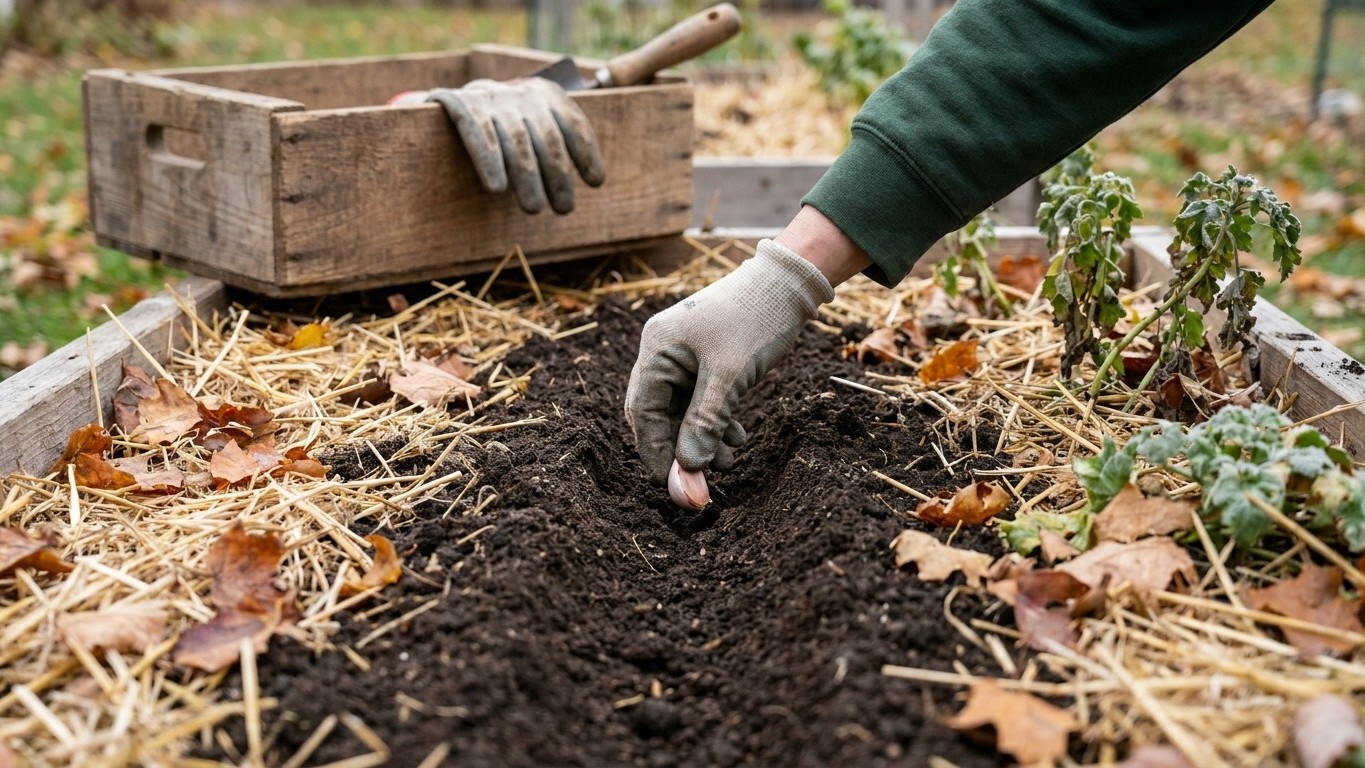
That doesn’t mean the trowel stays in the shed. Garlic and shallots are the classic November crop precisely because they want a cold shoulder: plant the cloves 2 to 3 inches deep while the ground can still be worked, then mulch with 4 to 6 inches of straw once the surface has firmed up. Roots establish through late fall and the plants push up in spring well ahead of anything you could start from scratch.
Bare-root fruit trees, roses, and shrubs can also go in during a mild stretch, as long as the soil isn’t waterlogged or frozen solid. The plant is dormant, the top growth isn’t demanding water and sugars, and the roots have the whole winter to settle before spring pushes new growth. A cold frame or low tunnel buys a few more weeks for spinach, mâche, and claytonia, crops hardy enough to keep growing slowly under cover even after the open beds have shut down. And if the ground is truly done for the season, rhubarb crowns or chicory roots dug and brought indoors can be forced in a dark, cool spot for a harvest that has nothing to do with outdoor weather at all.
What to start under cover
Counting backward from a frost date is the right habit, but it works against you this month rather than for it. New Hampshire’s last spring frost typically falls between April 16 and April 27 near the reference station, later inland and at elevation. Crops that need 10 to 12 weeks indoors before transplant, like onions or slow peppers, would be started in January or February to hit that window, not now. Start them in November and you get leggy, rootbound seedlings sitting on a windowsill for months before the garden is even close to ready. That’s the first failure mode: starting too early.
The second failure mode is the opposite mistake made at the wrong time of year, waiting so long that a slow crop never catches up to the season, and it’s worth flagging now precisely because seed orders placed this month determine whether that happens in spring. For November itself, “under cover” means something more modest and more immediate: microgreens and sprouts on a kitchen counter, which are ready in one to three weeks regardless of what’s happening outside, and cool-season herbs like parsley or chives potted up and kept on a bright windowsill.
Forcing bulbs is the other legitimate November project. Paperwhites and amaryllis planted now in shallow trays or pots will bloom indoors over the following weeks, and if you dig and pot a few clumps of chives or mint before the ground freezes, you can keep fresh cuttings coming through the darkest months. None of this substitutes for spring seed-starting, but it keeps something green and growing while the outdoor beds rest.
What is ready to pick
Outdoors, the honest answer for most of the state is: not much, and what’s left is finishing up fast. Brussels sprouts, kale, and collards left standing after that first freeze actually improve, since cold converts starches to sugars and takes the bitter edge off. Leeks are the toughest of the bunch. Mounded with soil or mulch, they can sit in the ground and be pulled as needed well past the point when everything else has been cleared, sometimes surviving under snow cover into winter.
A cold frame extends this further. Spinach, mâche, and hardy lettuce sown in September or earlier keep producing small, slow harvests under glass or plastic even as outdoor beds go dormant. Indoors, sprouts and microgreens are the closest thing to a fresh, fast harvest this time of year, ready within days to a few weeks of sowing regardless of the weather outside.
The other job this month is checking what’s already in storage. Squash should feel firm with no soft spots near the stem; any that have started to weep or soften need to be used immediately, not left to spread rot to the rest of the bin. Potatoes kept in a cool, dark space should be checked for green shoulders (a sign of light exposure, cut those parts away before eating) and for the sweet, sickly smell that signals a rotting tuber working its way through a bag. Onions and shallots in mesh bags or braids are worth a squeeze; a soft one anywhere in the batch should come out before it takes its neighbors with it.
The jobs that matter this month
This is the point in the year where the payoff isn’t a harvest, it’s next season. Dormant pruning of fruit trees, brambles, and grapevines is one of the highest-value jobs on the list: once leaves have dropped and the plant is fully dormant, you can see the branch structure clearly and remove damaged, crossing, or diseased wood without stressing an actively growing plant. Do it now, on a dry day above freezing, and the cuts have all winter to callus before sap starts moving again in spring.
Seed catalogs are already circulating by November, and the popular varieties, especially disease-resistant tomatoes and anything sold in limited runs, sell out well before spring. Ordering now, while the choices are still full, beats scrambling in February for a substitute.
Soil work belongs here too. If the ground isn’t frozen, this is a good window to pull a soil test, work in compost or leaf mold, and let the winter freeze-thaw cycle help break down amendments before spring planting. Turning the compost pile one more time before it locks up for winter keeps the decomposition process going a little longer and makes for a more finished product come spring.
- Clean and sharpen pruners, loppers, and shovels before they sit unused for months
- Drain and store hoses and shut off outdoor spigots before a hard freeze splits a pipe
- Repair raised bed frames, trellises, and fencing while the ground is still soft enough to reset a post
- Sketch next season’s crop rotation while this year’s layout is still fresh in memory
- Do a final check of stored squash, onions, and potatoes for early rot
None of these jobs feel urgent in the moment. They matter because a pruning cut made now heals clean, a soil test done now has months to inform amendments, and a seed order placed now guarantees the variety you actually want.
What not to do in November
The most common mistake this month is timing driven by mulch instead of soil. Piling straw or leaves over garlic, perennials, or a cold frame bed too early, while the ground is still warm, traps heat and moisture and gives rodents a cozy place to nest before winter even sets in. Wait until after a couple of hard freezes have chilled the soil, then mulch heavily in one pass.
The opposite error shows up during a mild stretch. A few warm days in the middle of the month can tempt gardeners to pull back a cold frame cover or row cover to “let the plants breathe.” Underneath, the crop has adjusted to a stable, protected microclimate, and a sudden cold snap right after uncovering can do more damage than the plant would have faced if left alone all along.
Fertilizing is another place where good intentions backfire. Nitrogen applied to perennials, lawns, or fruit trees late in the season pushes soft new growth right when the plant should be shutting down for dormancy, and that tender growth is exactly what gets killed by the next freeze. If a soil test calls for amendments, work in compost or slow-release minerals instead, and save nitrogen-heavy feeding for spring.
Finally, resist the urge to toss diseased plant material, blighted tomato vines, powdery-mildewed squash leaves, onto the compost pile because it’s convenient. Home compost piles rarely reach the sustained heat needed to kill off most plant pathogens, and next season’s bed can end up reinoculated with the same problem from this year’s compost.
Checking this against your own county
Everything above is a state-wide starting point, not a set of instructions for your specific yard. New Hampshire’s hardiness zones run from 3b up to 6a under the USDA Plant Hardiness Zone Map, and that range alone tells you the White Mountains and the Seacoast are not gardening on the same schedule. Elevation, valley cold pockets, and proximity to the coast or a large lake can shift both the first fall frost and the last spring frost by a week or more in either direction from the reference-station dates cited here. For a planting calendar built around your specific county, and for current advice from horticulturists who track conditions locally, the UNH Cooperative Extension is the resource to check before finalizing any planting date.
Common questions
Can I still plant garlic in New Hampshire in November?
Yes, as long as the soil is still workable and hasn’t frozen solid. Garlic actually benefits from going in during the fall, since it needs a cold period to form proper bulbs the following summer. Mulch heavily after planting to protect it through the winter.
Is it too late to plant bulbs in November?
In much of the state, no, provided you can still get a trowel into the ground. Once the soil has frozen hard, spring-flowering bulbs like tulips and daffodils can no longer be planted outdoors and are better forced indoors instead.
What vegetables can survive frost in a New Hampshire garden?
Kale, Brussels sprouts, collards, and leeks are the most cold-tolerant crops still standing after the first freezes, and cold actually improves their flavor by converting starches to sugars. Leeks in particular can be mulched and left in the ground for extended harvest.
Should I prune fruit trees in November?
Once the leaves have dropped and the tree is fully dormant, November is a reasonable time to begin structural pruning, as long as you’re working on a dry day above freezing. Avoid pruning spring-flowering shrubs now, since they set next year’s flower buds in fall and pruning removes them.
Gardeners who plant by the Moon can check the November 2026 moon planting calendar, a tradition rather than a proven method.
Related guides
Elsewhere? See what to plant in November in every state and province.