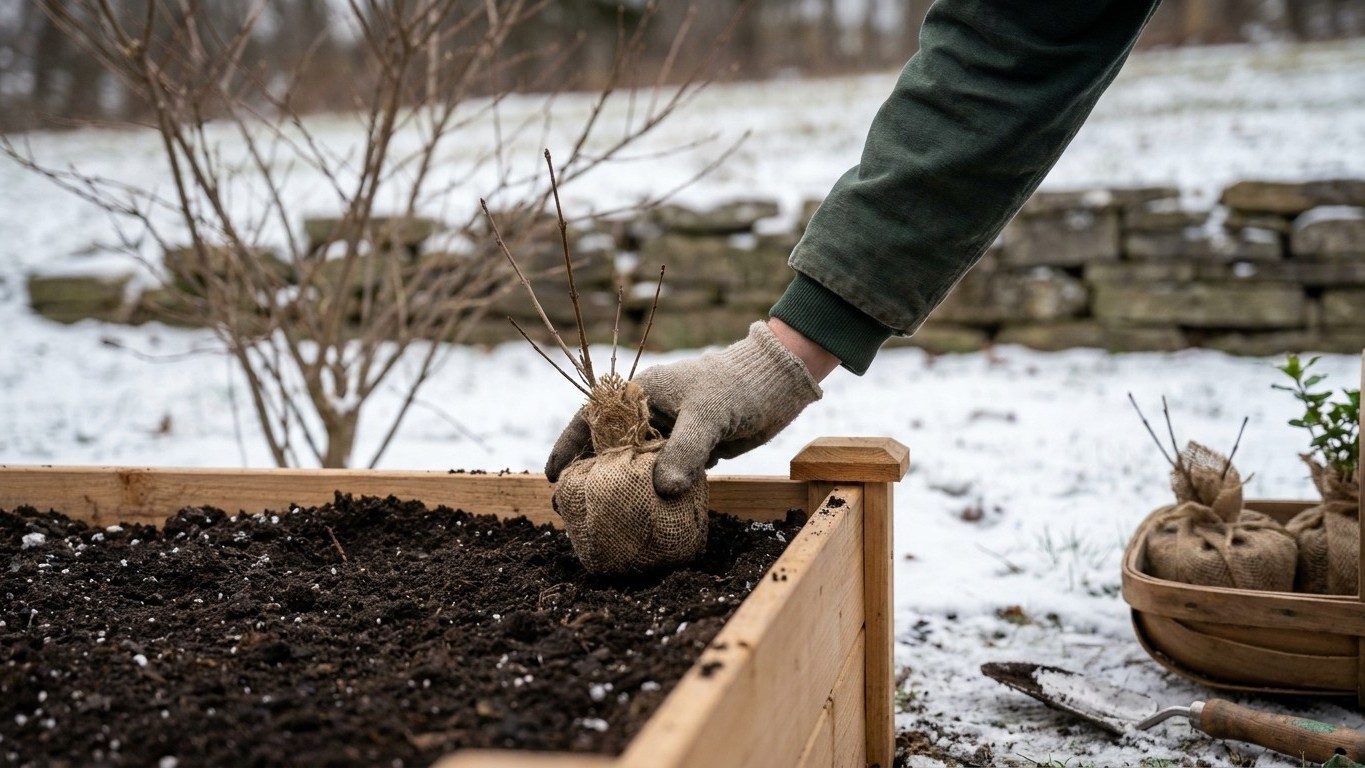

In December, nothing goes into open ground anywhere in the Northwest Territories. The soil has been frozen solid for weeks, long before the calendar reached this point, and there is no safe planting window to speak of. What remains possible is limited to cold frames, forced roots indoors, and dormant-season prep that sets up next year’s garden.
What goes in the ground in December

The reason this month is a flat no for outdoor planting comes down to soil temperature, not the date on the wall. Environment and Climate Change Canada’s normals for the Yellowknife A station put the average last spring frost at May 25 and the average first fall frost at September 18. That’s a growing window of roughly four months in an average year, and December sits squarely in the dead center of the gap on the other side of it, months away from either threshold. The ground has been locked under frost and snow since well before this point, and it will stay that way for months yet.
That mean frost date matters less than the warning attached to it: it’s a midpoint, not a guarantee. In half of all years, frost arrives even later in fall or lingers even longer in spring than these averages suggest. Whatever margin a gardener imagines around these dates, December offers none of it either way.
So there’s no honest way to list crops that go into the open ground this month, because none do. Garlic and shallots, which in milder regions go in during late fall ahead of freeze-up, have already missed their window here; by December the ground has been unworkable for weeks. What’s left is protected space. Cold frames and low tunnels set up earlier in the season can still shelter whatever hardy greens made it that far, provided they were tucked in before the real freeze hit. Roots dug in fall (chicory, rhubarb crowns) can be brought indoors now and forced in a dark, cool spot for a harvest that has nothing to do with outdoor soil at all. Dormant, bare-root planting of trees or shrubs isn’t an option outdoors here in December either; that work has to wait for a thaw the territory won’t see again until spring. This is a month for containers, forcing jars, and patience, not shovels in the yard.
What to start under cover
Seed-starting math works backward from the transplant date, not forward from today, and in the Northwest Territories that backward count runs into a wall fast. If the goal is tender transplants like peppers or tomatoes ready to go outside once the real frost risk has passed, most gardeners aim well past the average May 25 frost date to build in a margin, often into June. Peppers and similarly slow starters typically want something like eight to ten weeks indoors before transplant, plus a week or two of hardening off. Counting back from an early-to-mid-June planting date lands the sowing date in March, not December.
Start those tender crops now and the plants will be rootbound and leggy long before the ground and air are ready for them, which is one of the two classic failure modes here. The other is waiting too long and running out of the short growing season entirely once it finally opens up. December’s job under cover is different: order seed before northern-adapted varieties sell out, set up grow lights and heat mats, and start the things that genuinely benefit from a long, slow lead time or don’t care about outdoor frost dates at all.
| What to start now | Why December works |
|---|---|
| Slow perennial herbs, onions from seed for a very long season ahead | Long germination and juvenile growth phase absorbs the extra months |
| Microgreens and sprouts | Ready in days, no connection to outdoor frost windows |
| Forced bulbs for indoor bloom | Timed to the cold period itself, not to spring planting |
Tender vegetable transplants (peppers, tomatoes, eggplant) should wait for their own backward count in late winter, not join the December sowing list out of impatience.
What is ready to pick
Outdoors, the honest answer is little to nothing. Anything left in open ground has been frozen in place since well before this point in the season, and by December even hardy leeks or kale tucked under mulch are usually locked under snow and ice rather than reachable for a fresh cut. If a milder pocket allowed access earlier in the cold season, that window has almost certainly closed by now.
What still feeds a household this month comes from two places: what’s stored, and what’s grown indoors on purpose. Sprouts and microgreens started under lights a week or two ago are ready on a rolling basis and don’t depend on the garden at all. Cold-frame greens that were established and hardened off before the deep freeze can sometimes still be picked in small amounts if the frame is well insulated and the plants were mature going into winter, but this is the exception rather than something to count on.
Stored crops need attention now, not later. Squash should be checked for any soft spots or a dull, sunken patch on the skin, both signs it’s starting to break down and needs to be used first. Potatoes that have gone soft, sprouted eyes longer than a fingernail, or developed a green tinge should be pulled from the batch before they spread trouble to the rest. Onions are the most obvious tell: any that have gone soft at the neck or started to smell should come out immediately, since one bad onion in storage can take down its neighbors fast.
The jobs that matter this month
A dormant month is not an empty one. Fruit and berry canes that survive this far north, currants, haskap, hardy saskatoon, benefit from pruning while they’re fully dormant and the structure of the plant is easy to see without leaves in the way. Cutting now, rather than waiting for a false thaw, avoids stressing the plant during a brief warm spell and gets the job done while the wood is least likely to be damaged by the cut.
Seed catalogs move fast for anything bred to handle a short, cool season, and northern-adapted varieties are often the first to sell out. Ordering now, rather than in late winter, is the difference between getting the variety that actually matures in this growing window and settling for whatever’s left.
This is also the month to plan next year’s rotation on paper, before the pressure of an actual growing season forces rushed decisions. Soil testing and amending can happen now too, since results and amendments have all winter to work before anything goes back into the ground. A compost pile, even a small backyard one, keeps working slower in the cold but still benefits from an occasional turn to keep it from going anaerobic under snow cover.
Tool maintenance belongs here as well: cleaning soil and sap off blades, sharpening pruners and hoes, and oiling anything that will rust over a long, damp winter. Beds, cold frames, and any fencing or hoop-house structures should get a check for snow load damage or gaps that let in cold air, since a small repair now is far easier than an emergency fix once the ground refreezes hard around a broken frame. None of this shows results immediately, but skipping it costs real time and money once the season actually opens.
What not to do in December
The most common mistake this month is reading a brief warm spell as permission to act outdoors. A few days above freezing doesn’t thaw soil that’s been frozen for weeks, and any seed or transplant put into that ground will simply sit and rot or freeze once temperatures drop again, which they will.
A related error is pulling mulch or row cover off a cold frame during that same mild stretch to “let the plants breathe.” Exposed soil and plant crowns lose whatever insulation they’d built up, and a quick refreeze right after can do more damage than the cold ever would have if the cover had stayed put. Once protective mulch or row cover goes down for winter, it should stay down until there’s a real, sustained thaw, not just a warm afternoon.
Feeding nitrogen at this point in the season is also a mistake, whether to dormant perennials or to bulbs being forced indoors. Nitrogen pushes soft, leafy growth, and soft growth is exactly what gets damaged by cold or by the low light of a northern winter. Anything getting fed right now should be getting a balanced feed intended for the dormant or forcing stage, not a general growth booster.
Overwatering stored crops, or storing them somewhere too humid, invites the same rot that ends a good harvest early. Check the storage space itself, not just the vegetables, if problems keep showing up.
Checking this against your own county
Everything above is built around the Yellowknife A station, and the Northwest Territories is far too large and varied for one town’s average to apply everywhere. Elevation, latitude, and the moderating effect of a large lake all shift real frost windows by weeks in either direction. A community near the southern border sits in a very different reality than one above the Arctic Circle, even though both fall under the same territory-wide zone 1b rating (Canadian hardiness system, not USDA, and not directly comparable to it).
Before committing to any of the timing above, check it against the Government of the Northwest Territories agriculture services for guidance closer to a specific community.
Common questions
Can anything be planted outdoors in the Northwest Territories in December?
No. The ground is frozen and there is no safe outdoor planting window this month anywhere in the territory. Any planting activity this time of year happens under cover, indoors, or through forcing roots that were dug earlier in the season.
What does the average frost-free window actually mean for December planning?
Environment and Climate Change Canada’s normals put the average last spring frost at May 25 and the average first fall frost at September 18 for the Yellowknife A station. December falls well outside that window on the dormant side, and since these are averages rather than guarantees, the real safe margin in spring and fall is often narrower than the dates suggest.
Is it worth starting tender transplants indoors in December to get ahead of the season?
Generally no. Crops like peppers and tomatoes that need eight to ten weeks indoors before transplant are usually sown in March for a June planting date. Starting them in December means rootbound, leggy plants long before the ground or air is ready.
What Canadian hardiness zone applies to this area, and does it match USDA zones used elsewhere?
The reference city used for this territory sits in Canadian hardiness zone 1b, based on Natural Resources Canada’s 1991-2020 normals. This is a seven-variable Canadian rating, not a USDA zone, and the two systems don’t convert directly, so it shouldn’t be compared on the same scale as USDA figures used for US states.