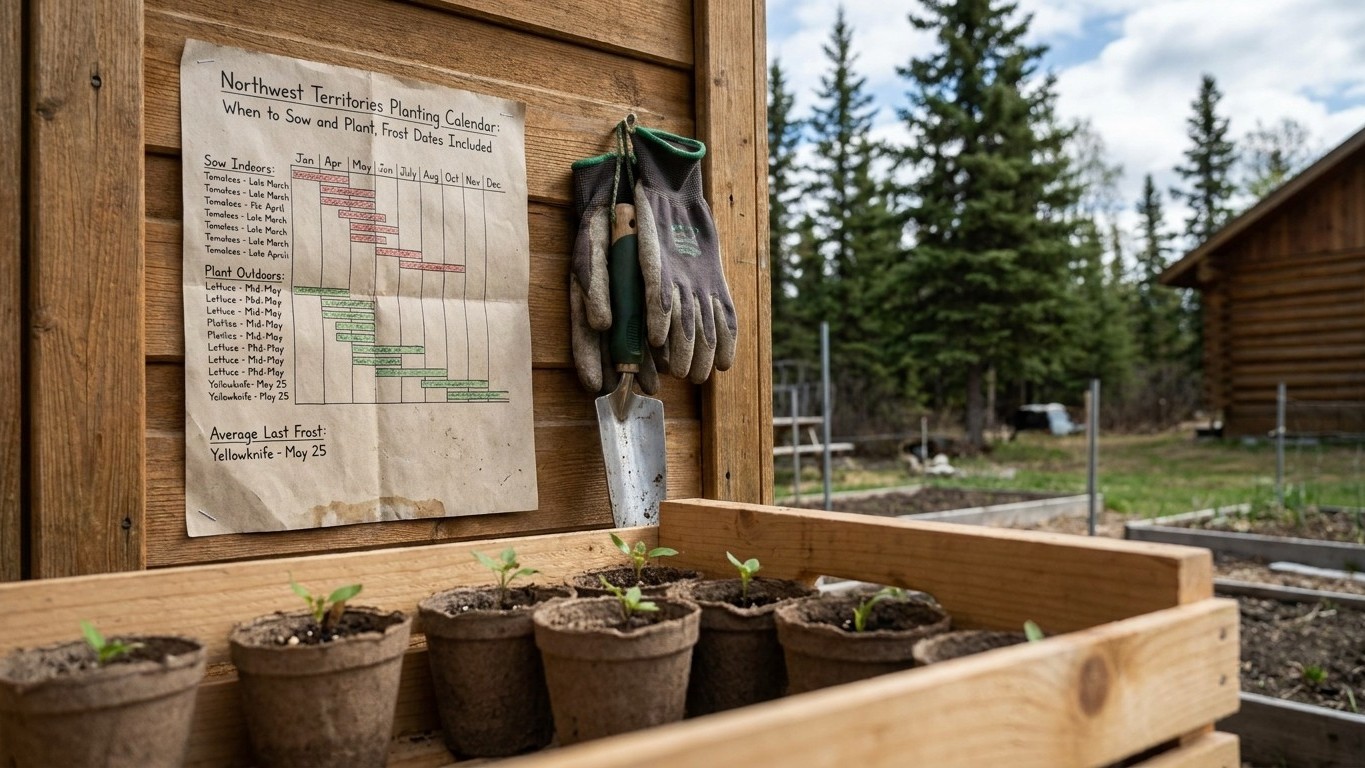

May 25 and September 18 are the two dates that run every garden plan in Yellowknife. That gap works out to roughly 116 frost-free days, the longest run of safe growing the territory offers, and it’s the number behind every days-to-maturity count on your seed packets. But these are averages pulled from three decades of records, not guarantees — frost has shown up well into early June and landed ahead of schedule some Septembers too. Plant against the midpoint, not the edges. Before that window opens, though, there’s still work to do indoors — see What to Plant in Northwest Territories in January for the earliest planning steps, What to Plant in Northwest Territories in February for the earliest indoor starts, and What to Plant in Northwest Territories in March for what to start while the ground is still frozen.
The frost window in Northwest Territories

Every planting decision in the territory starts with two dates recorded at Yellowknife. Environment and Climate Change Canada’s 1981-2010 climate normals for station YELLOWKNIFE A put the average last spring frost at May 25 and the average first fall frost at September 18. Between those two dates sits a frost-free window of about 116 days, the longest stretch most gardeners in the territory can count on for anything that can’t handle a freeze.
Those numbers are means, not promises. A mean date means frost falls after May 25 in roughly half of all recorded years and before it in the other half. Treat May 25 as the midpoint of a range that can slide into early June, not as the day you’re safe to set out a tomato — for a detailed rundown of what to get in the ground once that risk has passed, see What to Plant in Northwest Territories in April, and for the full lineup once that frost-free window is reliably open, see What to Plant in Northwest Territories in May. The same caution applies at the other end of the season. September 18 is where fall frost lands on average, but a cold snap can arrive earlier in a low-lying yard or in a year with an early winter pattern — for what to prioritize as that date approaches, see What to Plant in Northwest Territories in September, and once that first frost has passed, see What to Plant in Northwest Territories in October for what still holds up in the garden before winter closes it down entirely, then check What to Plant in Northwest Territories in November for the last tasks before the ground locks up, and once the ground is out of reach for fresh planting, see What to Plant in Northwest Territories in December for what still works indoors and under cover.
How the growing season adds up
Subtract May 25 from September 18 and you get 116 days, which is the number every days-to-maturity figure on a seed packet has to fit inside. That’s workable for most vegetables bred for short summers, but it leaves little room for slow-maturing crops or a late start. Once the frost risk clears in late May, the pace picks up quickly — see What to Plant in Northwest Territories in June for what to get in, and by the time that window nears its close, see What to Plant in Northwest Territories in August for what to get started as soon as the ground warms. Yellowknife itself sits toward the milder end of the territory’s growing conditions, and by midsummer that head start shows in what’s ready to go in the ground — see What to Plant in Northwest Territories in July for the crops that fit the window at its warmest point. Communities farther north, at higher elevation, or away from the moderating effect of Great Slave Lake typically see a shorter frost-free window, sometimes by several weeks, so a gardener in a more exposed or northern location should treat these dates as an optimistic starting point rather than a local guarantee. Growers comparing conditions elsewhere can check the Nova Scotia planting calendar for a maritime-influenced season of similar length, or the Montana planting calendar for a longer continental one built around very different frost dynamics.
Cool-season crops (see What to Plant in Northwest Territories in September for getting an early start, What to Plant in Northwest Territories in October for what to put in once the season is underway, and What to Plant in Northwest Territories in November for closing out the season)
Peas, spinach, lettuce, brassica transplants and most root crops handle a light frost without much damage, which is what makes them the first things into the ground in the territory. None of these depend on the last frost date the way a tomato does. What they need is soil that has thawed and dried out enough to work, which in most years follows roughly the same timeline as the frost dates themselves. Peas and spinach in particular tolerate a hard frost once they’ve germinated, so they’re usually the first seeds sown, often well ahead of the May 25 mean last frost tracked at Yellowknife.
What goes in first
- Peas and spinach germinate in cold soil and can be sown as soon as the ground can be worked, without waiting on the frost date at all.
- Lettuce, once established, tolerates a light freeze, so seedlings or direct-sown seed can go out while some frost risk remains.
- Brassicas such as cabbage, broccoli and kale are usually started indoors and set out as hardened transplants ahead of the last frost, since the transplant handles cold better than raw seed would.
- Root crops like carrots and beets are direct-sown once soil is workable and don’t need frost-free conditions to get started.
The mistake most new gardeners make with cool-season crops isn’t planting too early, it’s planting too late and losing weeks of usable cold-tolerant growing time on a crop that could have handled the frost just fine. Because the May 25 figure from Environment and Climate Change Canada is a mean drawn from Yellowknife, a grower elsewhere in the territory should watch their own soil rather than count days on a calendar. Cool-season crops go in when the ground can be worked, whether that lands before or after the regional mean.
The territory’s northern latitude also means summer days stretch long, and that extra daylight speeds up bolting in lettuce and spinach once temperatures climb. Sowing a small batch every couple of weeks through the cool part of the season keeps a supply coming before the plants run to seed, rather than betting everything on one large planting.
Warm-season crops

Tomatoes, peppers, squash, beans and corn all die at the first touch of frost, so the May 25 mean last frost tracked at Yellowknife sets the earliest possible outdoor date for any of them, and even that’s optimistic. Soil temperature matters more than the calendar here. Warm-season seeds and transplants sit and sulk, or rot outright, in soil that’s still cold even if the air feels warm enough. Most territory gardeners wait until early June, roughly one to two weeks past the mean frost date, before setting out anything that can’t handle cold.
Counting backward for indoor starts
Tomatoes and peppers need about six to eight weeks of indoor growth before they’re ready to transplant. If the target transplant date is early June, seed should go into trays roughly six to eight weeks earlier, which lands in mid to late April. Starting earlier than that produces leggy, rootbound seedlings that struggle after transplant instead of giving a real head start.
Every catalog days-to-maturity figure is counted from the transplant date, not from seed, and actual timing shifts by a week or two depending on the season’s weather. Working from an early-June transplant and the September 18 mean first fall frost tracked at Yellowknife, here’s how some catalog tomato varieties line up.
| Variety | Days from transplant | Type | Approx. first ripe | Margin before mean fall frost |
|---|---|---|---|---|
| Sakura | 55 | Indeterminate | Early August | 47 days |
| Edox | 55 | Indeterminate | Early August | 47 days |
| Valentine | 55 | Indeterminate | Early August | 47 days |
| Glacier | 55 | Determinate | Early August | 47 days |
| Sun Gold | 57 | Indeterminate | Early August | 45 days |
| Supersweet 100 | 60 | Indeterminate | Early August | 42 days |
| Juliet | 60 | Indeterminate | Early August | 42 days |
| Amalfi | 68 | Determinate | Mid August | 34 days |
| Cherokee Purple | 72 | Indeterminate | Mid August | 30 days |
| Big Beef Plus | 72 | Indeterminate | Mid August | 30 days |
| Tiren | 75 | Indeterminate | Late August | 27 days |
| Granadero | 75 | Indeterminate | Late August | 27 days |
| San Marzano II | 78 | Indeterminate | Late August | 24 days |
| Celebrity Plus | 78 | Determinate | Late August | 24 days |
The margin column is what matters most in a short-season territory. A variety with 47 days of cushion, like Sakura, ripens well ahead of the mean frost and still has slack for a cool summer. A variety sitting at only 24 days of margin, like San Marzano II, only pans out if the season runs close to average or the plant gets help from a wall, black plastic mulch or a low tunnel to bank extra heat.
Peppers run on a similar clock to the longer-season tomatoes and benefit from the same season-extending tricks. Squash, beans and corn are usually direct-sown rather than transplanted, and none of them should go into the ground until the soil has warmed well past the frost date, since cold, wet soil rots seed before it germinates far more often than a slightly late start ever costs in yield.
The fall planting window
Working backward from the September 18 mean first fall frost tracked at Yellowknife, a fall crop needs its full days to maturity plus a buffer, since growth slows as daylight and temperature drop through late summer even before an actual frost arrives. A crop rated at 60 days often needs closer to 75 or 80 days of real time once sown in mid-summer, because it’s growing into shortening days rather than lengthening ones.
What to sow for fall, and what improves after frost
The same cool-season crops that go in early in spring, peas, spinach, lettuce, brassicas and root crops, are the ones worth a second planting for fall, since they’re the group tolerant enough to sit through the season’s first light frosts rather than being wiped out by them. Spinach and lettuce sown for a fall crop mature into the cooler weeks approaching September 18 without the bolting pressure they face under early-summer daylight.
Several crops actually improve after a light frost rather than being harmed by it. Kale and other cold-hardy brassicas convert starches to sugars when temperatures drop, producing a noticeably sweeter leaf after the first touch of cold. Carrots and other root crops left in the ground past a light frost do the same, which is why many gardeners delay the root harvest rather than rushing it ahead of the September 18 mean frost date. Peas and lettuce, by contrast, get knocked back hard by a real freeze and are best harvested before conditions turn.
Because September 18 is a mean drawn from Yellowknife’s climate record, not a hard deadline, a fall crop can keep producing well past it in a mild year, or get cut short weeks early in a year running cold. Building in that buffer, rather than planting right up to the average date, is what keeps a fall planting from being wiped out by an early frost landing on the earlier half of the historical range.
Reading a planting calendar properly
A territory-wide calendar built on Yellowknife’s climate normals is a starting point, not an instruction sheet for every yard in the Northwest Territories. Elevation, exposure and the moderating effect of a nearby lake all shift a local frost date away from the station average, sometimes by weeks rather than days.
What actually moves the date in your yard
A garden close to Great Slave Lake tends to warm and cool more slowly than one further inland, since large bodies of water hold heat and release it gradually, which can push both the last spring frost later and the first fall frost later too. A yard at higher elevation, or in a low spot where cold air pools overnight, will often see frost before a neighbor’s garden just a short distance away. A built-up or paved area holds a bit more heat than open ground, nudging its local frost dates a little milder than the surrounding land. None of these effects are captured in a single station reading, which is exactly why the May 25 and September 18 figures from Environment and Climate Change Canada should be read as a regional average rather than a promise for any one yard.
The more reliable approach is to watch your own garden over a season or two rather than trust the calendar alone. Keep a simple record of the frost dates you actually observe, note where cold settles first in your yard, and use a soil thermometer before setting out warm-season transplants instead of counting days from a regional average. A late cold snap arriving after weeks of mild weather is the single most common way a planting calendar gets a gardener in trouble, since warm weather early in the season doesn’t mean the frost risk has passed.
Local help
The Northwest Territories’ extension service through the Department of Industry, Tourism and Investment is the best next stop for anything specific to your own community, including soil testing and community-level growing advice that a territory-wide calendar can’t provide. For more on growing conditions and resources across the territory, the Northwest Territories guides hub is a useful place to start browsing by topic, and it’s worth checking before you commit a full season’s budget to seed.
Common questions
Is May 25 actually safe to plant tomatoes outside?
No. May 25 is the average last spring frost recorded at Yellowknife by Environment and Climate Change Canada, which means frost has historically landed later than that date about half the time. Most gardeners wait until early June, and some still lose plants to a late snap after that.
Does the frost date change much depending on where I live in the territory?
Yes, often by weeks. The May 25 and September 18 figures come from the Yellowknife A station specifically, and communities farther north, at higher elevation, or away from Great Slave Lake’s moderating effect typically see a shorter frost-free window. Check with the territory’s extension service for anything closer to your own community.
What if I’m getting a late start and summer is already underway?
Cool-season crops like peas, spinach, lettuce and root vegetables can still go in for a fall harvest, since they tolerate the season’s first light frosts. For warm-season crops, a shorter-season tomato with a wide margin, such as Sakura or Edox at 55 days from transplant, has a better chance than a variety needing 75 or more days.
My short-season tomato still didn’t ripen. What went wrong?
The most common causes are a late or cold-soil transplant date, starting seed indoors too early or too late for the six-to-eight week window, or a summer that ran cooler than average and ate into the catalog margin. Days-to-maturity figures are counted from transplant under average conditions, not guaranteed under any conditions.
No, Canada uses its own plant hardiness zone system, based on seven climate variables rather than the single measure used south of the border, so the Northwest Territories should be gauged only by its Canadian zone rating. For a zone rating specific to your community, or for guidance on interpreting it for vegetable growing, contact the territory’s extension service directly.
Related guides
- Yukon Planting Calendar: When to Sow and Plant, Frost Dates Included
- Nunavut Planting Calendar: When to Sow and Plant, Frost Dates Included
- Nova Scotia Planting Calendar: When to Sow and Plant, Frost Dates Included