
In Northwest Territories, November means the growing season is long over and the ground is frozen or under snow across almost the whole territory. There’s nothing safe to direct-sow or transplant outdoors this month. The real gardening work now happens indoors and in storage: checking what you’ve put away, ordering seed, and getting tools and beds ready for spring.
What goes in the ground in November

The short answer: nothing goes into open ground in Northwest Territories this month, and pretending otherwise wastes seed and effort. The average first fall frost at Yellowknife A sits around September 18, and that’s a mean date, not a guarantee, meaning many years see frost land even earlier. By the time November arrives, the soil has been frozen or snow-covered for weeks in most of the territory. There is no workable bed to plant into, and no crop on this site’s lists that would survive being sown into frozen ground.
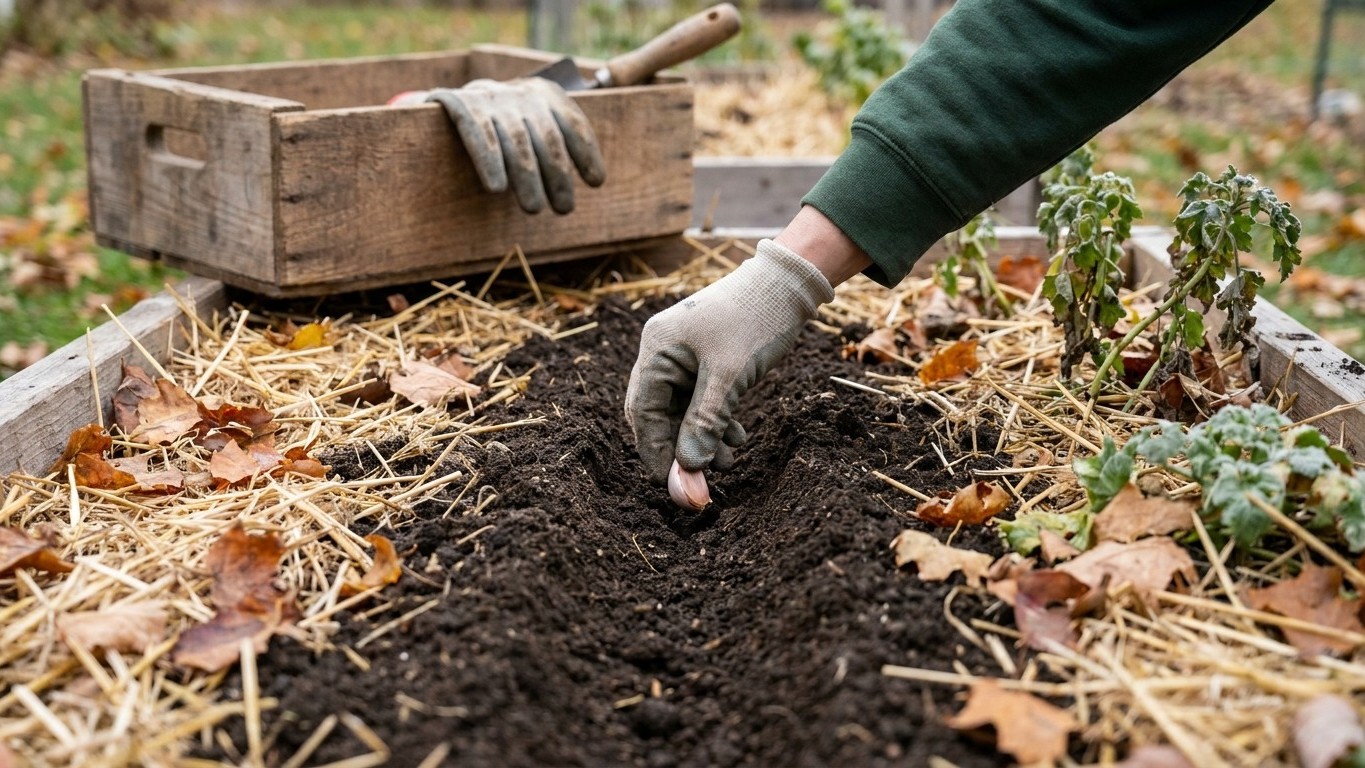
Garlic and shallots, which in milder climates go in during fall for a summer harvest, need to go into the ground while it’s still workable, typically well before freeze-up. If that window slipped past, November is too late; the bulbs would sit in frozen soil without rooting properly before winter locks everything down. Don’t force it.
What’s actually possible
What still works this month is entirely indoors or under serious protection, not in the open garden:
- Forcing rhubarb crowns or chicory roots indoors for a fresh harvest in the depths of winter
- Starting sprouts and microgreens on a windowsill or under grow lights
- Potting up any bare-root stock that arrived too late to plant, to hold over in an unheated but frost-protected space until spring
- Checking cold frames or low tunnels that were closed up earlier in fall, mainly to make sure snow load hasn’t collapsed them
Cold frames and low tunnels don’t buy much in a climate rated Canadian zone 1b; they slow heat loss by a few degrees, not enough to keep soil workable once deep winter sets in. Treat them as protection for whatever is already established, not as a way to plant something new.
What to start under cover
Work backward from the average last spring frost, May 25 at Yellowknife A, and November sits roughly six months out. That’s too early for almost every transplant on a typical seed-starting schedule. Slow growers like onions and leeks are usually started 10 to 12 weeks before the last frost, which lands in late February or March here, not November. Peppers and tomatoes are started even closer to that date, generally six to eight weeks out. Starting any of these now guarantees rootbound, leggy plants that stall long before they ever see a garden bed.
The failure runs both directions. Start too early and you spend months babying spindly seedlings that need repotting two or three times before the ground even thins out. Start too late and you run out of the short northern growing season entirely, since the frost-free window here, roughly May 25 to September 18, is already tight. November falls outside both safe zones for spring transplants.
What does make sense under cover this month is smaller-scale and faster-turnaround: microgreens and sprouts for the kitchen, which are ready in one to two weeks regardless of the calendar outside. If there’s a heated, well-lit space and genuine interest in a longer project, some slow perennial flower seeds that need three to four months of cool stratification before germinating can be started now in trays kept in an unheated porch or garage, timed to be ready for transplant once the ground opens. That’s a narrow exception, not a general green light for November seed-starting.
What is ready to pick
Outdoors, the honest answer is nothing. By November the frost-free window closed roughly six to eight weeks earlier on average, and any exposed leafy crop has long since been finished off by hard freezes. There’s no realistic harvest coming out of an open garden bed in Northwest Territories this month.
What still feeds the household comes from two places: storage and indoor growing. Sprouts and microgreens started on a schedule can be cut every week or two, giving fresh greens with none of the delay a garden crop would need. Beyond that, this is the month to go through root cellars, cold rooms, or basement storage and actually check what’s down there rather than assuming it’s fine.
What to check in storage
Winter squash should feel heavy for its size and the skin should resist a fingernail; any soft spot or sweet smell means it’s turning and needs to be used immediately, not stored longer. Potatoes want to stay firm, dark, and cool; sprouting eyes or a green tinge mean move them to the front of the use pile. Onions should be checked at the neck, since a soft neck is the first sign of rot spreading through the whole bulb. Carrots and other root vegetables packed in damp sand or peat need a quick check for any that have gone slimy, since one rotting root can take out its neighbors in storage. Ten minutes with a flashlight now saves a whole bin later.
The jobs that matter this month
November is not a pause between seasons, it’s when several jobs have hard deadlines of their own. Skip them now and the cost shows up in spring, not in November itself.
Dormant pruning is one of them, though in a Canadian zone 1b climate the list of fruiting trees and canes that survive at all is short. Where hardy shrubs or berry canes are established, prune while they’re fully dormant and the structure is easy to see without leaves in the way. Cutting into a plant that’s already starting to wake up in spring costs vigor it can’t easily replace.
Seed ordering belongs here too. Northern-adapted, short-season varieties sell out early, and waiting until late winter to order often means settling for whatever’s left rather than the variety actually suited to a frost-free window this tight. Pair that with planning next season’s rotation while the layout of this year’s beds is still fresh in memory, not reconstructed from a fading memory in April.
Soil testing can happen now if samples are sent to a lab rather than tested in frozen ground directly; results come back over winter, giving time to plan amendments before anything gets planted. Compost piles slow down drastically once temperatures drop, but turning them one more time before they freeze solid, and insulating with straw or leaves, keeps some microbial activity going longer than an untouched pile.
Tools deserve the attention now too: cleaning soil and sap off blades, sharpening pruners and hoes, and oiling anything metal before it sits unused for months. Beds and fencing damaged by summer weather or wildlife are easier to repair while there’s daylight to work with than in the dark heart of winter. None of this is filler. Skip the pruning and spring growth comes in weaker. Skip the seed order and the good varieties are gone. Skip the storage check and a whole bin of potatoes goes soft before anyone notices.
What not to do in November
The most common mistake is trusting a mild afternoon over the calendar and the ground. A stretch of unusually warm daytime air doesn’t mean the soil underneath has thawed enough to plant anything, and in a territory where the frost-free window averages only about four months a year, there’s no margin for that kind of guesswork.
Uncovering cold frames or removing mulch after a warm spell is another version of the same error. The protection was put there for a reason, and pulling it back exposes whatever’s underneath to the next cold snap with no buffer left. Once it’s off, putting it back doesn’t undo the shock to the plant.
Feeding nitrogen this late is also a mistake worth naming directly. Nitrogen pushes soft new growth, and soft new growth is exactly what gets killed fastest by hard freezes. Anything still in the ground, or any potted perennial being overwintered, should be heading toward dormancy, not being encouraged to grow. If soil amendments are needed, this is the month to plan and order them for spring, not to apply a fertilizer that works against the season.
Last, don’t leave stored crops unchecked because “it’s too cold for rot to spread.” Root cellars and basements still hold enough humidity and residual warmth for one soft potato or onion to spread decay to its neighbors over the course of a month. Checking storage isn’t optional cleanup, it’s the difference between using most of what was grown and losing a chunk of it to something that could have been caught in ten minutes.
Checking this against your own county
A territory-wide month is a starting point, not an instruction. Northwest Territories spans an enormous range of latitude and elevation, and the frost dates cited here come from a single station, Yellowknife A. Communities farther north, at higher elevation, or away from any lake-moderated microclimate can run weeks behind that reference point, meaning ground may already be frozen solid well before what’s described above, or in rare milder pockets, slightly less so.
Before acting on any of this, check conditions locally rather than assuming the territory-wide average applies. The Government of Northwest Territories agriculture services page is the place to start for guidance suited to specific communities and growing conditions across the territory.
Common questions
Can I still plant garlic in November in Northwest Territories?
Generally no. Garlic needs to go into workable soil well before freeze-up to root before winter, and by November the ground across most of the territory is already frozen or snow-covered. If it wasn’t planted earlier in fall, hold the bulbs indoors and plant them as soon as the soil opens up in spring instead.
Is it too early to start seeds indoors for next spring?
For most transplants, yes. With an average last frost around May 25, most seed-starting schedules point to late winter, not November. Starting six months ahead usually means leggy, rootbound plants long before the ground is ready for them.
What can I actually harvest in Northwest Territories in November?
Realistically, nothing from an open garden bed. Sprouts and microgreens grown indoors are the main fresh option, alongside whatever’s coming out of root cellar or basement storage: squash, potatoes, onions, and root vegetables put up earlier in the season.
What’s the Canadian hardiness zone for this region, and what does it mean?
The reference city for this territory is rated Canadian zone 1b, based on Natural Resources Canada’s system, which weighs seven climate variables rather than the single minimum-Temperature measure used in the USDA system. That means this figure doesn’t convert directly to a USDA zone number, and it applies to the reference location, not uniformly across the whole territory.
Gardeners who plant by the Moon can check the November 2026 moon planting calendar, a tradition rather than a proven method.
Related guides
Elsewhere? See what to plant in November in every state and province.