
By November, Nova Scotia has already crossed its average first fall frost, so this is not a month for new outdoor sowing of anything tender. The realistic outdoor list is short: garlic and shallots in workable soil, bare-root stock while it’s still dormant, and cold frames or low tunnels protecting greens sown weeks earlier. Everything else moves indoors or onto the to-do list.
What goes in the ground in November

The decision this month isn’t the calendar, it’s the soil. Once ground Temperature drops and daylight shrinks past ten hours, root growth all but stops even where the surface hasn’t frozen yet. Environment and Climate Change Canada’s 1981-2010 normals for the Halifax Stanfield station put the average first fall frost at October 18, which means most of the province has already had at least one hard frost before November even starts. That single fact reshapes everything on this list: this is not a planting month in the way April or September are. It’s a closing-out month with a few narrow exceptions.
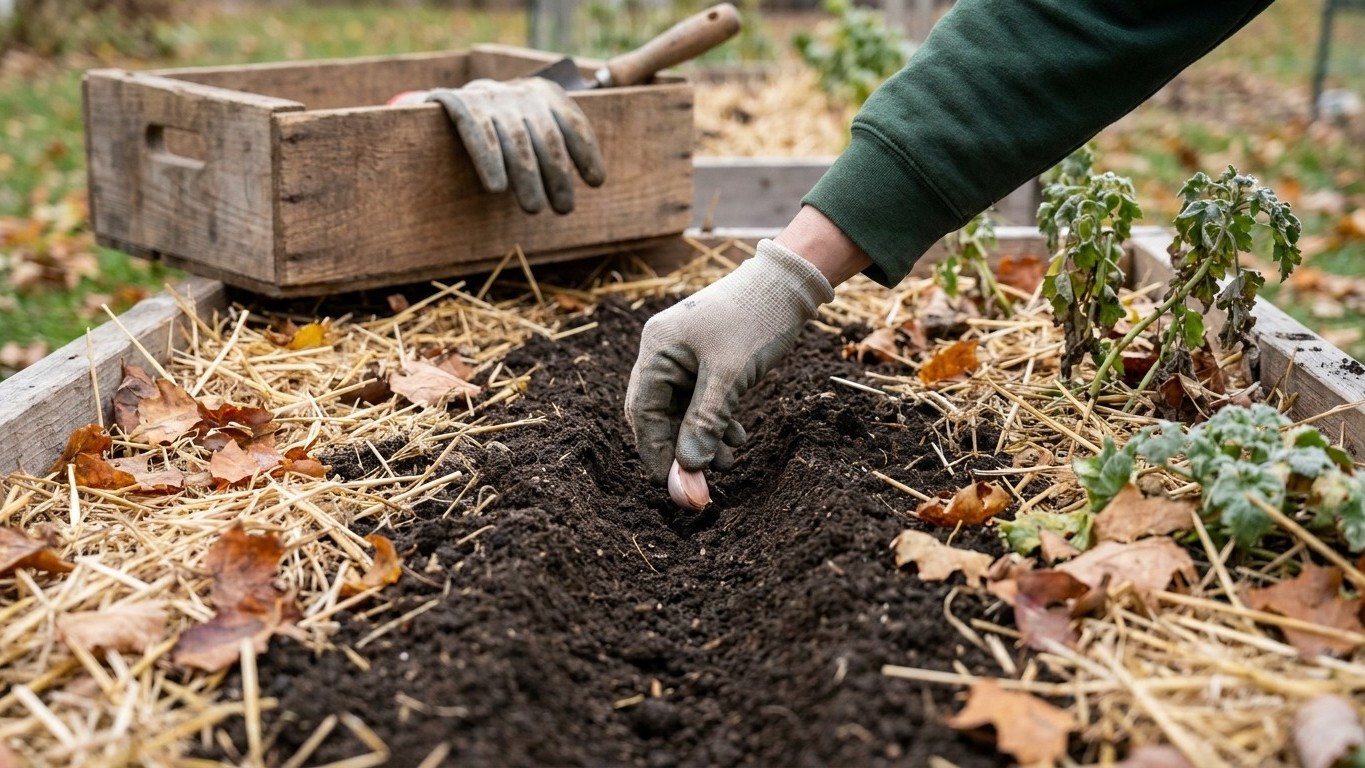
Garlic and shallots are the exception worth acting on. If the ground is still workable, meaning you can push a trowel in without hitting a frozen crust, both can still go in. Garlic in particular wants several weeks of cool soil contact before hard freeze to root in before dormancy, so a bed planted in early November, while risky if a hard freeze arrives fast, is still within the realistic window for much of the province.
Bare-root fruit trees, cane fruit and roses can also be planted or transplanted now, provided the ground hasn’t locked up. Nurseries often move dormant stock at this time of year precisely because the plant isn’t trying to grow, it’s just settling roots before winter. Mulch heavily after planting.
Cold frames and low tunnels matter more this month than any new seed packet. If hardy greens, spinach or mâche were sown in September, a frame or tunnel now buys them several more weeks of growth and, in a mild pocket, a harvest deep into winter. Forcing rhubarb crowns or chicory roots indoors in darkness is also a genuine November project, not a consolation prize.
The Halifax area sits in Canadian hardiness zone 6b, based on Natural Resources Canada’s 1991-2020 normals. That’s the Canadian system, built on seven climate variables, not the single-variable USDA scale used elsewhere on this site, and it applies to the Halifax municipality specifically, not to the whole province. Inland and upland districts run colder.
What to start under cover
Counting backward from the average last spring frost of May 7 is the right way to plan indoor starts, but in November that arithmetic points mostly toward late winter, not this month. What November-under-cover sowing actually accomplishes is different: it’s about getting hardy greens established before real dormancy sets in, so they resume growth on their own once days lengthen again.
Mâche, claytonia, spinach and some hardy lettuces can still be sown into an unheated cold frame or polytunnel early in the month if soil there hasn’t frozen. The goal isn’t a harvest now, it’s a root system in place before the plant stops growing altogether. Sown too late, past mid-month in most of the province, seedlings won’t get enough root development before cold shuts growth down, and they’ll sit vulnerable rather than protected.
The opposite failure shows up in mild autumns: a warm stretch tempts gardeners to keep sowing succession crops under cover as if the season were still open. Those seedlings put on soft top growth, then get caught leggy and unhardened when a real cold snap follows. The safer read of the calendar is to treat any November sowing under cover as the last one of the season, not the start of another round.
Onion and leek seed for very early spring starts belongs on a windowsill schedule that begins in later winter, counted back from that May 7 average frost date, not now. Trying to get a jump by starting them indoors in November usually just produces stretched, rootbound plants long before it’s safe to move them out.
What is ready to pick
Outdoors, the answer is honestly thin. Kale, leeks, parsnips and Brussels sprouts left in the ground are the reliable holdouts, since cold actually sweetens their flavor rather than ruining it, and they can often be pulled or cut through light snow cover. Check leeks and parsnips are still loose enough to lift before the ground locks hard.
Cold frames sown earlier in fall will still be producing small pickings of spinach, mâche or loose-leaf lettuce, cut a few leaves at a time rather than harvested all at once, which keeps the plant going longer. Indoors, sprouts and microgreens are the most dependable fresh food source this month, ready in one to two weeks from sowing on a windowsill with no outdoor risk at all.
The other half of “harvest” in November is really inspection. Go through stored squash, potatoes, onions and apples now and pull anything with a soft spot, a sweet smell, or shriveling skin before it spreads to the rest of the bin. Squash with a bruised or punctured rind rarely lasts through winter storage even if it looks fine today. Potatoes that have gone green from light exposure should be used or discarded, not eaten. A five-minute check now, repeated every couple of weeks, saves whole crates later.
The jobs that matter this month
This is where November earns its keep, even without much happening in open ground.
Pruning, planning and protection
Dormant pruning of fruit trees and cane fruit can begin once leaves have dropped and the plant has gone fully dormant. Removing dead, crossing or damaged wood now, while the structure is visible without foliage, sets up a cleaner, healthier plant for spring without the risk of cutting into active growth.
Seed catalogs for the coming season are already circulating, and ordering now, rather than in the rush of late winter, means the popular and short-supply varieties are still in stock. Pair that with actual planning: sketch next season’s bed layout and rotation while this year’s crop positions are still fresh in memory, since rotation only works if it’s decided before spring pressure forces a shortcut.
Soil, tools and storage
Soil testing and amending, particularly liming, works best done now while the ground is still workable, because lime needs months to adjust pH before spring planting. Turning the compost pile one more time before it freezes solid keeps decomposition active longer into the cold season.
Cleaning and sharpening tools before they’re put away for winter protects both the tools and next year’s cuts, since a dull, rusted blade tears plant tissue rather than slicing it cleanly. Walk the property to repair raised beds, trellising and fencing while the ground still allows post-setting, and finish that check of stored crops for rot mentioned above. None of this is filler. Skipped now, each item becomes a spring problem instead of a fall chore.
What not to do in November
The most common mistake is treating a mild stretch of weather as permission to plant or uncover as if it were still fall proper. A warm week doesn’t cancel the season, it just delays the next frost by a few days, and tender seedlings or newly uncovered cold frames caught by the following cold snap lose everything gained.
Feeding nitrogen fertilizer this late is another classic error. Nitrogen pushes soft, leafy growth, and soft growth is exactly what winter cold damages first. If beds need feeding, it should have happened well before dormancy set in, and any remaining fertility work now should be compost or slow-release amendments, not a nitrogen boost.
Delaying garlic planting until the ground is frozen solid is a mistake that shows up the following summer as small, poorly divided bulbs. Garlic needs real time rooting in cool soil before winter dormancy; planted into frozen ground, or not at all because the window was missed, it simply doesn’t perform the same way.
Mulching too early, before the ground has actually started to cool and firm up, can trap warmth and moisture that invites rot and gives slugs and rodents cover rather than protecting the plant. Mulch is a winter tool, applied once the ground begins to firm, not an autumn one applied on the first cool day.
Checking this against your own county
A province-wide month is a starting point, not an instruction. Nova Scotia’s frost dates and hardiness numbers here are drawn from the Halifax Stanfield station and the Halifax municipality specifically, and elevation, coastal exposure and the difference between the South Shore and the interior or Cape Breton highlands can move real frost timing by weeks in either direction. A garden a short drive inland from Halifax can be weeks behind it on the calendar.
For local specifics, the Nova Scotia Department of Agriculture maintains resources worth checking: novascotia.ca/agri.
Common questions
Is it too late to plant garlic in November in Nova Scotia?
Not necessarily, but it’s tight. Garlic needs the ground workable and several weeks of cool soil contact before hard freeze locks it up. Early November plantings still generally have time; later in the month depends entirely on how fast the ground firms up in a given location.
Can I still start seeds indoors in November for spring planting?
It’s early for most transplants. Counting back from the average last spring frost of May 7, onion, leek and early brassica starts belong on a later-winter schedule, not now. Starting them in November typically produces leggy, rootbound plants long before it’s safe to set them outside.
What does Canadian hardiness zone 6b actually mean for my garden?
It’s a rating built on seven climate variables by Natural Resources Canada, specific to the Halifax municipality in this case, and it does not convert directly to a USDA zone. Treat it as a general reference for cold tolerance in that area, not a precise match to hardiness numbers used on US plant tags.
What should I check on stored vegetables during November?
Go through squash, potatoes, onions and apples every couple of weeks. Pull anything soft, sweet-smelling, shriveled or green-skinned (for potatoes) before it spreads decay to the rest of the storage bin.
Gardeners who plant by the Moon can check the November 2026 moon planting calendar, a tradition rather than a proven method.
Related guides
Elsewhere? See what to plant in November in every state and province.