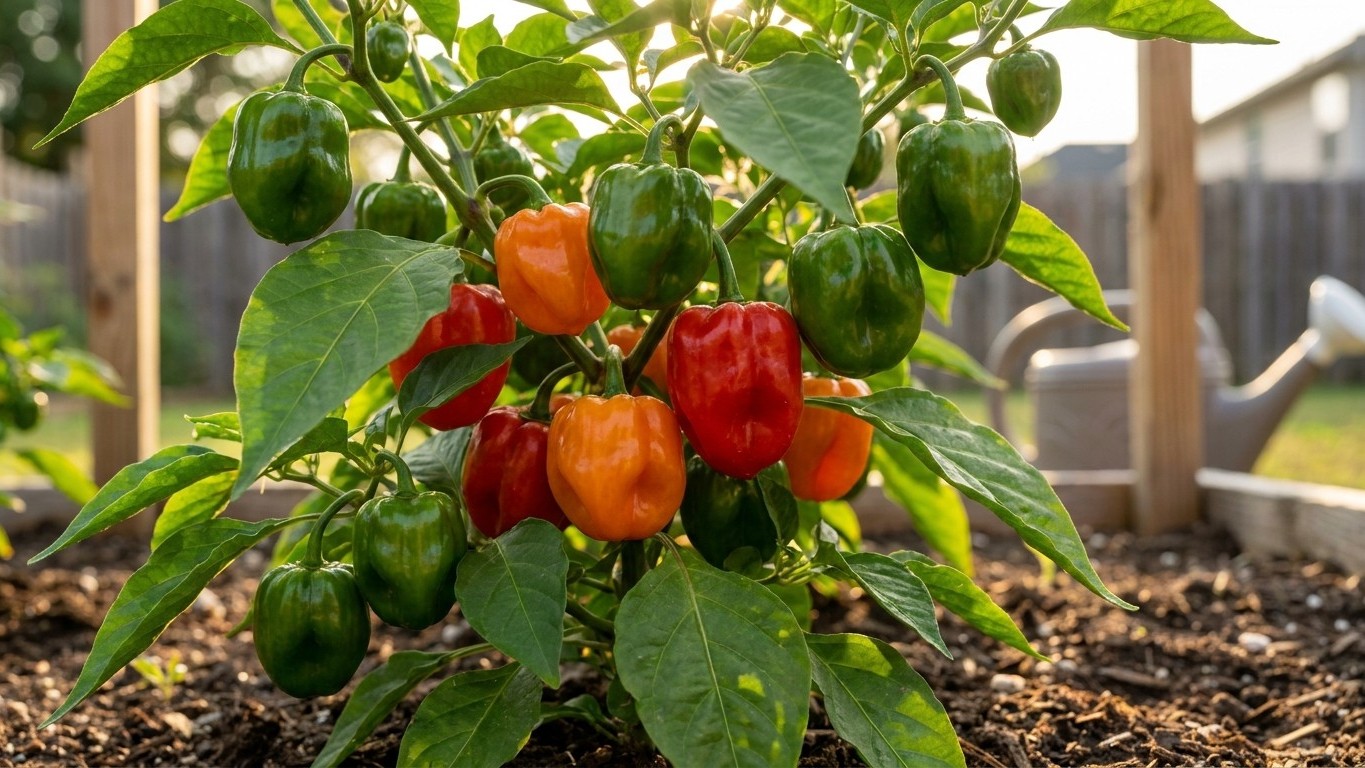

Pick peppers when the fruit is full size, firm and glossy, usually 70 to 85 days after transplanting and always before a hard frost. Then keep them out of the fridge. Clemson Cooperative Extension puts the best storage at 45 to 50 °F (about 7 to 10 °C), and a household refrigerator runs colder than that. Peppers from the crisper drawer come out pitted and soft. In Nova Scotia the fall frost sets the deadline, so the harvest plan starts with the calendar and ends in a cool corner of the house.
When are peppers ready to pick in Nova Scotia?
The 70 to 85 days come from Clemson Cooperative Extension, and they count from transplanting. Seed doesn’t enter into it. Utah State University Extension says transplants need 8 to 10 weeks indoors before they go out, and that they belong in the ground once the soil reaches 60 °F, after frost is past. A plant is already two months old when the harvest clock starts.
Environment and Climate Change Canada puts the mean last spring frost at May 7 at the Halifax Stanfield station. That date is the midpoint of a window. In one year out of two the last frost falls later, and northern and upland districts run weeks behind the airport. Soil at 60 °F often arrives after the last frost, so a soil thermometer is a better guide than the calendar. Say a plant goes out on June 1. Day 70 lands on August 10 and day 85 on August 25. A cool summer pushes the fruit toward the later end or past it, so watch your own plants rather than the calendar.
Fruit set decides whether there is anything to pick at all. According to Utah State, it fails at both ends: nights below 55 °F, or days above 90 °F (32 °C). Heat is the smaller worry here. Halifax Stanfield averages 0.6 days a year at or above 32 °C and 2.8 days a year above 30 °C. The cool end is another matter. Night lows differ from one yard to the next, so watch your own thermometer through flowering. If blossoms drop during a cold stretch, Why Peppers Fail to Set Fruit in Nova Scotia walks through the causes.
At harvest, look for a fruit that has reached full size for its variety, with firm walls and glossy skin. Green is a legitimate stage to pick, and colour is a bonus for those who can wait. Cut the stem with pruners instead of pulling, because branches snap easily. Chewed or scarred fruit is a reason to pick sooner. What Eats Pepper in Nova Scotia, and When covers the usual culprits and their timing.
Keeping them, and for how long
Clemson Cooperative Extension’s Home & Garden Information Center gives the target in one sentence: “The optimal conditions for storage are temperatures of 45 to 50 °F and 80- to 90-percent relative humidity for two to three weeks.” That is the whole recipe: 45 to 50 °F, high humidity, and a time limit.
The two to three weeks is a ceiling under ideal conditions. A pepper that was bruised, sun-scalded or already softening at harvest will not reach it. Peppers picked after a cold snap in the garden tend to be shorter-lived too. Treat three weeks as the best case and check the fruit every few days.
Why does the fridge damage peppers?
A refrigerator is set colder than 45 to 50 °F. Below about 45 °F peppers develop chilling injury: small sunken pits appear on the skin, the walls go soft, and the fruit breaks down faster than it would have on a counter. The damage often shows only after the pepper warms up again, so a pepper that looked fine coming out of the crisper can turn to mush that evening. Nearly everyone puts peppers in the fridge by habit, and that habit costs most people the fruit they spent a whole summer growing.
What about humidity?
The range of 80 to 90 percent is moist, much damper than a heated house in winter. Peppers lose water through the skin and wrinkle when the air is dry. A loosely closed or perforated bag, or a lidded container with a few air holes, holds moisture around the fruit without trapping so much that it rots. Keep the peppers dry going in, and wash them just before use. Standing water inside a bag is the quickest way to start mold at the stem.
Surplus beyond what you can use in a couple of weeks does better in the freezer. Sliced raw peppers work well in cooked dishes, though they lose their crunch. For fresh eating, the clock described above is the one that counts.
Where in the house that actually is
A kitchen or any heated room is warmer than 50 °F, so peppers there ripen and shrivel fast. A garage is the opposite problem: it follows the weather, so check it with a thermometer before you trust it. In Nova Scotia, where frost arrives in the fall and nights cool quickly after that, an unheated garage can ruin a crate overnight. Frost damage and chilling injury look alike, and neither can be undone.
The room that usually comes closest is a basement or cellar, particularly a corner on an outside wall, away from the furnace, the water heater and the dryer vent. A cool, unheated mudroom or enclosed porch can work in early fall, when nights haven’t turned hard. A cold room, if the house has one, is the best bet of all. No room is guaranteed, because houses differ in insulation, foundation and how much heat leaks from the mechanical room.
That is why a thermometer settles the question better than guessing. Leave a thermometer where the peppers will sit before you commit a harvest to that spot, and read the lowest and highest temperature, not just the current one. A min/max model costs little and shows the overnight dip that a single daytime reading hides. If a spot stays between 45 and 50 °F, use it. If it runs colder, move the crate. If it runs warmer, expect a shorter storage life and eat those peppers first.
A basic hygrometer, the kind sold for humidifiers and cigar boxes, covers the humidity side. Basements often run damp, which suits peppers. A dry spot can be corrected with a covered container.
Common questions
Should I pick peppers green or wait for color?
Either works. A full-size, firm green pepper is edible and can be picked at any point. Waiting for color lets sugars build, but the plant is also exposed to cool nights and frost longer, and leaving fruit on can slow the production of new fruit. If the forecast turns cold, pick rather than gamble.
What should I do when frost is in the forecast?
Pick every fruit that has reached full size, including green ones, and bring them in before the cold night. Frost damages leaves and fruit, and damaged fruit does not store. Once the plants are cleared, the fruit goes to a cool, humid spot as described above.
Can peppers go in the fridge at all?
In the warmest part of the fridge, the damage is usually small. After that, pitting and softness begin. A cut pepper is different: once the skin is open, it belongs in the fridge in a sealed container.
Does Nova Scotia get too hot for peppers to set fruit?
Rarely at the reference station. Halifax Stanfield averages 0.6 days a year at or above 32 °C and 2.8 days above 30 °C. Cool nights are the bigger risk, since fruit set also falters when nights drop below 55 °F. Watch your own nights, because they vary by yard. For the full growing picture, see Growing Peppers in Nova Scotia.