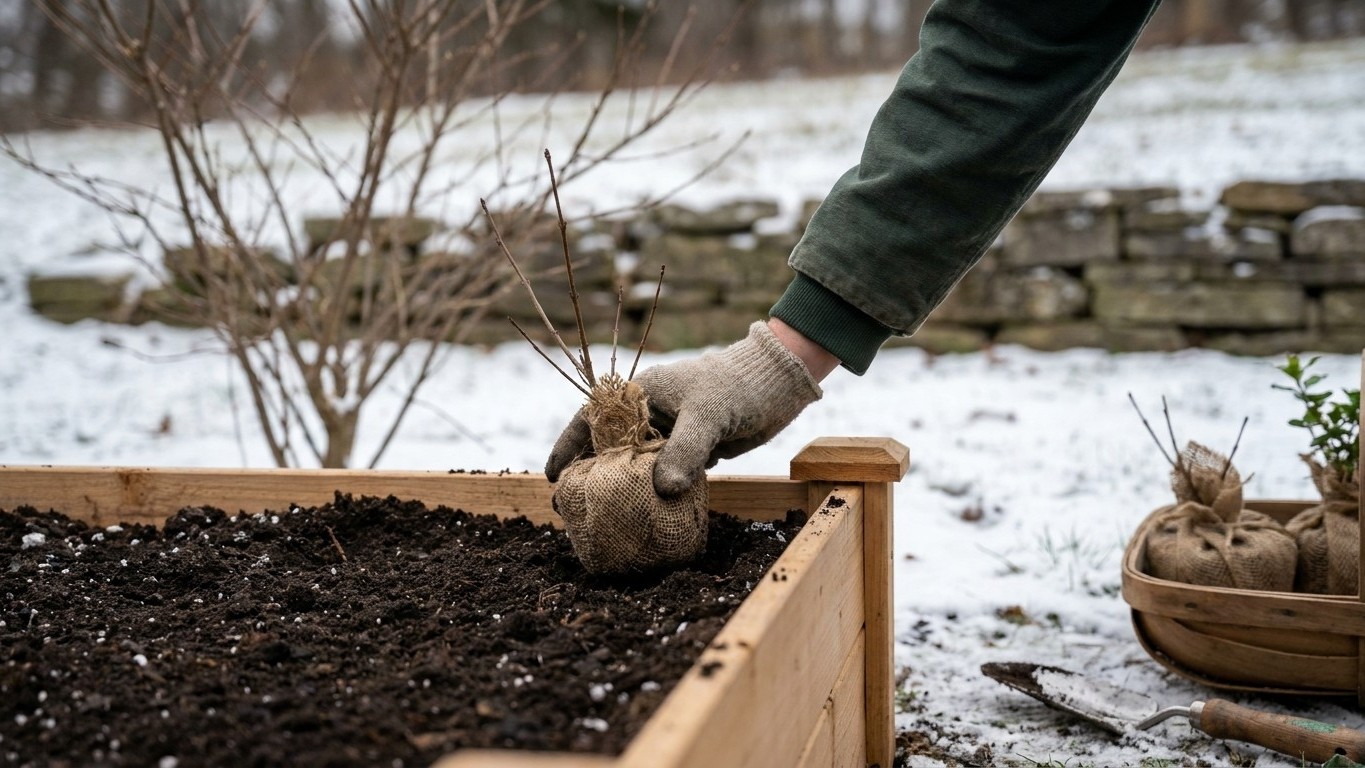

December in Nunavut is not a planting month. The ground is frozen solid, most communities sit in or near polar night, and there is no open-ground gardening happening anywhere in the territory. What actually happens this month is indoor work: starting sprouts and microgreens under lights, checking stored food, and getting seed and supply orders in before shipping windows close for the season.
What goes in the ground in December

Nothing goes into open ground in Nunavut in December, and that is not a seasonal exaggeration, it is the physical reality of the territory. The reference station at Rankin Inlet averages a last spring frost around June 19 and a first fall frost around September 13, which leaves a mean frost-free window of roughly three months, and even that figure is a midpoint, not a promise: in one year out of two, frost arrives later than that June date. December sits at the opposite end of the calendar entirely, months away from either edge of that window, under a snowpack that in most communities does not melt off until well into spring.
The usual “still possible in the dead of winter” options that work farther south simply do not apply here. Garlic and shallots need workable soil to go in the ground before it locks up, and Nunavut soil is either permafrost or has been frozen for months already by December. Cold frames and low tunnels rely on daytime solar gain to hold a few degrees above ambient, and across most of the territory December brings very short days or none at all, so there is not enough light energy reaching a frame to matter. Bare-root and dormant nursery stock, the kind gardeners farther south tuck into trenches or mulch piles this time of year, has no outdoor home here either.
What is realistic is entirely indoors. Forcing rhubarb or chicory roots in a dark, cool room still works, since it depends on stored root energy and a controlled indoor temperature rather than on outdoor soil or daylight. Community greenhouse spaces, where they exist, are used this month for maintenance and for starting the earliest indoor crops rather than for anything planted in ground beds. If there is a hardiness zone number attached to a Nunavut community, it will be a Canadian zone, built from seven climate variables rather than the single winter-minimum measure the USDA scale uses, and it does not translate onto a USDA map. The reference city tied to that number in Nunavut sits at zone 0a on the Canadian scale, among the coldest zones the system records.
What to start under cover
Counting backward from a mean last frost of June 19 is the right way to plan indoor sowing anywhere, and it is worth doing that arithmetic honestly even here. Alliums and peppers, the slowest crops to reach transplant size, are typically started 10 to 14 weeks ahead of the last frost. Counted back from June 19, that lands in late February to mid-March, not December. Slower still, some growers push alliums out to 16 weeks, which still only reaches back to early March. By that math, nothing in the standard seed-starting calendar actually needs to go under lights this month, even for the longest-season crops.
That leaves two honest options for December sowing under cover. The first is food that does not depend on the frost calendar at all: microgreens and sprouts, grown on a counter or under a small light setup, ready in one to three weeks regardless of what month it is or how far away spring sits. The second is maintenance, not sowing: checking that any grow lights, heat mats, and timers are working before the real seed-starting season opens in late winter.
The two failure modes still apply, even on this compressed schedule. Starting too early, before there is any real reason to, produces rootbound, leggy seedlings sitting under artificial light for months longer than they need to, stretching thin and weak before they ever see a transplant date. Starting too late, once the true countback window opens in late winter, leaves alliums and peppers without enough size on them to make full use of the short growing season once it finally arrives. December’s job is neither: it is testing equipment and growing quick indoor crops, not committing seed trays to the long-season vegetables yet.
What is ready to pick
There is nothing to harvest outdoors in Nunavut in December, and no amount of season-extension changes that under permafrost and near-total darkness in most communities. That is the honest answer, and it is worth saying plainly rather than stretching the truth to fill a list.
What still comes out of a kitchen or a community growing space this month is indoor produce: microgreens and sprouts started earlier in the month are usually ready within one to three weeks of sowing, cut with scissors just above the growing medium once the first true leaves appear. These are a real, fast source of fresh greens through the darkest stretch of the year, and they do not depend on outdoor light or soil at all.
The other job this month is checking whatever is in storage. Households and community programs that laid in root vegetables, squash, or onions earlier in the season should be going through that stock now, since December is deep enough into storage that early spoilage starts to show. Squash with a soft spot near the stem, potatoes that have gone soft or sprouted, and onions with a wet neck or mold at the base should all come out and get used or discarded before they spread rot to the rest of the stock. Checking every few weeks rather than waiting until spring is what keeps a whole bin of stored food from turning at once.
The jobs that matter this month
A winter month in a cold climate is not an empty page, it is a planning and maintenance page, and Nunavut in December has a full list of jobs that pay off later even though nothing is growing outdoors right now.
Ordering ahead of shipping limits
Seed and supply ordering matters earlier here than almost anywhere else in the country, because freight into Nunavut communities runs on limited, seasonal shipping rather than year-round trucking. Getting seed orders, replacement grow lights, potting mix, and greenhouse repair materials on order now, rather than waiting until the growing season is closer, avoids being caught without supplies when the short window to use them finally opens.
Equipment, planning, and stored food
This is also the month to clean and sharpen any hand tools that saw use in a community garden or greenhouse over the previous season, since rust and dull edges set in fast when tools sit unused for months. Anyone running a greenhouse structure should check it over now: seals, vents, and heating equipment are far easier to repair before a cold snap than during one. Planning next season’s layout, including what worked and what did not in a raised bed or greenhouse plot, is easiest to do now while the details are still fresh, rather than trying to reconstruct it from memory in spring. And the stored-crop check described above deserves a regular slot on the calendar, not a one-time pass, since rot spreads through a bin faster than most people expect once it starts.
| Task | Why December is the moment |
|---|---|
| Seed and supply ordering | Shipping into Nunavut communities is seasonal, not year-round |
| Grow light and equipment checks | Needed before real seed-starting begins in late winter |
| Stored crop inspection | Early rot shows up now and spreads if left unchecked |
| Greenhouse structure repair | Easier to fix seals and vents before deep cold sets in |
What not to do in December
The most common mistake this month is treating a stretch of unusually calm or brighter weather as a sign that anything can move outdoors. It cannot. Air temperature swings do nothing to change the fact that the ground is frozen solid and will stay that way for months, and a few hours of pale midday light does not add up to a growing day.
A second mistake shows up around indoor seed starting: jumping the gun and sowing slow crops like onions or peppers weeks before the countback arithmetic calls for it. As shown above, even the longest lead times land in late winter, not December. Starting early out of impatience produces exactly the leggy, rootbound seedlings that struggle once they finally do get transplanted, since they spend far too long under artificial light with a limited pot size before the season is ready for them.
A third mistake is overwatering anything grown indoors under low light. Growth slows in weak light even under grow lamps, and soil that would dry out in a few days under strong summer sun can stay wet for a week or more indoors in December. Wet, cool soil around slow-growing seedlings is exactly the condition that invites damping-off and root rot. The fix is simple: water on the plant’s schedule, judged by soil dryness at a fingertip depth, not on a fixed number of days.
Checking this against your own county
A single frost window and a single hardiness zone number, both drawn from the Rankin Inlet station, describe one point in a territory that spans several climate zones from the mainland coast to the high Arctic islands. Communities farther north or at higher latitude run behind that reference window by weeks, and some see even less winter daylight than Rankin Inlet does. Before planning around any date on this page, check it against Agriculture and Agri-Food Canada’s own resources for the territory, available at agriculture.canada.ca, and against any local community garden or greenhouse program’s own experience with the specific microclimate of that settlement.
Common questions
Can anything be grown outdoors in Nunavut in December?
No. The ground is frozen and most communities have very limited daylight or none at all this time of year. All growing activity this month happens indoors, under artificial light.
Is it too early to start seeds indoors in December?
For most crops, yes. Counting Back From the mean last frost date of June 19, even the slowest crops like alliums and peppers are typically started in late winter, not December. Microgreens and sprouts are the exception, since they are ready in one to three weeks regardless of the outdoor calendar.
What does a Canadian hardiness zone of 0a actually mean?
It places the reference community among the coldest zones on the Canadian scale, which is built from seven climate variables rather than the single winter-minimum figure the USDA system uses. It does not convert to a USDA zone number and should not be compared directly to hardiness zones cited for US states.
What should be checked on stored vegetables this month?
Squash, potatoes, and onions kept in winter storage should be inspected every few weeks. Look for soft spots near the stem on squash, sprouting or softness on potatoes, and mold or a wet neck on onions, and remove any affected item promptly so the problem does not spread through the rest of the stock.