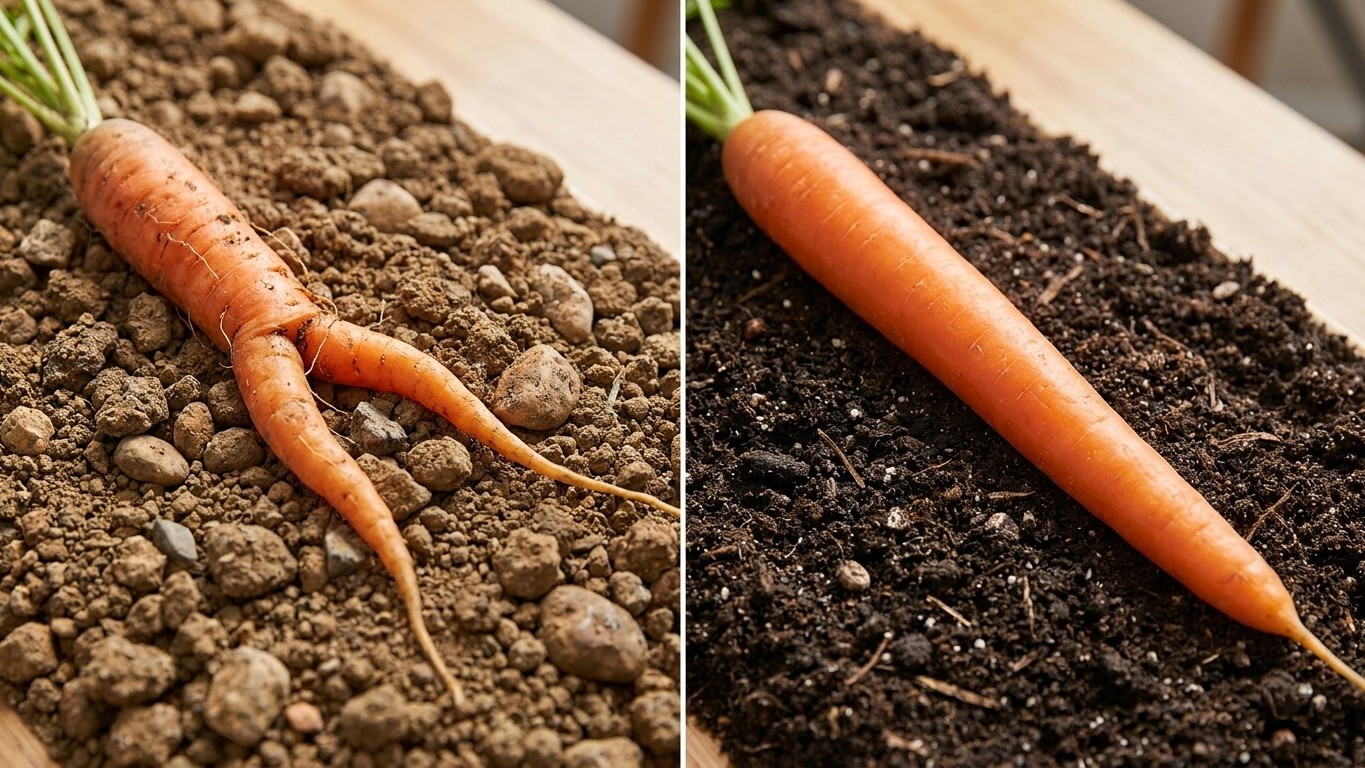

Carrots grown in heavy, rocky, or shallow soil come out forked, stunted, or twisted around whatever they hit underground. Carrots grown in loose, deep ground come out straight, long, and smooth. The shape of the root has almost nothing to do with the seed packet and almost everything to do with what’s under the seedling on day one. That single fact explains most of the carrot failures gardeners blame on weather, timing, or variety.
The short answer
Utah State University Extension describes what a carrot wants in plain terms: “fertile, well-drained, deep, sandy soils rich in organic matter.” Every word in that phrase does work. Fertile and rich in organic matter feed the plant. Well-drained keeps the root from sitting in water it doesn’t need. Deep and sandy are the two that decide the shape of the root itself, because a carrot is a taproot pushing straight down, and sand offers almost no resistance to that push.
Why heavy soil fails a carrot specifically
Put that same seed in heavy or rocky ground and the tip of the root meets something it can’t move through. It doesn’t stop. It splits, curls, or shoots sideways looking for a gap. The result is a fork, sometimes two or three roots tangled together where one clean carrot should have grown, a problem explored in full at Forked and Twisted Carrots. For a deeper look at Carrot Soil: Why the Root Forks and What Fixes It, Utah State University Extension is direct about the fix, and about what the fix is not: heavy soils “need to be amended with plenty of compost and should be double dug to allow good root development.” The answer to bad soil is better soil, not a different seed packet, and preparing the bed properly starts well before the seed goes in the ground, as explained in Sowing Carrots, with proper spacing maintained soon after through Thinning Carrots, and getting the soil right from the start also pays off later at Harvesting and Storing Carrots, just as getting the water right matters just as much once the roots are established, a subject covered in detail at Watering Carrots.
Worth sitting with for a second: the carrot most people picture, long, tapered, unblemished, is the exception in ordinary garden dirt, not the rule. It’s the product of soil that got prepared before the seed ever went in.
One more fact worth carrying past the vegetable bin. NC State Extension notes that on this plant, “leaves, roots, flowers, and seeds are edible. The roots are a common vegetable and can be cooked or eaten raw. The flower clusters can be french-fried to produce a carrot-flavored dish, the aromatic seed is used as a flavoring in stews, and the leaves can be cooked or made into a pesto.” That’s the garden carrot, Daucus carota subsp. sativus, the same plant this whole article is about, not a wild relative.
What actually decides it
A carrot root doesn’t grow the way a tomato plant grows. There’s no branching structure to fall back on if one path is blocked. It’s a single taproot elongating downward, and every inch it travels has to displace or slip past whatever soil particle sits in front of it. Sand particles are small, round, and loosely packed, so the tip glides. Clay particles bind together, and a stone doesn’t move at all. That mechanical difference, not fertility, not water, is why the same seed produces a straight root in one bed and a twisted one twenty feet away.
Root architecture versus ground architecture
This is also why “fertile” and “deep, sandy” are listed as separate requirements rather than one idea. A soil can be rich in nutrients and still stop a root cold if it’s compacted or full of rock a few inches down. Depth matters independently of fertility. A gardener who tests only for nutrients and skips the physical dig-test is checking half the requirement.
That test is simple and it’s the one that actually settles the question at home, because a state’s general soil description spans hundreds of distinct soil series and says almost nothing about one particular backyard. Dig a hole a foot or more deep where the row will go. Note where the color or texture changes, whether you hit clay, hardpan, or rock, and how the soil behaves when squeezed, whether it holds a ribbon shape (more clay) or falls apart immediately (more sand). That five-minute check tells you more about your carrots’ future than any regional soil map.
Choosing the root instead of fighting the ground
There’s a second lever besides amending the ground, and it costs nothing but a seed choice. NC State Extension describes cultivars with very different root architecture: ‘Atlas’ produces “small spherical roots 1-2 in long,” good for shallow soil and containers; the Nantes group produces “6-7 in long cylindrical roots,” tender and sweet, and grows well in heavy soils; ‘Little Finger’ is “a Nantes type with 4 in long roots,” small and sweet. A round or short root doesn’t fork in shallow or rocky ground for the simple reason that it never has to travel far enough to meet the obstacle. The clay is still there. The root just doesn’t need to cross it.
How to do it
- Dig-test the bed and pick a strategy. Check depth and texture as described above. If the soil is heavy, rocky, or shallow, decide now whether you’ll amend it or grow a short, round cultivar instead.
- Amend if the ground stays in the plan. Work in plenty of compost and double dig the bed, loosening it well beyond the depth the mature root will reach.
- Wait for the soil, not the calendar. Sow once the soil is at least 40 F, and time it for 2 to 3 weeks before the last frost.
- Watch the Temperature window through germination. Seeds germinate best between 55 and 65 F. Above 80 F, germination itself drops off.
- Thin at the right leaf stage. Once seedlings show 3 to 4 true leaves, thin to 2 to 3 inches apart, in rows spaced 12 to 18 inches.
- Keep growth below 75 F where you can. Above 80 F germination suffers, and above 85 F root color suffers, so shade or timing matters more as the season warms.
- Water frequently and evenly for the whole cycle. The crop runs 70 to 100 days from seeding, since carrots are sown in place with no transplant step, and uneven watering during that stretch is the other main cause of a split root.
- Store at 32 F and 95 percent relative humidity once the roots come out of the ground, to hold quality after harvest.
What goes wrong
- Forked roots. The tip met heavy or rocky ground and split. Remedy: amend with compost and double dig before the next sowing, or switch to a short, round cultivar like ‘Atlas’ for that bed.
- Split or cracked roots. This usually traces back to uneven watering rather than soil. Remedy: water frequently and uniformly rather than letting the bed dry out and then soaking it.
- Seeds that never come up. The soil was colder than 40 F at sowing, or the bed swung above 80 F during germination. Remedy: check soil temperature before sowing and stay inside the 55-65 F window when possible.
- Pale or washed-out root color. Soil temperature climbed above 85 F during growth. Remedy: sow earlier relative to the last frost, or mulch to keep root-zone temperature down through the hot stretch.
- Woody, harsh-tasting roots. Clemson Extension notes that “carrots near maturity that are allowed to remain in the garden under high temperature conditions tend to develop a strong flavor and roots that are coarse and fibrous.” Remedy: pull mature roots promptly rather than leaving them in hot ground; this applies to carrots already near maturity, not a young crop.
- Limp or rotting roots after harvest. Storage conditions missed the mark. Remedy: hold roots at 32 F and 95 percent relative humidity rather than a warmer, drier spot.
Common questions
Does adding more fertilizer fix a forked carrot?
No. Forking is a mechanical problem, the root tip meeting resistance, not a nutrient shortage. Utah State University Extension ties the fix to soil structure: compost and double digging, not additional feeding.
Can I just transplant carrots into better soil later if my bed tests poorly?
Carrots are sown in place. There’s no transplant step in their growth cycle, so soil preparation has to happen before sowing, not after the seed is already down.
Is a state’s typical soil a reliable guide to my own yard?
Treat it as a starting point only. Any state contains a wide range of soil series, and the dig-and-squeeze test in your own bed will tell you more than a general regional description.
What besides the root can I actually eat from a carrot plant?
According to NC State Extension, the leaves, roots, flowers, and seeds are all edible on the garden carrot: roots cooked or raw, flower clusters french-fried, seeds used to flavor stews, and leaves cooked or made into pesto.