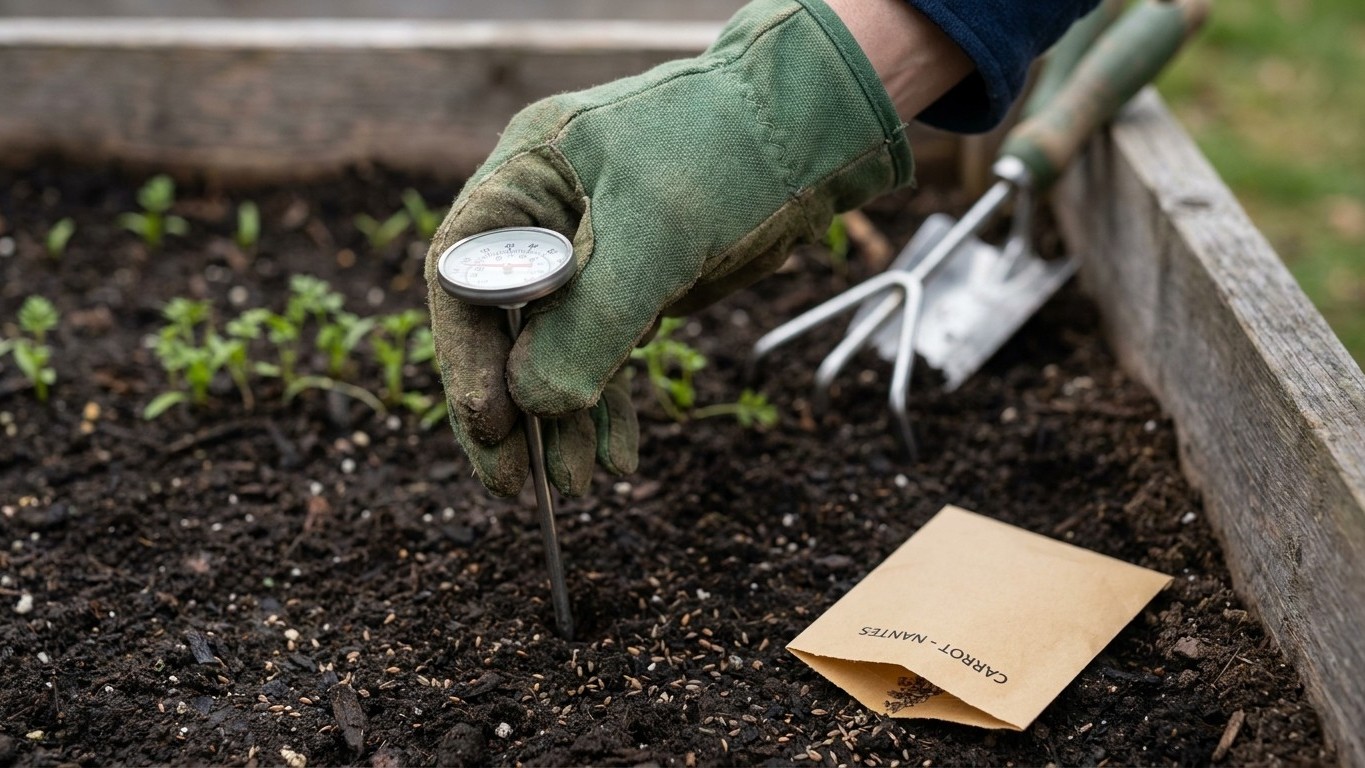

Soil Temperature decides the sowing date, not the calendar page. Carrot seeds germinate best at 55-65 F, but Utah State University Extension sets the working floor at 40 F, the minimum soil temperature before you drop a seed at all. Frost dates still matter, but only as a backstop: sow 2 to 3 weeks before the last frost, once soil is warming, not while it’s still locked in cold.
The short answer
Utah State University Extension, in its guide Carrots in the Garden, gives two numbers that matter more than any date on a seed packet. First, the soil needs to be at least 40 F before you sow anything. Second, germination actually performs best once soil sits in the 55-65 F range. Those two figures aren’t the same thing, and confusing them is where a lot of thin, patchy rows come from.
Why the frost date is a rule of thumb, not the rule
The instruction to sow 2 to 3 weeks before the last frost exists because, in most gardens, soil temperature and frost timing move together in spring. As the last frost approaches, soil is usually climbing through the 40s into the 50s. But “usually” is doing a lot of work in that sentence. A raised bed warms faster than a low, shaded row. A south-facing slope warms faster than a north-facing one. Mulch left over winter can keep soil cold weeks longer than bare ground nearby. The frost date is a calendar proxy for a soil condition, and proxies fail exactly when local conditions differ from average, which is more often than gardeners assume.
That’s why the honest short answer isn’t a date at all. It’s: sow when your soil reads 40 F or warmer, ideally trending toward 55-65 F, and treat the “2 to 3 weeks before last frost” window as the season when that’s most likely to happen, not as a substitute for checking the dirt itself.
What actually decides it
Seeds are chemical machines waiting for the right trigger. Below a certain soil temperature, the enzymes that break down stored starch into usable sugar barely function, so the embryo inside the seed coat stays dormant no matter how much water surrounds it. That’s the mechanism behind the 40 F floor: it isn’t an arbitrary cutoff, it’s roughly the point where those internal processes start working at a rate that produces a seedling before rot sets in. Soil colder than that just sits there, wet and inert, and a wet, inert seed is a target for fungus long before it’s a target for germination.
The upper end matters just as much
Heat causes a different kind of failure. Growth wants to stay below 75 F. Push soil above 80 F and germination rates drop, because the same enzymes that stall in the cold start working too fast and inefficiently in excess heat, burning through the seed’s energy reserves before a root system can establish. Above 85 F, the damage shows up later and differently: the root itself loses color quality, even in plants that did germinate. So there are really two ceilings, not one, a germination ceiling around 80 F and a root-quality ceiling around 85 F, and a soil that spikes into either range at the wrong growth stage causes a different failure than one that spikes in the other.
This is the part a gardener can carry to any soil, anywhere, without knowing this article’s numbers by heart forever. Soil temperature is a moving target across a single day, colder at 6 a.m. than at 2 p.m., colder four inches down than at the surface. A single warm afternoon doesn’t mean the seed bed is ready. What matters is the sustained reading, taken at seed depth, at a consistent time of day, over several days. Once you understand that the number is chasing an enzyme reaction rather than a season on a calendar, you can reason your way through a soil this article never described: check it, don’t guess it.
How to do it
Before you sow
- Check the soil texture first. Carrots want fertile, well-drained, deep, sandy soil rich in organic matter, according to Utah State University Extension. If your ground is heavy clay or full of rock, that gets fixed before seed goes in the ground, not after.
- Amend heavy or rocky soil with plenty of compost, and double dig the bed to loosen it deep enough for straight root development. This is the published remedy for the exact problem heavy soil causes, and it happens weeks before sowing, not the same afternoon.
- Take a soil temperature reading at seed depth, ideally over a few consecutive days rather than a single check, to confirm it’s holding at 40 F or above.
- Time the sowing window: 2 to 3 weeks before your area’s last frost, provided that soil reading already clears the 40 F floor.
After sowing
- Keep the seed bed consistently moist while soil temperature climbs toward the 55-65 F germination sweet spot; uneven moisture during this stretch undoes an otherwise good temperature reading.
- Watch soil temperature through the following weeks, not just on sowing day. A late heat spell pushing soil past 75 F changes how the crop grows even after germination is done.
- If soil temperature approaches 80 F during germination, expect reduced germination rates and don’t read a thin stand as a seed-quality problem when it may simply be a heat problem.
What goes wrong
Soil structure failures
- Forked roots. Heavy or rocky soil is the direct cause: the root meets resistance and splits into several roots instead of growing as one. The remedy is the soil itself, amended with plenty of compost and double dug for depth, not a different approach to sowing or a different seed choice.
- Treating it as a variety problem. It’s tempting to blame the seed when roots come out forked, twisted, or stunted. Utah State University Extension’s guidance points the other direction: fix the ground the crop is growing in before assuming the crop itself is at fault.
Timing and temperature failures
- Sowing into soil below 40 F. Seeds sit dormant and often rot in cold, wet ground before they ever germinate. The fix is patience: wait for the reading, not the date on a packet or a neighbor’s planting schedule.
- Sowing when soil is already past 75-80 F. Germination rates drop and root color suffers above 85 F. If a warm spell hits before you’ve sown, either wait for it to pass or accept a weaker stand, rather than sowing straight into it.
- Relying on the frost date alone. The 2-to-3-week window before last frost is a general pattern, not a guarantee for every yard. Microclimates, raised beds, slope, and mulch all shift local soil temperature away from the regional average, so the frost date without a soil check is a guess dressed up as a schedule.
Common questions
What’s the minimum soil temperature for sowing carrots?
Utah State University Extension puts the floor at 40 F. Below that, germination stalls and seeds are prone to rotting in cold, wet ground.
Is there a best soil temperature range, separate from the minimum?
Yes. Seeds germinate best at 55-65 F, a warmer range than the 40 F minimum needed just to sow safely.
Does heavy soil mean I should choose a different carrot variety instead of fixing the ground?
No. The published guidance treats heavy or rocky soil, and the forked roots it causes, as a soil problem to fix with compost and double digging, not a reason to switch seed.
How hot is too hot once seeds are already growing?
Growth wants to stay below 75 F. Above 80 F germination rates drop, and above 85 F root color quality suffers, even in plants that already germinated successfully.
If you follow the almanac, here is when to plant carrots by the moon. It is a tradition, not a proven method.